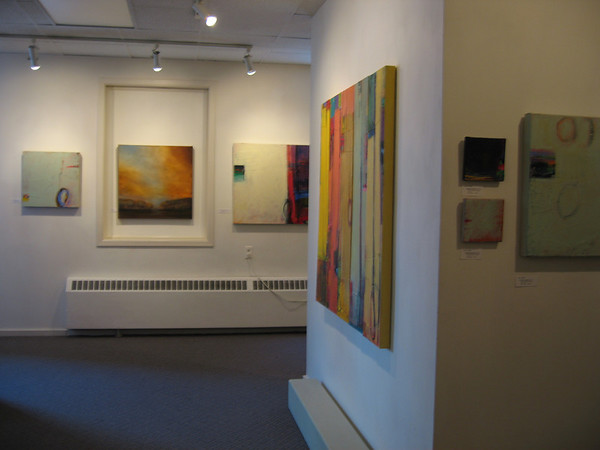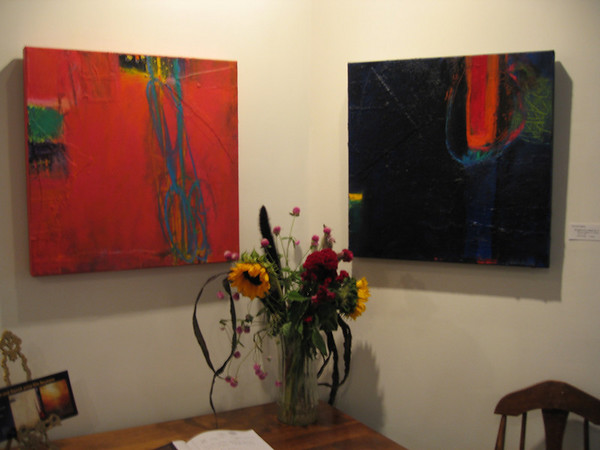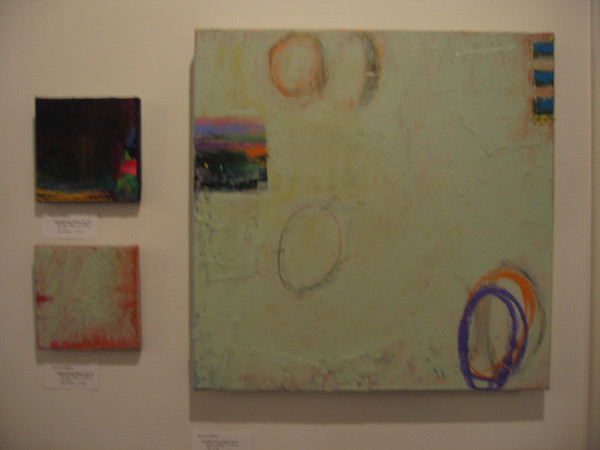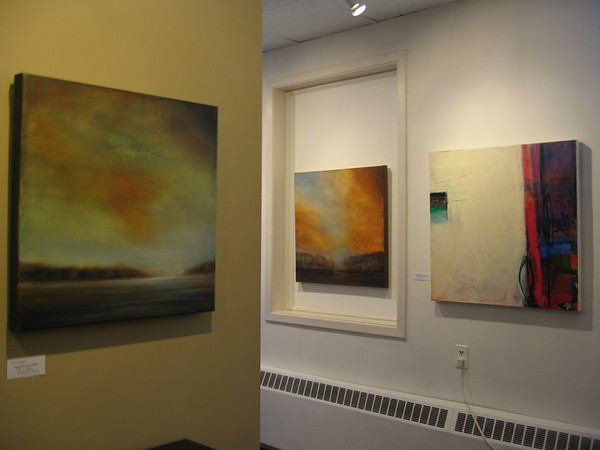
My week in Denmark was wonderful. I slept most of the first day, having not slept much on the trip over. My flight left Halifax at midnight and I expected to be able to catch a few but watched two movies instead (one was To Kill a Mockingbird . . what a good film! I had read the book recently and loved it.) I had a long wait in Heathrow so I lay down on the benches along with the other weary travelers and took a brief nap.
It was mostly cool and sunny in Denmark, very beautiful, as I had remembered it. Thora found me a wonderful place to stay. Part of an old farm complex, quiet and clean and beautiful, like all of Denmark. Although people drive very very fast on the country roads, disturbing at first. And they drive a lot because everything is so far apart.
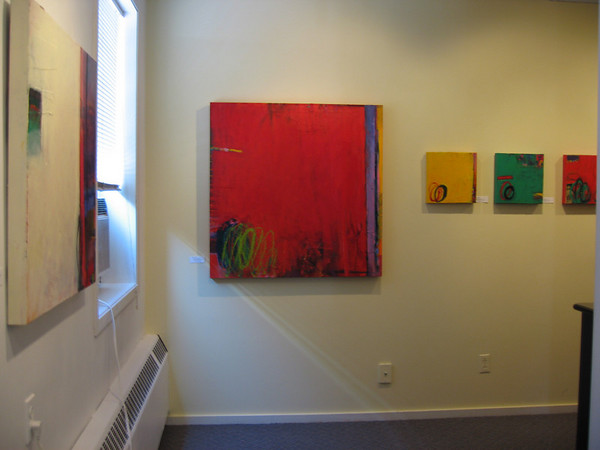
On Friday, I went to Aarhus, the second largest city in Denmark, to meet Joanne and Aaron. It was a quick trip. I took the bus and train down and rode back with them the same way. We saw some sculpture by the sea. It was the opening reception, with a marching band of high school girls, speeches and balloons. The crown prince had met his bride at the exhibit in Tasmania. They had both fallen in love with the sculpture and with each other, so they wanted to bring the exhibit to Denmark. I was able to get some pix of the royal couple.
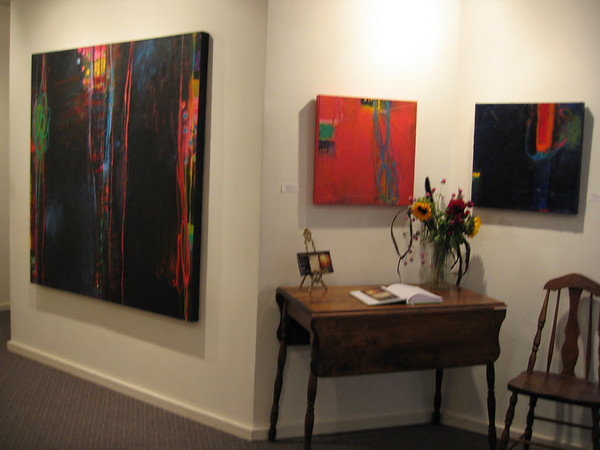
The opening reception for my exhibit was on Saturday. It was well attended and well received. Two large paintings sold right away and then several other people wanted the same pieces. Interesting.
On Sunday we went to Skagen, the northernmost point of Denmark. Then in the evening, Joanne went back to Exeter. Monday Thora, Aaron and I went to Ebeltoft, a town with lots of old houses. We traveled around all day. Very very beautiful country. (I took lots of photos and will post them when I return home. I'm having major camera lust for Aaron's camera. I think mine has a time limit on its remaining days.)
I’m now in Exeter, U.K. with Aaron and Joanne, after a very long trip from Denmark. Aaron and I had a lovely time in Aarlborg before returning the car I had rented (and before loading ourselves onto the plane to Gatwick). We just hung out, took pix and ate. The town is on water, a harbor town like most of Denmark. Not too big, the third largest city in Denmark. The plane left Aarlborg on time, 6:50 pm, but the bus connections were lousy and one of them, the one to Exeter, broke down. We didn't get in until 4:15 am, to bed at 5 am and up again at 10 am. I'm lucky to have slept so well when I did.
Today Aaron showed me around Exeter a little. More tomorrow when we are better rested. Lots to see and do.
For a few weeks recently I was occasionally having twinges of anxiety. I didn’t know why. Nothing was on my mind that was upsetting. Maybe the travel, but I’ve done such trips before. Then as soon as the boxes of paintings were picked up (last Wednesday) and shipped to Denmark, I felt so relaxed. No more anxiety, just excitement about my travels.
I leave here June 1 and arrive in Denmark June 2. Aaron and Joanne will meet me there. The opening reception at the Galleri Saltum is June 6 from 2 to 6 pm. Do stop by if you are in the area!
Joanne has to go back to Exeter June 7. Aaron and I will hang around Scandinavia (no definite plan yet) until June 10. Then on to London to see the Queen (I actually did see her the last time I was in London, at the Parade of Colours). From there a few days in Exeter and surroundings, and then home on June 15.
In the two weeks before my trip, I’m just hanging out, gardening, reading, cleaning house, having lunch with friends. I’m beginning to want to get back into painting mode, did some work yesterday and probably will again. I need to order more canvas stretchers, start some new paintings. Fill up the (not too) empty corners of my studio.
Tomorrow Brian is coming over to help me pack up my paintings to go to Denmark. It will be good to see them go. I won't be able to fuss with them anymore.
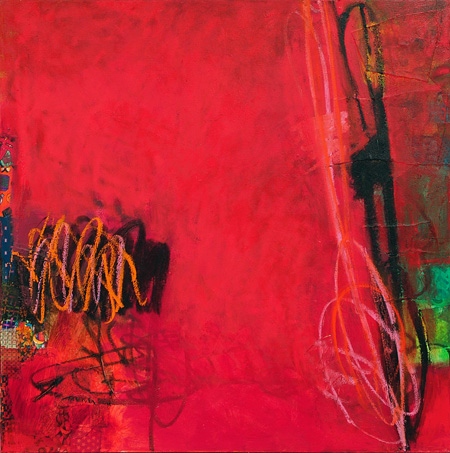
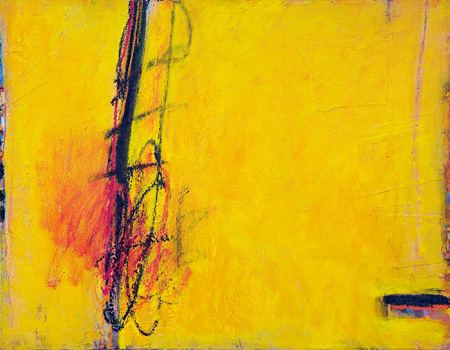
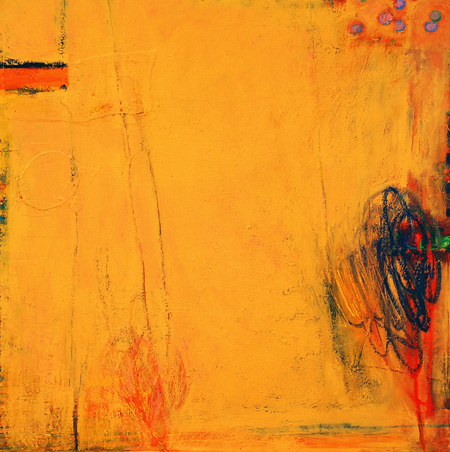
Here are some that will be in the exhibit:
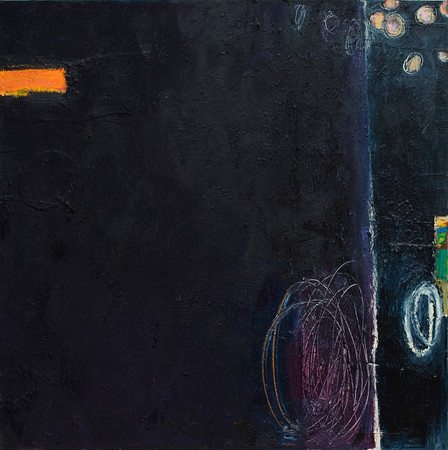
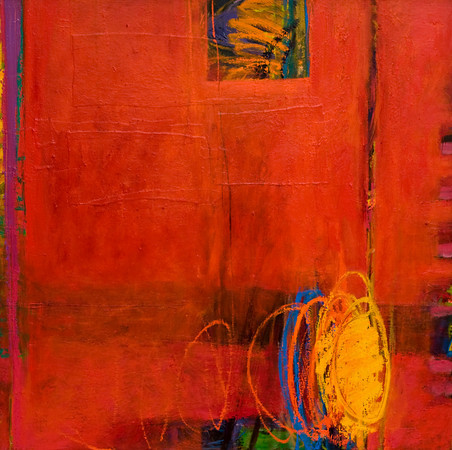
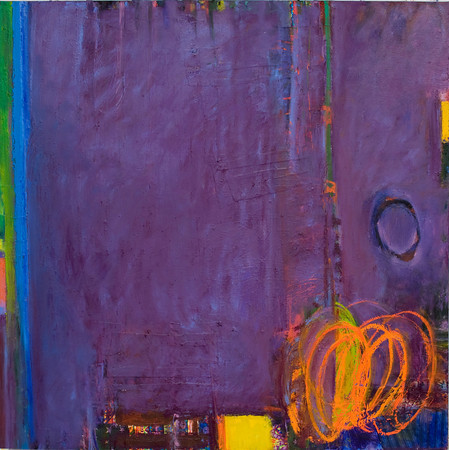
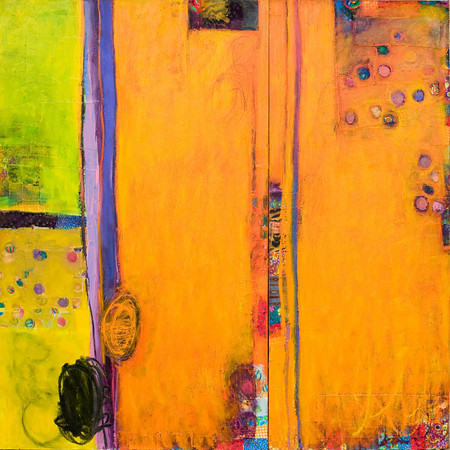
I recently taught a six-week abstract painting class. I don’t know why I didn’t say anything here. Maybe because it was such a new experience for me. I’ve never taught nor been taught about abstract painting. That doesn’t mean I’m not qualified to teach it but that I needed to figure out how to teach it. I’ve been working in abstraction for fifty years. It was a commitment I made long before I went to art school. Non-representational painting just feels right to me. But I had to learn about it on my own.
My education in art school was not representational but process oriented, with objects for reference. Now, if you understand that, you can paint abstract! To translate, we studied how to create form with color (or marks of color) and the form includes the space the objects live in. I hope that makes sense. It is a difficult concept for young painters to understand. I’ve tried to teach the way I was taught but rarely find a willing student. It took me two months of struggle in art school to even begin to understand this way of working. So I thought abstract painting would be a more enjoyable subject for me to teach since it is my main preoccupation. It’s something I know a lot about now, after so many years of painting.
In the class I gave them lots of exercises that were taken from ways in which I approach a piece of artwork. There were times when various students expressed frustration with the exercises, with abstraction, with their work, my teaching methods. But in the fifth class, suddenly everyone in the class got it. A very thrilling moment for all of us. I felt I could eat the excitement in the room with a spoon. I plan to teach the class again in the fall, with a few changes, additions, and this time I’ll know it can be done.
This event is a fund-raiser for GPI Atlantic. "Founded in 1997, GPIAtlantic is an independent, non-profit research and education organization committed to the development of the Genuine Progress Index (GPI) – a new measure of sustainability, wellbeing and quality of life." I've donated three paintings for a silent auction. The paintings are on display in the GPI office.
Arielle Legere is a fifteen year old jazz singer who sang at the Montreal Jazz Festival. This should be a really good event. If you are in the area, do stop by!
I started taking tango classes again a while back. I lucked out this time: my class is gender balanced, equal number of girls and boys. The class that started last week is “close embrace”. It’s currently a popular form of dancing. I knew little about it before the first class. My memories of close embrace dancing are from high school, and those are the good memories.
Close embrace in tango, however, is another story. First, I’m not with a date; my dance partner is whoever is next in the line of dance. It could be, as it was last week once, someone I've never met before. Second, the position of the follower (or in this case, female dancer) is one of leaning into the leader (or male dancer). It means giving all your weight to your partner, trusting he won’t let you fall. It was, at first, very scary. But with practice, I got the hang of it, more or less. If I tensed up at all it was uncomfortable. So it is a good lesson in relaxation.
Meanwhile, I’m avoiding my studio. Except to go over the paintings I will be shipping soon to Denmark (for the exhibit in June) with a heat gun. As there is wax in the medium of the oil bars I use, I find it helps the many layers meld together. And it is definitely a good idea to send dry paintings.
Just when I was beginning to fret about my personal economy, things turned around for me. Expecting to make a living as an artist is a faith-based life. I was starting to question that faith, question the livelihood part, the part that makes it possible to continue making art—buying art supplies, shipping out paintings on consignment, traveling for an exhibition, paying for shelter, eating, things like that—when I went to my mailbox yesterday and discovered a letter had been there for a couple of weeks (yes, the mailbox is out of my usual route and a nuisance to get to) informing me I received a Nova Scotia Arts Council Grant. What a relief.
At times like this, when there is a lot of fear in the world, it is hard not to be affected. I find myself wanting to turn the radio off sometimes when the news is so down-turned. It’s too much. I try to shy away from complaining, yet I was starting to wonder if it was better to say things are tough and hope for a positive response or not to say things are tough and then they wouldn’t be. After all, so much is how you think about it. I sincerely think external events are a reflection of your inner thoughts. But to stay positive . . . sometimes that is definitely a leap of faith. It’s great when it pays off!
A couple of weeks ago I went to a jazz concert given by students, from middle to high school, in after school ensembles. One of Yoko's students was performing and we took two other students of hers. Some of the music was really good, especially the older kids.
When we were walking through the lobby towards the auditorium, I saw the panel I had worked on for the Visual Arts Nova Scotia collaboration, Canvas. I had neglected to bring my camera that night and had wondered where it was.
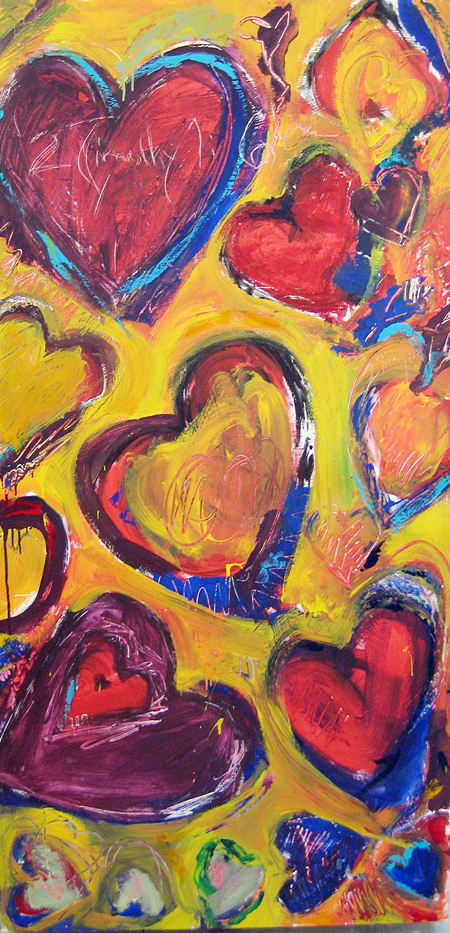
For the past few weeks I’ve been torturing myself with thoughts—am I repeating myself, am I getting the painting that I want, what painting do I want, does the work look as spontaneous as the small black and white pieces I did, etc. etc. etc. On and on and on. Yet. I continue to go into my studio, change my clothes (and shoes), put on my mask, and paint. I don’t think I have completed a painting in weeks, but I am coming close, maybe.
My niece, who plays in the Rome Opera Orchestra, wrote me recently, after reading my post on being a woman artist. I had said I thought artists are all working with a mind of play. That is what crosses the sexual barriers. She replied:
I have to remember to enjoy the play in the playing. It is easier for me when I am teaching small children because everything they do is play. And so we play with music and violin and sound but it is always play for them. It is harder for me when I am at the opera, but I do enjoy the sounds and that I make together with my wonderful colleagues. It is just hard to keep the spontaneity and joy. I wish I had time for more of my own play/playing—that is my first relationship to it all and I suppose, to myself. In which case, necessary.
Now I have to remember that the major relationship to my work is with myself. I do this, painting, because I have to. As I told a friend recently, it’s not that I can’t do anything else, it’s just that I can’t do anything else. This is what I do. Paint. And the paintings teach me, help me grow and learn about things, nonverbal things, I might never come up against without this play that I do. So ultimately, there is no right way to paint, as long as I continue to paint. And eventually we will see what happens.
This piece was first printed Monday on Women’s Voices for Change:
With my breasts aching and full of milk, I left Tamar, my three-week old baby girl, with a sitter and attended the opening reception of the Washington Area Artists Exhibition at the Corcoran Museum of Art. After leaving school, I lived in Washington for the first year of marriage. This was a juried show, and I was proud to have a large painting in it. Work I had done while pregnant with my first child. I stood in front of the painting with my husband and listened to peoples’ comments. My favorite was: “This must be an artist from Baltimore because I don’t recognize the name.” A big compliment to me. The work was strong; therefore, the artist should be familiar.
I was out of school for less than two years and it all seemed so easy. I could have my career, my children, and live happily ever after. Although I have continued to paint through life with two children, a divorce, many moves around Manhattan and on into Nova Scotia, it hasn’t been easy. Not at all.
I was lucky in one way: The children were the easiest part. I was blessed with intelligent, supportive children who, I dare say, raised me, taught me how to be a better person. The art part I taught myself. Through all the years of marriage and child rearing, I continued to paint, sometimes more, sometimes less.
My children have been on their own for about twenty years now. I’ve satisfied the mothering instinct with pets. I’m still very close to my children. I have some photographs sitting on the shelves in my studio. They are of my children when they were young. I see the photos every time I enter the room; they are my inspiration. I wouldn’t be the artist I am today without my kids. I want to be a good example for them so they can know it is possible to do what you believe in, to believe in what you do, to follow your passions.
When I had my first baby, my biggest obstacles to painting were the constant care she needed and my own loneliness. I had plenty of time to work—if I had only been more mature myself. My own mind was the biggest challenge.
I’d married for security, wanting only to make art and have a family. I never wanted to “work” again. I had had several “dumb” jobs before marriage—from waitressing to clerical to sales. I was even fired from a job selling Christmas cards at the Metropolitan Museum of Art in New York because my attitude was not good—it was October and without many sales, a very boring job. I was later fired from a clerical job because I admitted I was an artist.
Even though I thought the security of being married to a financially successful man would help my art, I found it ultimately suffocating. My children grew up with and without and with television. We had to give the TV set away three times— because I became addicted to daytime soaps. It was a relief from the tensions of my daily life. The final decision to quit the addiction was when, on a beautiful sunny day in April, I found myself sitting in front of the TV flipping between the various soaps then playing with my three-month old son on my lap. I was in tears as I asked my husband please, give away the set.
I’m not someone who has a generic love for children. To me they are people: some I love, some not so much. It takes me time to get to know a person of any age. But I learned to love my own children unconditionally. It wasn’t as easy as I had imagined. I had about as much experience with children as I had with being an artist when I started each “profession”.
My studio is in my home. I tried once to have an “outside” studio; that was the last year of my marriage. I saw it as my “halfway house,” where I could feel what it would be like to be away from the domestic chores and struggles I thought were hindering my artwork. I didn’t do much valuable work that year. But I did gain the strength to leave the marriage and discover more intelligent ways to feed my art, instead of starving it as I had been doing.
When my second child, Aaron, was born, I was much more comfortable with the responsibilities of child rearing. I brought him into my studio in an infant seat and, as he watched, I drew from a model. When he was older, he had become so accustomed to my working that when I was grouchy, he would tell me to go paint.
We also had lavish dinner parties often, straight out of Gourmet Magazine. I enjoy cooking and the social aspect of serving a good meal. But when I would spend three days preparing a meal for six people, I knew I was avoiding my studio. About a year after one dinner like that we went to a party given by one of our invitees. At the meal people were complimenting the hostess. She thanked them and commented on my culinary expertise. I said I haven’t done that since they were over. And she said: “Good!” Shortly afterward, I left the marriage entirely, with Aaron and Tamar (then five and eleven), two cats, two fish tanks, a gerbil and tons of art supplies. Freed from the marriage, I began to develop a more professional relationship with my work.
The most important thing for me as a mother was to always accept my children for the people they are. To let them know I loved them unconditionally and that they could do whatever they set their minds to do. That was hard in some ways, because I still had to learn to be more accepting of myself.
Once I did, which took many years, I was able to be a better mother while also having a steady flow of creativity. What helped me overcome the obstacles to making art was becoming a student of Buddhist meditation. With the practice of calming my mind, I was able to get out of my own way. For the past thirty years I have experienced a continuous flow of artwork. Meditation has also been helpful to being a better mother.
People often ask me if I have trouble selling my art, my “babies”, letting go of it. No, this what I do. I do sometimes keep some small pieces when I feel they are seminal to what I am doing, when there is something I still need to learn from them. If I didn’t let go of the paintings I couldn’t do more. That would be counterproductive. My tendency as a mother was to push the babes out of the nest as soon as they seemed able to navigate this very complicated world. It’s what I would want—independence. I also want that for my artwork. Each painting has a life of its own. Each person as well. Individuality is important; it is important for each painting to speak for itself.
Both of my children are working in the arts—Tamar writing and photography, Aaron in illustration and design. Even though they saw the emotional and financial hardships I have and do endure, they also see how I continue to work and pick away at the problems that arise from being an artist. They see the value of a life centered on the creative process.
Although I am not fond of labels, even in my artwork, I would say I am a domesticated dreamer. Even without the children here, I still enjoy my home. I enjoy having a studio at home so I can continue the household while I dream. It works for me.
Last Sunday, when Suzanne was here, somehow we started talking about artists’ books. I dug into my bookshelves and pulled out stacks and stacks and stacks of books I had made, mostly in the early ‘80s. I was surprised, looking through them, how many interesting ideas I had explored and how many of them had found their way into my artwork. And also, how many more I can use. Those books were more than just something in the past. They seem to be foretelling paths into the future.
I did my first collage pieces in those books. Also were some pencil sketches, all abstract, with masked out areas to form “images”. My favorites were the ones where small marks and cut-out areas moved through the book to tell stories. Probably I will now be doing more books. Reading is something I love. Making a book makes sense.
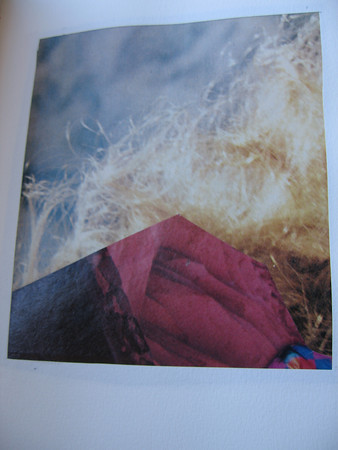
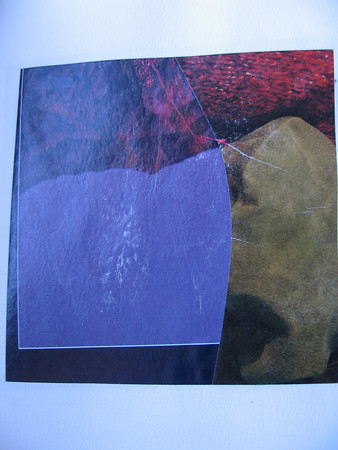
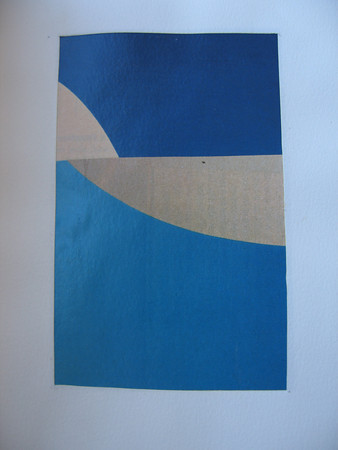
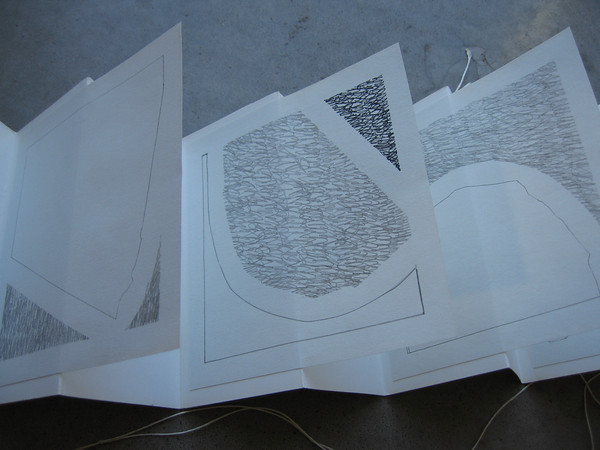
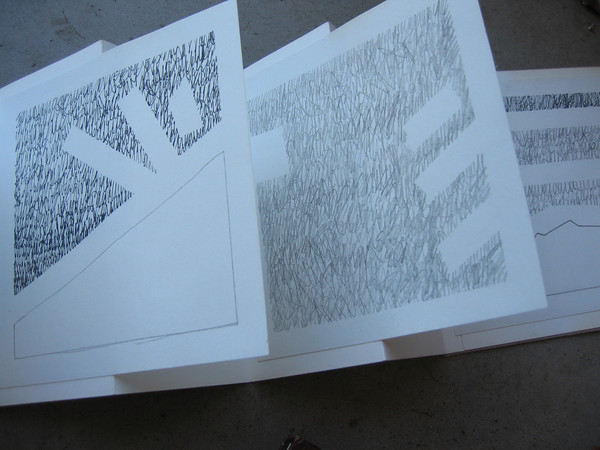
My driveway is a sandwich of ice/sand/ice/sand with a layer of light snow for frosting. Meanwhile, Lila and I have been taking delicious walks on the lake. When there is a snow covering, walking is easy. Sometimes it is too icy but then, sometimes even the road is treacherous. After a winter like this, no one will have a good reason to complain about black flies in May.
Suzanne and Lucky came over today. We (the people) had a lovely lunch of chicken soup and fresh-out-of-the-oven banana bread, then we all four went for a walk on the lake. Suzanne just sent me the perfect photo of the girls doing their usual thing, running:
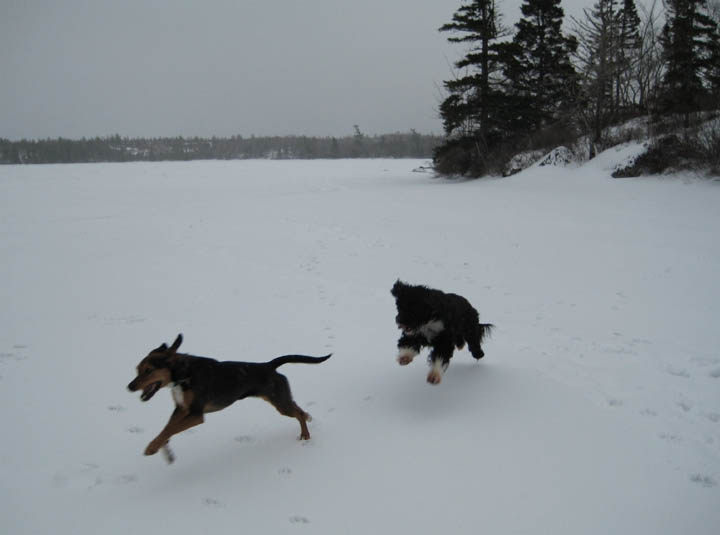
After they left, my neighbor Mike came over with his three dogs and Lila had another run. It is not all a playday. I did put in a good morning in my studio. But then, studio time is usually a pleasure. This morning, however, was the pre-painting work: I finished getting some large canvases (three 5' x 7' pieces, each made up of three panels) ready for paint. That means they now have three coats of primer (a back-breaking job I am happy to turn over to any elf who stops my way), some collage of photos and fabrics, and a final coat of primer to cover any glue that may be left on the canvas area. So now it really will be playtime in my studio!
When I mentioned how I wanted my large canvases to have the qualities of the small black and white pieces, my friends who visited on Sunday felt it wasn’t necessary. The small pieces are just what they are and the canvases are something else. I’m still contemplating this one.
A couple more small pieces:
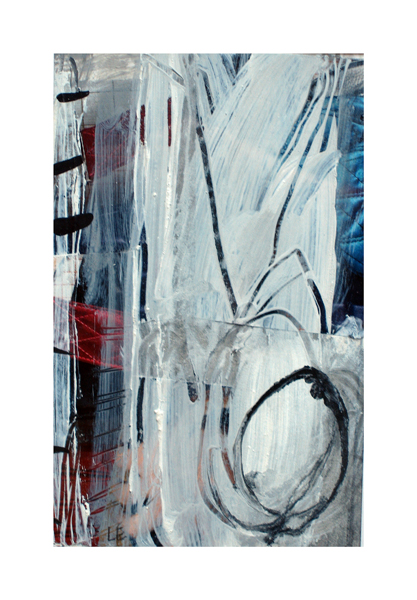
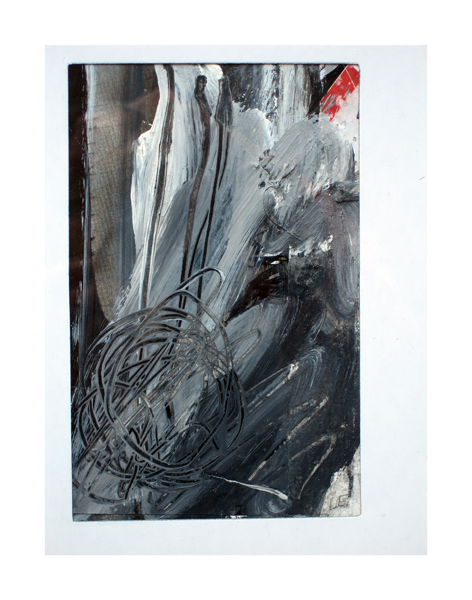
A couple of days ago I saw part of a documentary (CBC TV) on the creative process. The focus was on the brain activity as seen during musical composition. The researchers wired Sting’s brain to machines and ran him through an MRI scanner while he was creating music. The doctor was very excited by his findings, mainly, the equal use of the right and left hemispheres of the brain when an accomplished composer such as Sting was composing. Apparently this was unusual.
Sting himself was, in the end, not as happy about the research. I was fascinated by his discomfort with the process. He wasn’t so sure he wanted to have his creativity analyzed. His fear was that once it is understood it would loose its magic. That he’d no longer be able to compose, to make music.
To the artist when something works it is not clear how. It just does. It is magic. I can spend hours, days, years trying to figure out why one painting is so much better than another and still not understand how it got to be that way. It’s a process that belies analysis. It often feels like another hand at work through mine. It just feels right. All of the descriptions about what a piece of art means can hardly explain the core of the work. That is untouchable. Only felt.
This past Tuesday I had an article I wrote posted (complete with visuals) on the website Womens Voices for Change. It's an interesting site with many different voices, political voices, social voices and some from the arts. My article was about being a woman artist and I will reprint it here:
One of the more vivid memories of my childhood: I am nine years old, walking down the middle of my one block-long street in Bethesda, Maryland with my neighbor and friend Carol,. We‘re telling each other how much we wished we were boys. All the things boys could do were so appealing to us then—sports, strength, audacity. My dad was working in the yard, and I remember his smile as he overheard our longings.
I wouldn’t want to be a boy. And I’m not sure I really did then. I knew they were very different from girls, and I was curious. Carol had a brother and I was envious of that. There were always boys in her house. I had a sister; I only knew about girls.
Over the years I’ve been very aware I am in a male-dominated profession. All the instructors in my undergraduate art classes at Brown University and Yale’s MFA program were male. I heard often the assumption that the men in our class would have careers as practicing artists and the women would be teachers.
Actually, while there were fewer female students, every single one had one ambition: to be an “artist.” Very few male or female students expressed an interest in becoming teachers and giving up a career as professional artists.
Yet the students from my class whose names I see on gallery listings are always male.
I don’t know what has happened to the female artists. Possibly, like me, they are still making art and having various degrees of success. I’ve never believed we couldn’t do it—couldn’t be on top of the pile of aspiring artists, to be the successful one, regardless of sex. It just takes dedication, persistence, confidence, and probably, most important, a feeling of stubborn necessity. I love painting. I feel privileged to live where I do and do what I do.
In the late 1970s in New York, I had a friend who would call up famous female artists. She’d hang up just when the person answered the phone—all she needed was to hear the voice of a successful artist. Inspiration: It’s all around us.
As a young artist I was fascinated by Louise Nevelson’s sculptures. I saw her works in major galleries and museums and never thought of them as “women’s art”. They were just good art. They also fed my confidence that “it” can be done. When I saw Eva Hesse’s retrospective at the Guggenheim in the early 70’s, I did, however think about her being female. She was very attractive, very feminine in her bearing. Yet there was something daring about what she did, her sculpture, the experimentations with materials, something neither male nor female. Again, inspiring. I’ve read recently in Louise Bourgeois’ writings she felt very intimidated by the male dominated art-world of her day. But she never stopped working. And that in itself is inspiring.
Like a racehorse, I’ve always worn blinders, just looked straight ahead. I’ve not thought about gender in the production of my artwork. I paint because I have to paint. It is the blood that runs through my veins, a vital necessity for my life.
I have at times used techniques and images that are labeled “feminine”— circles, sewing the canvases, soft colors. Men have, however, used circles and soft colors, no doubt, and there have also been men who have sewn their canvases. A well-known New York artist once did a lot of sewing on his paintings, crudely decorative additions. I don’t know if he still does. They are very good pieces. For a few years in the ‘70s, I also did some sewn canvases. At that point I was looking for a way to clean up my canvases, make the “statement” of the work more direct, have the mark clearer; my paintings had been too “fuzzy”, no definite imagery, just a color field and a few faint lines.
In the sewn pieces, I would stain canvas with thinned acrylic paint, cut it up and sew it back together in more obvious forms than I had been using. But people would usually comment that sewing equals female, even though tailoring has traditionally been a male-dominated occupation. Because I didn't put them on conventional stretcher bars, I stopped doing these sewn pieces when my step-mother referred often to them as hangings, not paintings. To me, hangings made them feel too decorative and this has never been what I am looking for in a painting.
If you want to push the point, I use male/female imagery now: circles/lines, often in a tense relationship with each other. But I don’t think much about that part of painting, what the symbols mean, just about what feels right, what works on the painting as I am making it, what makes a painting sing, more about the song than who is singing it.
I just hit five feet in height. This actually surprises people, as my paintings are big and have a boldness that I am told belies my size and gender. I used to think that the best thing to be, as a female artist, would be black and tall: As a Tall Black Woman I could proclaim me, while as a short Caucasian, I don’t really think it is worth talking about.
Studies recently show happy people live longer — and that people who are happy know how to play. Making art is a form of play, doing something with love, passion, caring, trying out ideas, taking risks. The place in the brain that governs the need to make art is likely the same in both men and women.
Possibly it is that place where a person, either male or female, knows how to play. In a way, it’s like someone obsessed with a video game: we take our “play” very seriously. It feels like an inner need. It is also an offering to society, not just a game at home. Something beyond the person. Seeing art as gender-specific is a societal thing, but actually, if you look at a piece of art it is usually impossible to tell the sex of the artist.
What I really feel most strongly is that the paintings should speak for themselves. Currently the consideration of sex is less important in viewing artwork. And I’m sure this trend will continue. Women wouldn’t allow it to be otherwise.
After a tough morning in my studio, I have some thoughts about my recent small black and white pieces and their translation into color. First, they work differently because they have a white border around them. That gives them some breathing room, some quiet space. All my work in the recent years has had that but usually in the middle of the paintings. These black and white are active in the middle, quiet at the edges because of the border.
Then too, I used a brush and the brush marks are a very active part of the piece. I’ve been using oil bars (paint sticks) for over twenty-five years and don’t want to start using a brush again. I don’t want to have to clean the brushes or use any turpentine in my studio. So I am having to continue with the paint bars.
Interesting thoughts. Now when I look at work I did last year, before the holidays, I want to rework so many of them. I have started to do that but I also want to leave some as they are and start fresh. So I have a stack of stretchers and bought some canvas yesterday. Lots of work to do.
My current inspiration is coming from some small, four by six inch (more or less) black and white pieces I did on paper. The series was done so I could choose two to take to my sister and her husband for their 50th wedding anniversary party (which I never got to because of the weather). My task now, besides packing up and mailing their pieces, is to figure out what makes these be so important to me and how to translate that into color, with paint and a larger scale, onto canvas.
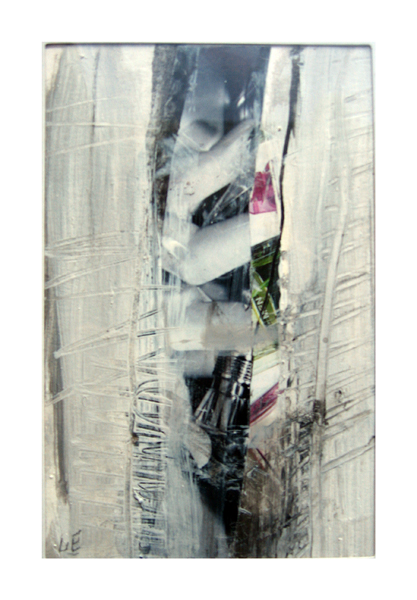
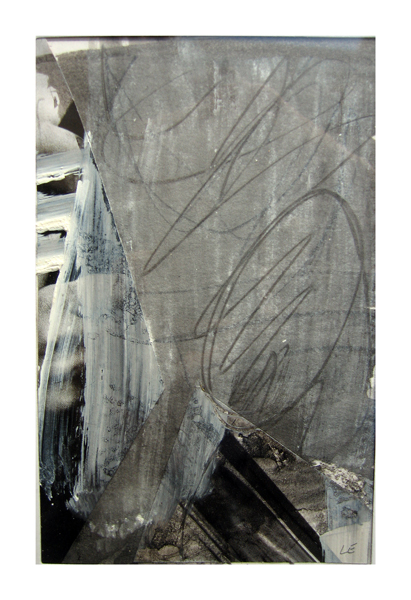
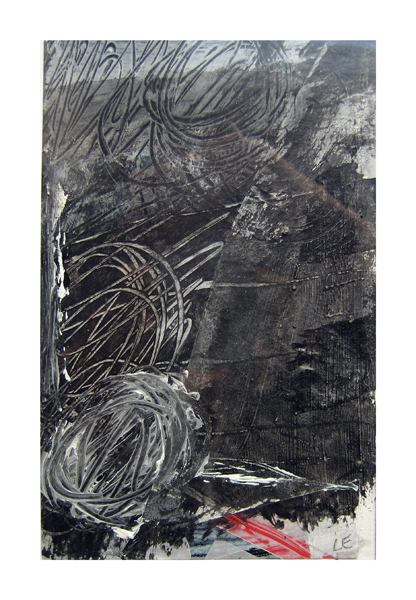
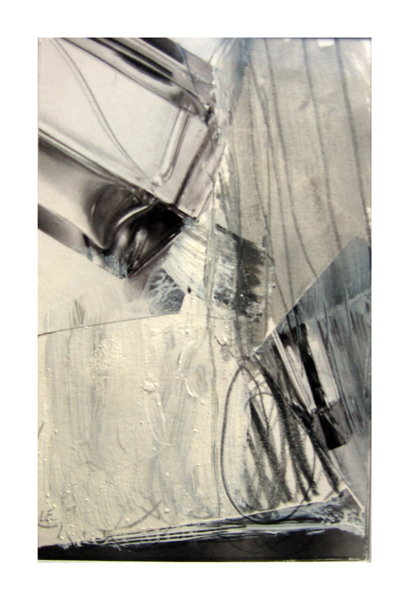
As I sit here waiting for a box of paintings (baker’s dozen, thirteen 20” x 20” pieces) to be picked up for a shipment to Naples, Florida, my thoughts wander to my studio and to all the possibilities brewing there. Sometimes it’s good to have a break from working. A fresh view.
I’d left some unfinished work and the ideas have been tumbling through my mind for a couple of weeks. A friend had come over the week before I left for Ottawa and encouraged me to leave even more of the under-painting exposed. I’ve been moving in that direction, but often I go too far in tidying up towards the end and losing the initial exuberance.
The (more or less) black and white pieces I do on paper usually stay more expressive because the color is so limited and the paint very fluid. I worked on a series of these pieces just before the holidays. The intention was to take two for my sister’s anniversary party. But I never got there due to the weather; they will have to be mailed. So I’ve had a lot of time to ponder what makes them different from the larger oil canvases. Now let’s see what happens.
I just had an amusing conversation with the Program Officer in charge of granting at the Nova Scotia Department of Culture. I needed to know if I have to submit a report so I can apply for another grant. I hadn’t remembered when I received a NS grant and it turns out my last one was in May of 2007 and I do need to write a report. I jested with him that I’m due for another one. So he’ll have to stack the jury for me with people who don’t need to read about art in order to appreciate it!
He was telling me some people have unreasonable requests for granting. One person put in an application asking for twice the allowable amount without any proposal or budget. Her excuse, when he called her, was that it was the first time she’s applied. (The application does come with instructions.) He’s seen people ask for money to buy a new car. I don’t need a new car; I’m very happy with my 2005 Honda Element. But with all the snow we’ve been having, I could use a garage!
Ever since my Friday night excursion into collaborative art-making, I’ve been haunted by the energy of the experience. It’s in my mind and in my hand, wanting to come out in the work in my studio. I want the freedom I felt then, the abandonment of inhibitions that came with the single-mindedness of painting, not even caring about the people watching, just feeling like the paint was part of me and I wasn’t really there. And the interplay of another person’s brush strokes. Being fed by someone else’s creative energy. Playing with it, changing it, enjoying it.
That haunted feeling is what makes creativity. It’s the obsessiveness of the creative process. It’s the dwelling place. It’s exciting, it’s demanding, it’s absorbing. It’s home.
Visual Arts Nova Scotia (VANS for short) had a fundraising “event” last night, an interactive, improvisational community painting frenzy called CANVAS. A group of artists gathered together at the St. Mary’s Boat Club to work on three double-sided panels. Starting with a literary passage for inspiration, the goal was to work together to complete a “painting” by the end of the evening.
I really didn’t want to go to the event at all. It was the end of a long tiring week. I would have been happy to watch Coronation Street and then curl up with a good book (I’m now reading To Kill a Mocking Bird and enjoying it very much), but I had agreed a couple of months ago to participate so I pulled myself together and went. When I first walked into the room, I looked around and was paralyzed with the thought of painting in front of all these people. My work process is very private, time consuming, intimate. Other than my children, I’ve never allowed an audience. Then I found a like minded fellow artist and we shared our discomfort.
But to my surprise some magic happened. I found a panel that had been started with a series of large (and small) hearts outlined in black. So I found some red paint and then some yellow and started splashing the paint on. Another painter joined me and we had a wonderful time. Sometimes I would paint over his work and sometimes he changed mine. It was exciting and it was challenging and it was fun. Sometimes the painting looked like mud but because it was acrylic it was easy to bring it back to life.
The only bummer in the end was I didn’t have my camera with me. So I’m hoping someone will email me a photo and I’ll post it here later.
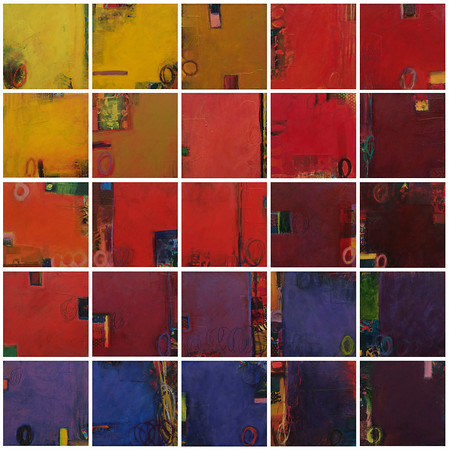
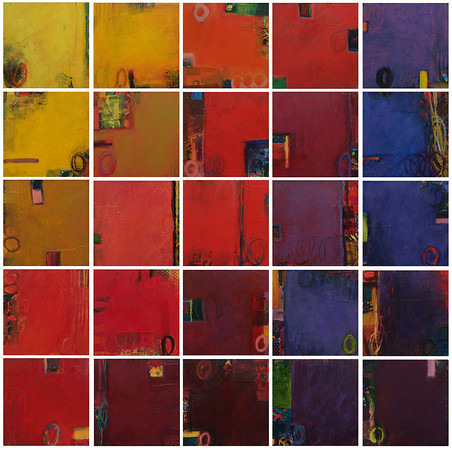
Here is, finally, the version of the twenty-five panel piece as I intended it to be. I like it best this way. And my gallery in Ottawa is interested in having it for the opening of their new space. When that happens, I will definitely let you know. It's been postponed a few months already. So I am looking forward to seeing it happen, as are the owners.
Meanwhile, Hurricane Kyle is about to thrash Nova Scotia and New Brunswick later this evening. The current projected path is towards Yarmouth, about three hours west of here. But we are already experiencing rain and strong winds. I've folded up the lawn furniture and brought in some potted plants. Lila is pacing and I'm closing windows. So much for summer.
I just finished reading Philip Roth’s novel Everyman. There’s a great quote in it I keep thinking about as I am cleaning up my studio preparing for the next burst of painting. As a retired art director of a well-known ad agency, the main character in the novel now has the time and space to fulfill his lifelong dream of becoming an artist. When, after a short time in his new life, he assesses his talents as mediocre, his enthusiasm for painting has dwindled, and the romance with Art has faded, he is reminded of the words of the painter, Chuck Close: “Amateurs look for inspiration; the rest of us just get up and go to work.”
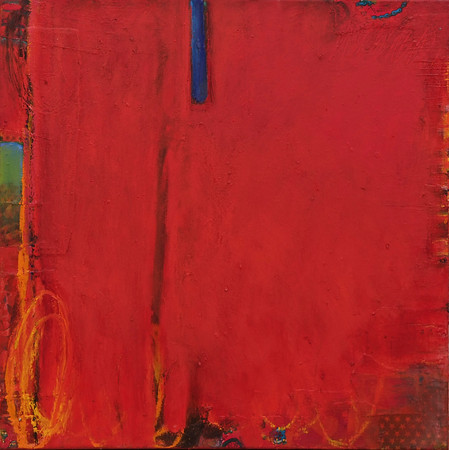
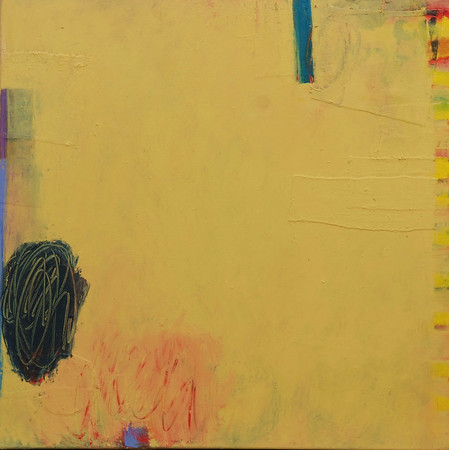
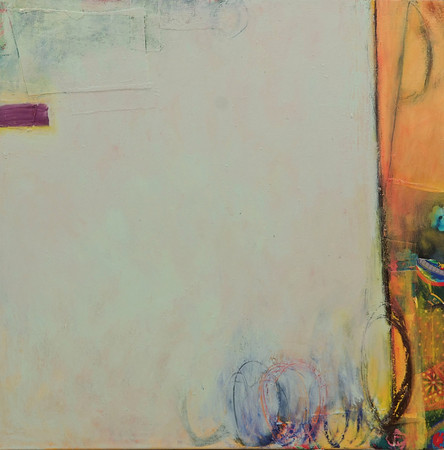
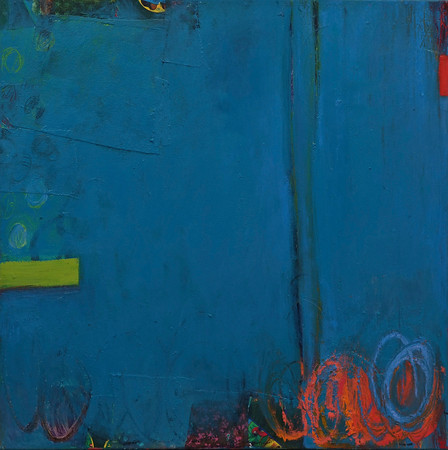
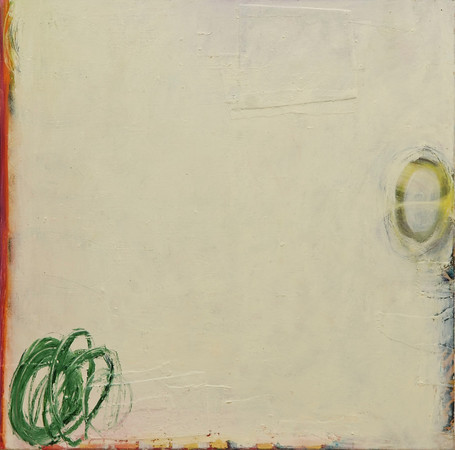
All these paintings are 30 inches square. I work best large so it is always a challenge to contain the size (and I do like challenges). I am particularly interested in what happens in the last one, the "white" one, where the "image" is partially eliminated and the "field" is very stark. Not too many people respond to it the same way I do--with the same curious pleasure--but that's okay. As my mother would say, that's what makes horse-racing.
A couple of more recent paintings. These are five feet high, seven feet wide, composed of three panels.
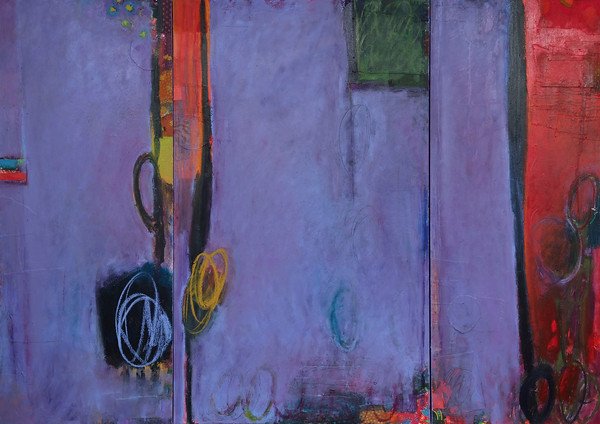
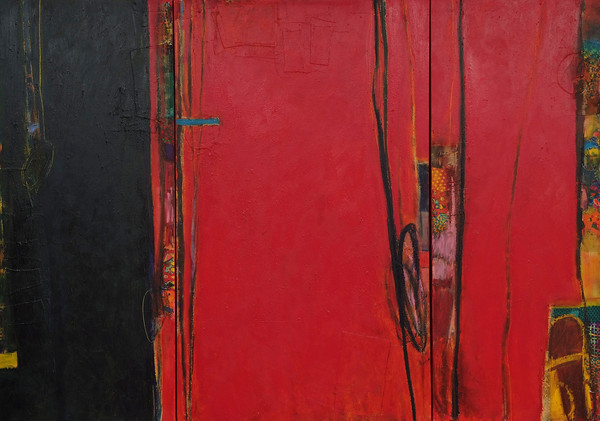
The red painting is the one that moved me to tears when I finished it. Maybe because it had been through so many incarnations, I was just relieved to see it settled. Or excited. And pleased.
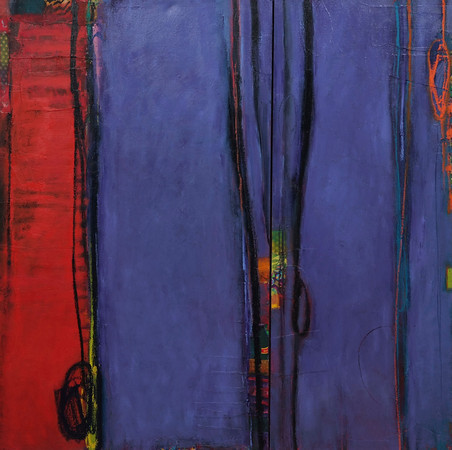
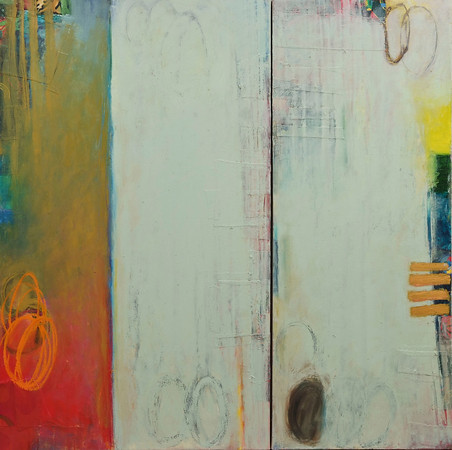
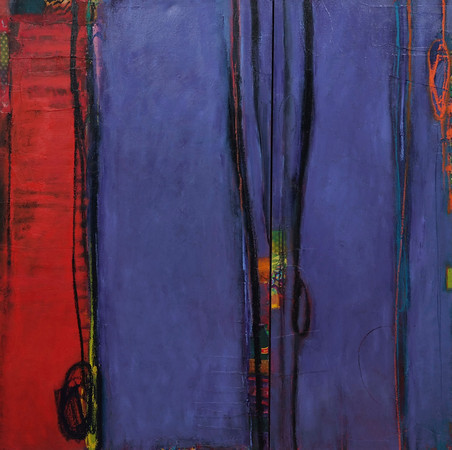
I’ve been working on some two-panel pieces—one panel five feet by two and the other five by three, making a five foot square painting. I named them It. Here are numbers two and three. Number one, a red and black paintings, went to Denmark. I would have liked to go with it!
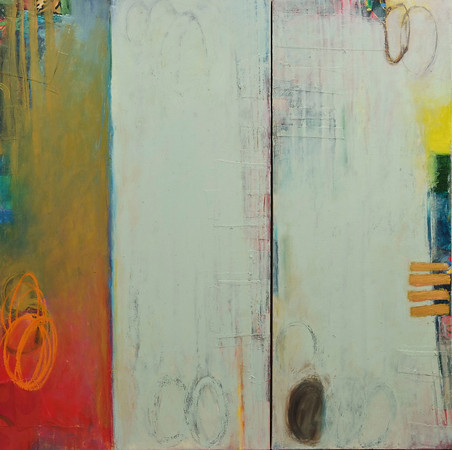
The first painting, the mainly pale green one, came up into my living room for a brief stay. Taking it out of my studio I was able to see it needed more work, was too busy. I calmed it down (too many "stripes") and now I am much happier with it.
The second painting, the blue-purple one, also underwent some renovations after being photographed. Then I was able to see the color was not working, needed to be intensified, and also the red area was at that time not as exciting as it is now.
I'm leaving them as they are and hope they find new homes soon. My studio is crowded and I need to start some new work.
I can't work on this anymore. It's done. Maybe I would rearrange the panels. That's an option.
As promised, here are a few photos of new work. Ever since leaving art school I've worked in black and white on paper for experimentation and discovery. These recent pieces give me many suggestions for new work. So I've ordered more stretcher bars to start some new paintings in the near future.
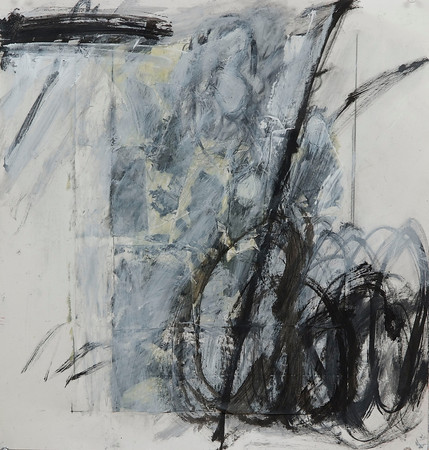
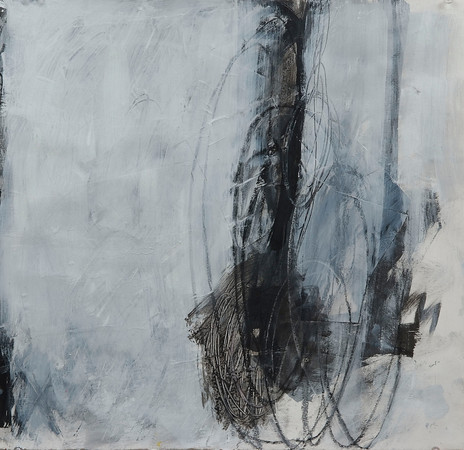
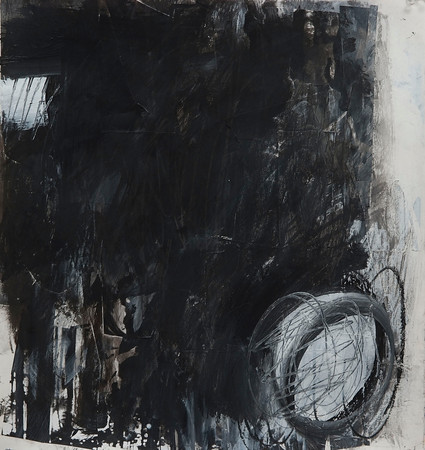
Lila was a little down yesterday. She missed Damian. He was very good with her and she had been following him around like a puppy dog. She was fascinated when he played with her toys; he made up new games with them, very different than her chewing and tossing games.
As for me, I went from top to bottom cleaning the house. It was too hard seeing remnants of Tamar and Damian without having them here. I even cleaned up my studio, put fresh paper on the floor (I use flooring paper so I can keep it fairly clean at times), put away bubble wrap and other odds and ends. Sorted paintings, saw which ones needed more work and making decisions what sizes to work on next. I’ll have to have some new stretcher bars made up soon. My studio is full, mostly finished work. I had photos taken last week and will post them soon.
So now all is back in order. Today I’ve been busy catching up on the business side of making art as well as weeding in the garden. Tomorrow I can paint again.
Alyson Stanfield threw out the question for thought: What is art? My (very loose) answer is that art is when something personal—a thought, a feeling—is transformed (with words, physical materials, aurally) to become available universally, to have universal impact—taken beyond the personal reference.
So, is this art? A graciously painted rock in the woods at Mills Reservation in Montclair, New Jersey. Someone had inspiration to transform the rock for public consumption. . . . Or is it craft?
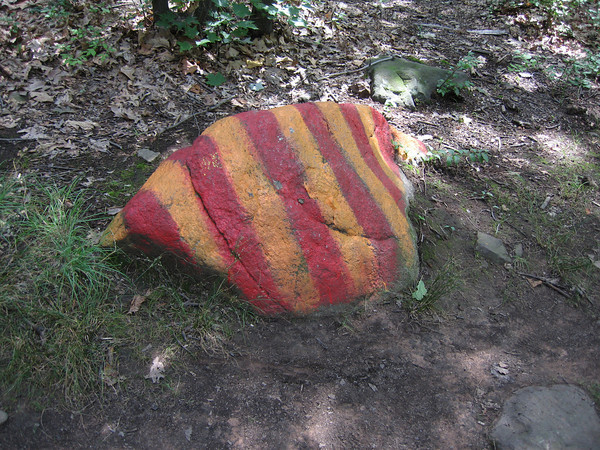
Certainly it was a crafty idea.
I went to a dinner party a couple of nights ago. It was a sixtieth birthday celebration for my friend Suzanne. There were seven of us sitting around the table, all people in the arts. So the conversation was mostly about art, of course.
I mentioned that I had seen the Louise Bourgeois exhibit at the Guggenheim a couple of weeks ago and was very inspired. Suzanne had seen it at the Pompidou Centre in Paris in May and hadn’t liked it at all. She thought there was too much talk about pain. Too much focus on her childhood, her parents. Enough, thought Suzanne, get on with it. Have a life, as they say today. I agree, artwork is better when it transcends the personal, is not a diary, can be interpreted, and felt, on many levels. But I thought Bourgeois' work successfully transformed the original impetus, the pain, into something universally beautiful and expressive. And I was so inspired that Bourgeos said she was glad the art world had overlooked her until she was in her seventies because she was able to do her own work all those years without any outside pressures.
Suzanne had read the blurbs about the artwork posted on the walls. I hadn’t and perhaps that is why I was able to enjoy the exhibit so much more than she did. So much can be said about artwork that then destroys the pleasure of experiencing it in its purity, as art, not idea. I much prefer looking at the art to reading about it (especially if I have to stand up to do the reading). Although, I must say, because I liked the exhibit so much, I’ve been eager to learn more about it. So it goes both ways it seems. Seeing and understanding, knowing and seeing.
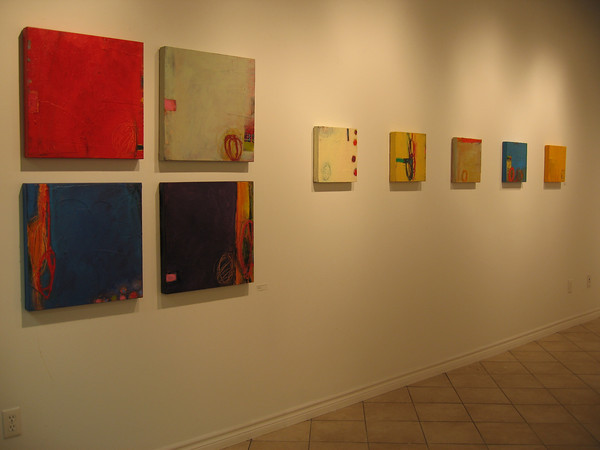
Lila and I went to Truro yesterday to hang an exhibit of my paintings at the Marigold Cultural Centre. The gallery is small so I made the selection with that in mind. I think it looks good. Clean and crisp for a small space. If you are in the area, do stop by. It's up until the end of the month.
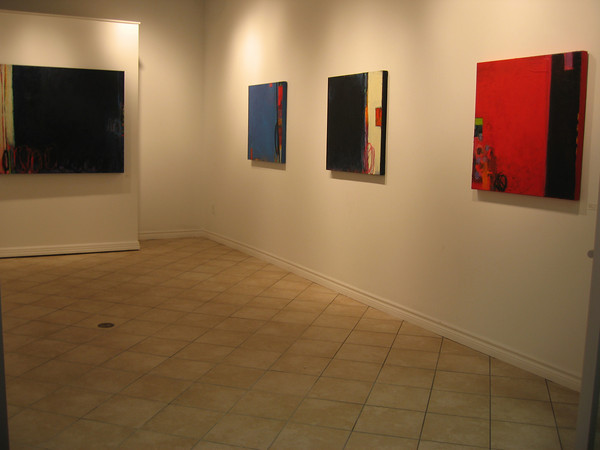
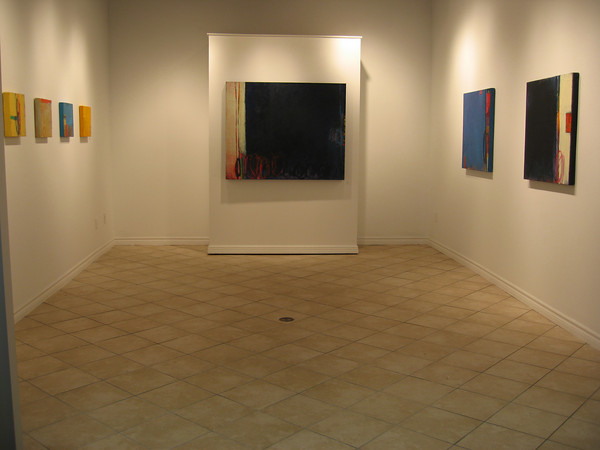
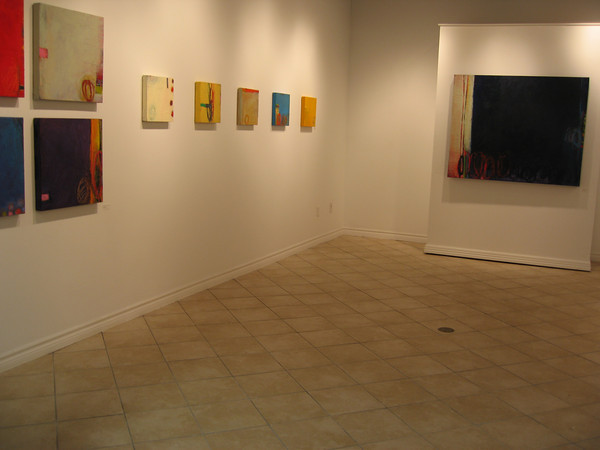
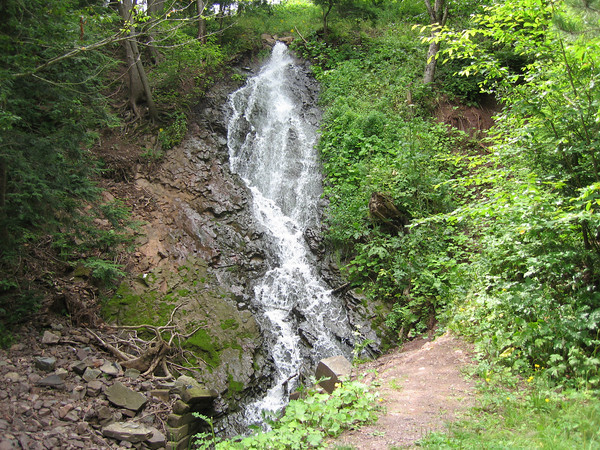
And of course, we took a stroll through beautiful Victoria Park.
To my surprise, I just found a very early piece of my work listed for sale on eBay. Someone in Cyprus is auctioning it off. Sale is over August 6. I like my recent work so much better. This piece is a work on paper, using oil pastels and collage. It was before I found a way to work on canvas that was satisfying to me. Canvas talks back, is much more sassy. Now I find working on paper much harder because it is not as challenging.
I went into Manhattan yesterday. First to the Louise Bourgeois exhibit at the Guggenheim, then visited with some friends, Leah and Pedro, in the loft building where I used to live in Soho. I hesitated because of the rain but am so glad I did go. I have my old appreciation of the NYC cultural offerings back. Next visit I will plan more time there. I've had an aversion to Manhattan for a while, the crowds, commercialism and speed. You could fart anywhere in the City and no one would notice because it is always so busy, noisy and smelly. It was raining just before I left, when I was on the bus, in the museum but otherwise, bright and sunny, so I didn't get rained on after all.
The exhibit was fascinating. I loved seeing Bourgeois’ work, how it evolved over the years and how she thought about it. I'd not seen too much of it before and I am inspired to learn more about her. The work is mainly about body, gender, desire and sexuality. Most of it is very sensuous. She is constantly playing with different materials and how they can be used counter to their nature. (Making soft, breast-like forms from marble, people-like forms from wooden sticks). Each piece has so many layers of meaning and possibilities.
Her inspiration throughout her life was her childhood, her family, especially her father. From my brief visit with her, it felt like there were no (visual) thoughts about her husband and three sons, other than in a performance piece she held a rose, implying to her son (who was there) "I never promised you a rose garden." She was, she has said, protecting their privacy. I can imagine she would have been a strong mother figure, with her penetrating intelligence, wit and dedication to her work.
She's in her 90's now and still active, has a salon gathering at her house where young artists come to meet her. She challenges them: "do you know what you are doing in your work" and "do you know why you are doing what you are?" I have to try that one on for size! I know what I say to people, what I write for public consumption, but the real inner thoughts, the ones that really inform the work, to me, they are so visual they transcend words. Maybe I need to dig a little deeper to see what words I can put on the wordless.
I have a confession to make: sometimes I do a painting that brings up so much emotion for me I feel like crying. This morning it was with a five foot by seven foot, three-panel painting I’ve been working on for at least a year. Off and on, of course, and always thinking it was finished before I went at it again.
If I can remember correctly, at first it was a pale yellow, then a peachy yellow, then a bright yellow. It never felt quite right even though it was a good painting. I kept seeing red when I looked at it (and I don’t mean anger). So last week I went into it with rose madder, leaving a small portion of the first panel yellow. The yellow under the red gave it a glow that was interesting. It looked good, but not good enough. Once away from the painting, I “saw” that the yellow part needed to be black. And the red, more red. So that’s what happened this morning.
If my emotions are trustworthy at this point, finally it works. I’ll leave it as it is and have a photo soon.
My friend Suzanne and her dog, Lucky, came out today for a swim. As we sat in the sun on the dock after enjoying the delicious water, she was telling me about how another artist is working. Marilyn has been taking photographs from her visits to Mexico, crumpling them up, taking photos of that and making paintings from the final photograph. I was surprised when Suzanne told me Marilyn had always been working from photographs, all her paintings. In fact, Suzanne said, almost all painters these days are working from photographs.
But not me. I prefer not knowing what might happen when I start a painting, what accidents and circumstances of paint will create the final image. I might take a photograph when I think a painting is done and then realize, when I see the photograph, that it still needs more work. Working from photographs was always something I thought was a taboo. I guess it’s not.
My gallery in Switzerland, the Halde Galerie, set up an exhibition at the Canadian Ambassador's villa in Bern (the capital) and she sent these photos.
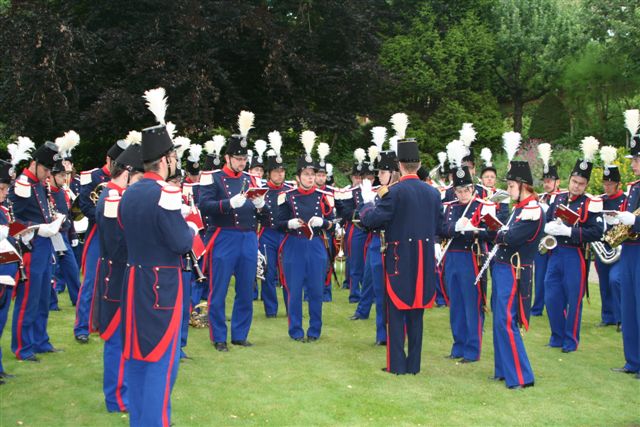
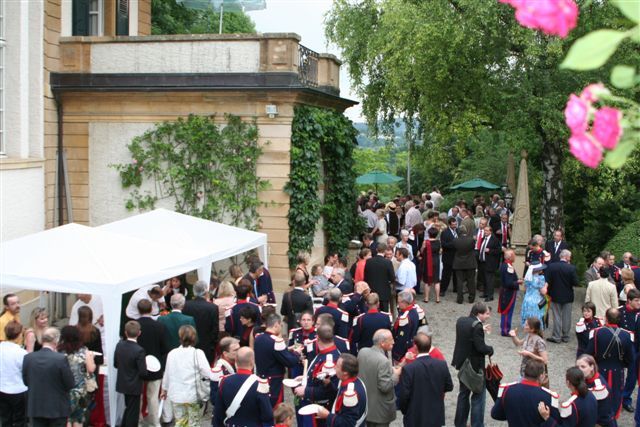
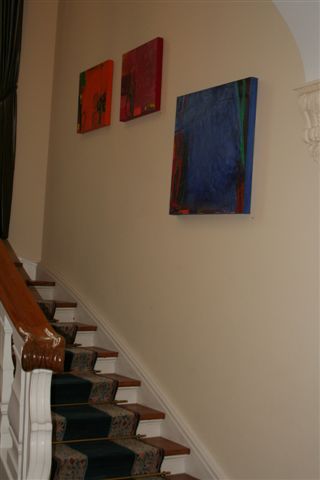
I was thinking all day I should post something about how much I love living in Canada, being a Canadian, thinking Canadian. I do, but I didn’t. She did it for me.
With great pleasure (and some necessary stress), I’ve spent the last week laboring over several shipments that just went out the door! With the help of my friend Brian, I’ve packed up eight paintings to go to Ottawa, six to England, and five to Denmark.
The hardest part was choosing what to send where. The gallery in Ottawa chose what he wanted which was very helpful. Denmark chose sizes and colors, also helpful. But for England I had to make my own decisions. I changed the selection daily and some days, hourly.
I find it very interesting what colors and types of paintings various parts of the country and other countries connect with. Here in Halifax, even though they talk about the intensity of my colors, most people gravitate (when they purchase a painting) to the softer colors. Ottawa chose the stronger colors: reds, indigo, bright yellow. Denmark too wants the reds and indigo paintings. England is a new gallery for me so it was more difficult to decide what to send. I’ll know when they get there if my choice was right.
And with all these paintings gone, my studio is still full! It seems I paint a lot.
On her blog, Allyson Stanfield posted a quote from Romare Bearden:
Painting and art cannot be taught. You can save time if someone tells you to put blue and yellow together to make green, but the essence of painting is a self-disciplined activity that you have to learn by yourself.There are no goals that I still want to reach. I don't believe in goals; goals are for a football team. An artist is just seeking what he might find.
My thoughts are: yes and no. What CAN be taught is discipline. What can’t be taught is vision. And vision, the energy of the artwork, is the most important ingredient. It’s the energy, the force, the reason that takes the artwork beyond the mere craft of the piece.
Discipline is very important in making art. It’s the foundation. It involves not only how you use your time in the usual sense (hours and concentration) but also how you coordinate your mind and body and, more specifically in most cases, mind and hand. What a good teacher can teach is methods to stimulate good useful discipline. Without discipline, art cannot happen. Without vision, it has no power.
The National Endowment for the Arts has released a new survey of artists working in the U.S. I found this on Alyson Stanfield's Art Biz Blog. The report is very interesting. First, as is obvious to any artist anywhere in the world, it seems the population of artists in the U.S. at least, has more than doubled since 1970. (They are needed to fill all the galleries that have also much more than doubled since 1970--my comment).
Where do all the artists come from? For all I know, from under the bed. But really, everywhere I turn, people tell me they want to make art. No matter what they are doing in their day-job. Maybe we should all be artists. Then, maybe, just maybe, the world would be a more pleasant place. Or would it? Not if we all became “cutting edge” artists. Putting that aside, making art for some is relaxing, a hobby, for others a life passion, a necessity, a compulsion and obsession. Whatever it is and whoever they count as artists, the report does point to the importance of art and artists.
Second, opportunities for artistic employment are greater in metropolitan areas. More than one-fifth of all U.S. artists live in Los Angeles, New York, Chicago, Washington, and Boston. Half of all artists live in 30 metropolitan areas.
Unique regional concentrations emerge. New Mexico has the highest share of fine artists, Vermont has the highest proportion of writers, and Tennessee, the highest proportion of musicians.
In response to this, I must admit New York City was a powerful school with a big playground for me as a young artist and now living in a more rural setting is more nourishing as a mature artist. And I have heard that Nova Scotia, my current home, has more artists than any other province in Canada.
The next revelation is that artists are 3.5 times more likely to be self-employed. Well, how else are they to be able to support themselves! We are often not the type to work in a group, office, follow directions, be a good employee. Artists must, by necessity, be self-directed or the work wouldn't happen. And making art is very expensive.
The most interesting revelation is that artists are more educated: artists are twice as likely to have a college degree as other U.S. workers. Yup, making art is not for dummies. Not that college degrees mean everything either. But it does mean that making art requires discipline (in order to get a degree) and intelligence (in order to make the many decisions required in making art).
So that’s it folks. Art is a major industry.
Why do we have a need to make nice-nice? Granted I don’t enjoy listening to someone complain. But sometimes it seems to me it would be a good idea to say something isn’t very nice. Doesn’t feel good. If you can’t see the down side of something, how can you make the up side happen?
What makes me think about this is one of the many rejection letters I receive. This one came recently. It was in reply to a proposal for an exhibit. The writer told me they “admired the longevity and consistency of purpose you have demonstrated as a painter.” Nothing about the quality of the work. The omission makes it quite clear why they didn’t want to give me an exhibit. Why not just say they don’t like my work, or it doesn’t fit into their agenda, or really, that abstract art which doesn’t have an outright social message is not cutting edge right now. And cutting edge is very important these days. It would, in my opinion, be a daring act in these troubled times to show work that deals with the emotions of being human by connecting to the subtleties of emotions, not to ideology.
When I told a couple of friends that this letter upset me more than other rejection letters, they tried to find a positive slant on the writer’s comments. Personally, I don’t see them but what I do see is my need to rewrite my proposal in a more aggressive tone to match what is happening in the art world these days. Then maybe the reader will like what they see.
Hey, Everyone, check out this month’s Shambhala Sun Magazine (pp. 66, 69 and 70), July ’08. I have some watercolor figure paintings featured. They’ve surprised everyone—although, in fact, I’ve been teaching figure drawing for over twenty years and have always loved drawing the human body.
At one point in my art career (I was in my thirties at the time), several artist in the neighborhood got together and hired a model. We did this once a week. Gradually the group dwindled to just two of us and later just me. (Models were paid much less in those days.) I did this for several years. Often the drawings were quite large, sometimes more than life size. I’d roll the paper out on the floor to draw. They were line drawings. My request for a Christmas gift back then was a battery operated pencil sharpener. I would sharpen four-dozen pencils at a time; when one broke (and they did often because I was bearing down hard) I always had another by my side. People often think they are ink drawings because the pencil line is so firm. I now have a drawer full of these drawings. Occasionally I look through them.
I developed a way of working that in many respects is similar to my paintings. The figure took up more than the page, often extended beyond the paper. The space was very important to me, both the form of the body and how the space was used by the body, by where the body was and was not. Sometimes it was hard to see at first where the body was because so much of it was off the paper. It’s hard to explain, but the important point here is the similarity to my painting process. I’m drawn (pun intended) to mass and contour, to a sensuous space and eccentric (off-center) composition. And it can be done with or without a recognizable image. I’m most comfortable with the purity of abstraction, the removal from concept and context . With the freedom that gives me
Commenting on the work of Berthe Morisot, Edouard Manet said “This woman's work is exceptional. Too bad she's not a man.”
Although this was in the 19th century and now we are into the 21st, it still makes a woman artist stop and think. Fortunately, all my painting life, this thought has never taken root. I believe if you don’t acknowledge such a strange idea, then it can’t be true. And it seems it is less true now. This way of thinking, thankfully, has much less power than it did even a few years ago.
I’ve always loved Manet’s paintings. I still do, whatever he thought about Morisot being a woman. What I love about Manet’s work is its strength, it’s directness. These may be masculine qualities, but not qualities owned by men. Monet’s paintings are soft and gentle, feminine qualities. But also not qualities owned by women. So the only thing for an artist to do is to follow his or her heart—paint what has significance to them. To me, integrity is the most important ingredient in good art.
I may not be of the “Facebook generation”, haven’t yet found it much fun, but I do greatly enjoy the way people connect on the internet. I love the “accidental” ways people come across my artwork and similarly, the “chance” meetings on blogs. Recently I received a comment from Mary Ann on the West Coast who “found” my blog and has just started her own. Her artwork and writing is well worth taking a look, both sensitive and thoughtful.
In addition, my friend Jackie who lives in Ottawa saw a video of me on TV (the one on BRAVO where I was paired with a musician from Monitoba to create work from each other's work) and contacted me. She lives in Ottawa now but about fifteen years ago was a student of mine at NSCAD U. I always liked her artwork and was delighted to renew a friendship. She too has started a new blog. This one is about her explorations of a gluten free diet. Her recipes are well worth trying. When visiting her in Ottawa two weeks ago, I had a scone she made and it was delicious. It’s great: she does the research, I get the results!
These three paintings are 30" x 30". I had put four together to make a five foot square painting but it just didn't work. It was too predictable, if that makes any sense. Too much square: four squares to make a big square. Just no good. So I reworked each square and am much happier with the pieces now, as separate paintings.
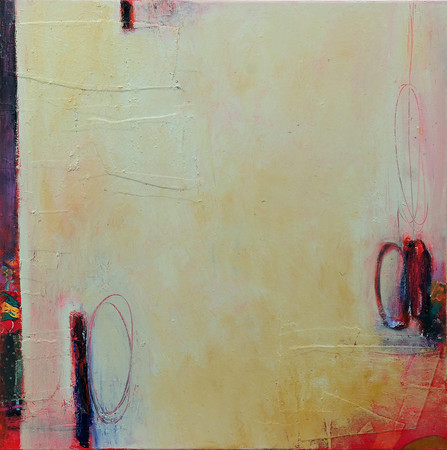
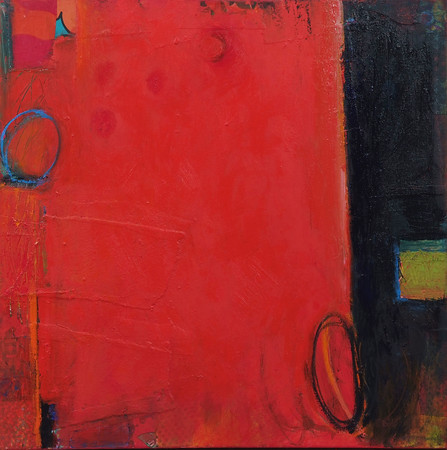
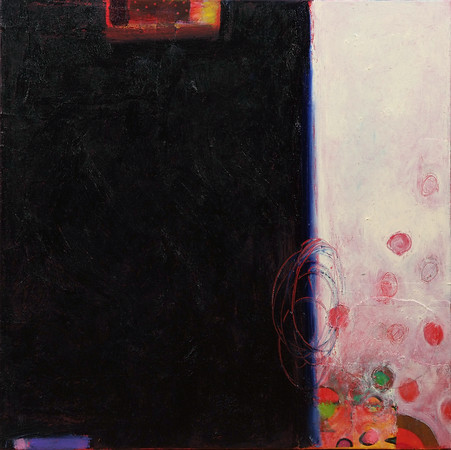
I've been trying to find ways to make large paintings without having them too cumbersome for shipping. I also really like to work with multiple panels, to see the images jump from one canvas to another. It's also a way to get myself to allow images to be other than at the edges because the edges are inside the final painting. So here are two I feel good about, both five feet square.
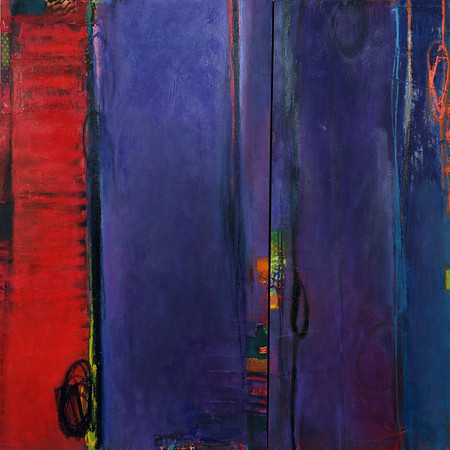
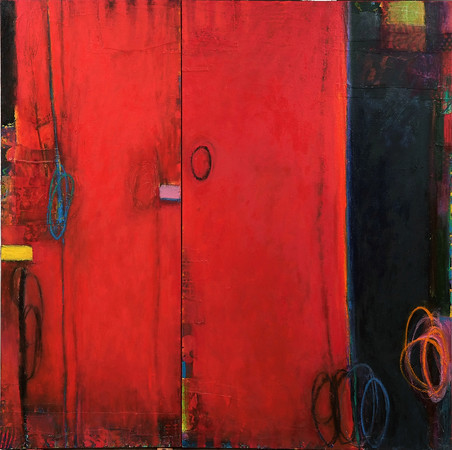
Today I prepared (put down the collage elements) two more sets of two canvases (one five by two, one five by three) to start two new ones next week.
My studio is so crowded, I had to take this painting up into my living room to see what it looked like. I hung it over the piano, the only large wall space I have, (The painting is 5 feet high, 7 feet wide.) A friend pointed out the area that needed work and of course, once I saw the painting in a clean space, I could see he was right.
I brought the paint up into my living room, moved the piano and set up a ladder. Now it is done, finally.
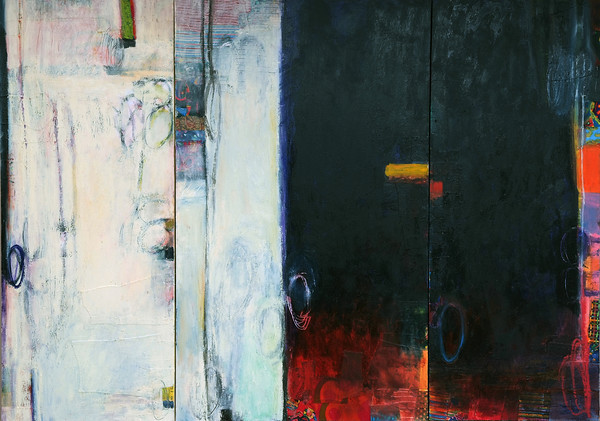
I had some photographs taken last week of new work. Modern technology is fascinating and useful. Because I don't have a wall space big enough to hang the piece, we photographed each one of the twenty-five twenty inch squares individually and then Steve, my photographer, put i all together in Photoshop. Amazing.
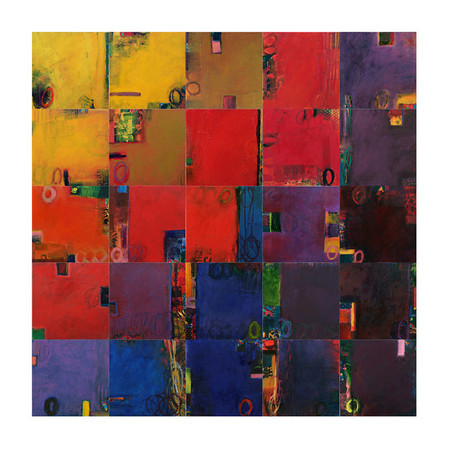
Now that I can finally see it as one piece, I probably could work on it some more but right now I want to stop. Put it aside and think about it later.
A couple of nights ago I dreamed I went into a small room, probably a bathroom, put a scarf on my head and some new glasses and then came out of the room to tell the people there (I don’t remember who) that “I am now a different person.” In truth, I picked up new glasses the next day, yesterday. My old ones broke a couple of weeks ago and were just patched up so I could wear them. I loved those glasses, thought they were the best yet, but I think my new ones are even better. At least for now. My broken ones are six years old and the prescription was wrong so all and all it is a good change. Yet before picking them up I was getting minor “Did I make the right choice?” thoughts. Glasses are a major article of clothing, a major presentation of body. It feels like a major body renovation. Granted I don’t wear them all the time, but still, they feel like part of me, an appendage, attached.
I was also supposed to have my paintings photographed Wednesday evening but because of (yet another) snowstorm and icy roads, it was postponed until Monday evening. That was a lucky change. I, of course, reworked most of the paintings I intend to have photographed. Being away for a week gave me a fresh view. I am impressed with the changes. Change in glasses, change in paintings: what else is going to change (the word of the times!)? As they say, the only thing you can count on is change. It's inevitable but it still involves choices.
When I was in art school, my teacher told me not to look at other artists’ work, just to paint. Not to be influenced by others. Of course, it’s impossible not to want to see what other artists have done, are doing. I couldn’t follow his advice. Now I can see that what he meant was to trust myself.
For a long time, I listened to other people, was upset by what they said if it was critical of my work. When I was about twenty-six, a friend came down heavily on me for covering up old paintings, using them as a basis for the next one. I went under the covers for two weeks. Now I deliberately put down images I know I am going to cover up. That’s what I like to do. Make layers of possibilities resolve into one image.
Another time, back in the ‘60s, a friend came down heavily on me for using acrylics. I went under the covers again for a couple of weeks. A few years later, when I had gone back oils, he was using acrylics.
But now, after years of exposure to the critical eye of the public and friends, I trust myself. I know what I want a painting to do. I know how to get there most of the time. Still, there are times when a little helping eye is invaluable. I’ve been working on this twenty-five panel piece for a while, took some photos of it on the floor of my studio and sent it to the gallery owner who has someone possibly interested in it. The client saw it and said she didn’t like the dominance of blue in the piece. She had, apparently, seen a previous one I did that had some “ochres and rust” (probably alizarin crimson) in it and wanted one more like that. So it was back to the canvases. And, in this case, I am grateful to someone else’s opinion. The piece looks much better.
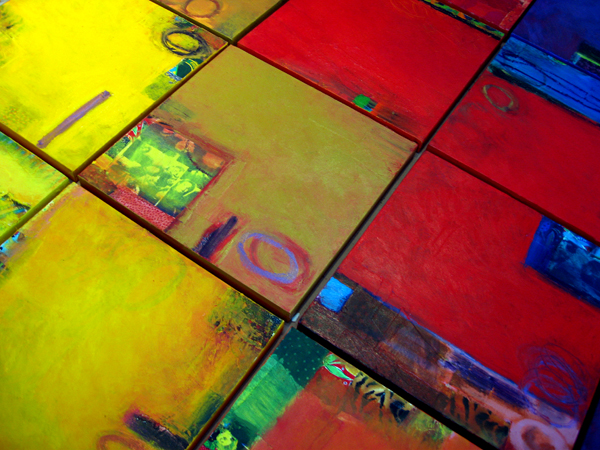
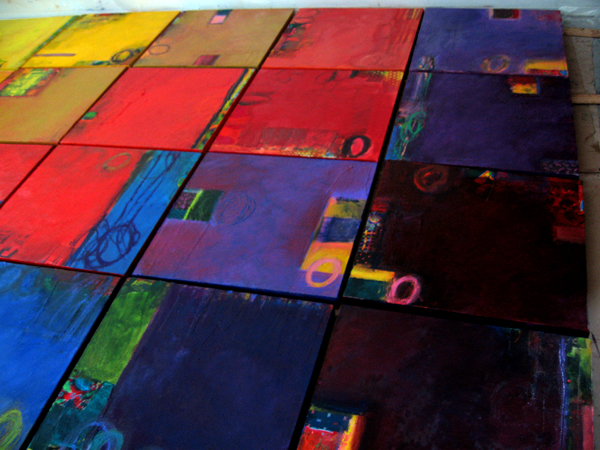
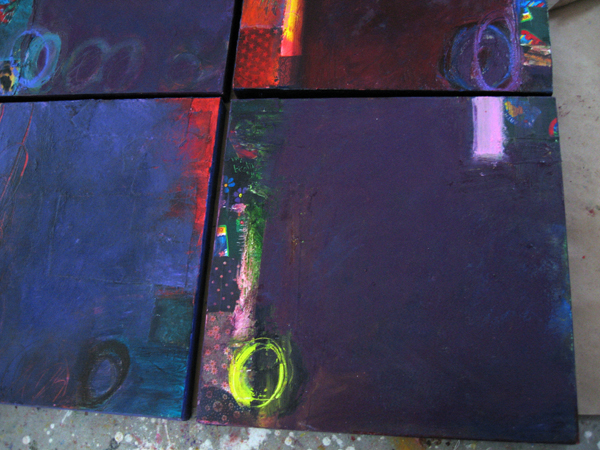
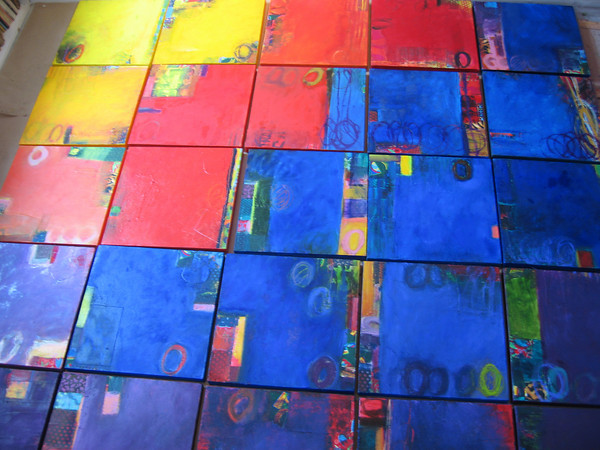
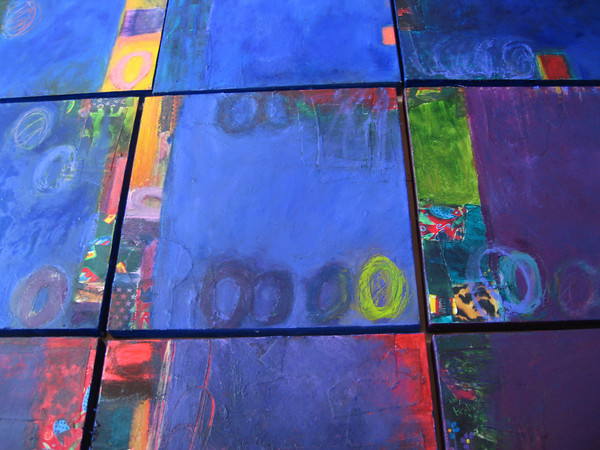
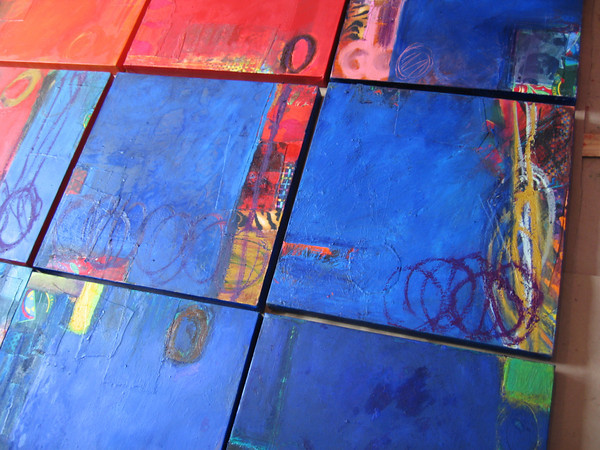
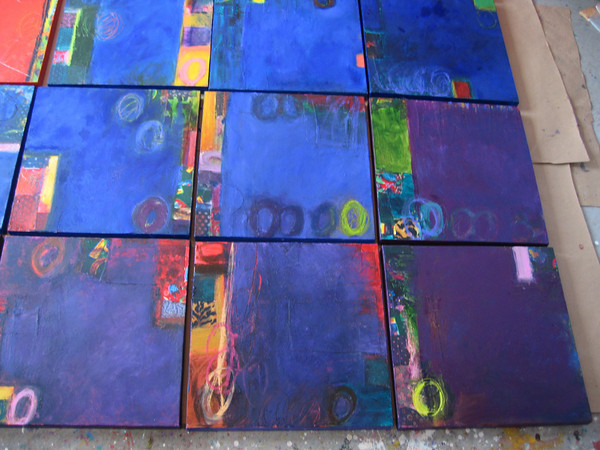
I think it's almost done--the twenty-five twenty inch square paintings--to become one big piece. I laid it out on the floor again this morning:
The party I went to Saturday night was all girls. Well, except for the boy dog of the house, a beautiful big (165 pound) Newfoundland Sheepdog. Usually I don’t find this kind of party much fun. Often there seems to be something missing. But this was a really enjoyable evening. Maybe it was because we were all in the arts and had that to bind us. And most of the artists I know do like to play.
Lila had a good time too. I always wanted a dog I could take everywhere with me. She’s turned into that kind of pet. And after such a difficult first two years, no can be more delighted than me. She played some with her Newfie friend and she worked her way around house. The worst thing she did Saturday was snitch a couple of pieces of pizza off the counter. Naughty but nice.
Or maybe I just have indulgent friends, friends who also enjoy my spirited pup. I certainly won’t complain about that!
I used Lila as an example, metaphor for making art during midterm critiques on Wednesday. We did a group session, everyone taking turns putting up their homework assignments and about six drawings from class. One student said disparagingly that her work was a struggle; drawing was a struggle. So I couldn’t help but tell them the story of Lila: how it has been a struggle. I’ve had four dogs (she’s the fourth) and none of them have been so difficult. But with persistence and determination, the struggle has relaxed and we have a strong bond.
My artwork seems to come in two main categories: the ones that paint themselves, just flow from the ether and those that are a struggle, take excessive revisions. When those difficult ones finally come together, they have a special charge, something that comes out of the resolution of struggle. So I told the students not to be afraid of the process of their work.
For a couple of days, Friday and Saturday to be exact, I was being followed. I wore a GPI tracker and wrote down exactly what I did by the minute all day. It was great fun; I felt very important for two days and I’m glad it lasted only two days. I was part of a Saint Mary’s University time management study. They will call me for a final interview soon. The purpose of the study is to help in basic urban planning.
It happened to be a busy couple of days. I did the usual (painting, walk the dog, clean up, eat, sleep) as well as my Tai Chi class, the park, some theatre, a party. But what became clear to me was how I don’t function in a linear manner. It was hard to write down what I did in an afternoon at home. I’d start one thing, start another, go back to the first, start a third, go back to the first (or second) and so on. It wasn’t multitasking because I was doing only one thing at a time. But I certainly didn’t finish one thing before starting another.
I paint that way as well. Work on many pieces simultaneously—have several paintings going at once. Part of it is the drying time but I don’t think I would work well any other way. My focus is very much where I am, what painting I’m working on, or what “thing” I am doing around the house, yet I seem to need the opportunity to move around from one thing to another. Sometimes I think it would be a good idea to stay with one thing to the end but that doesn’t happen very often. And this does work. For me.
Some of the best ideas come when I’m not even thinking about anything. When least expected. I was lying in the tub this morning and suddenly I knew what I wanted to do next with my paintings. I’ve been working on a piece made up of twenty-five twenty inch squares. It’s laid out on the floor of my studio, taking up a lot of space. (I did take Cheryl McClure's suggestion and photographed this with my digital camera to see how it is working. It helped. Definitely. I could see from the photo shot more clearly what was happening than when I looked at the painting itself. It’s interesting how that works. And it no longer, after this morning, looks like what you see below.) But it IS coming together, finally, and I may be able to send it out soon. (There is a possible potential client for it, maybe, I hope!) Assuming it will dry in time.
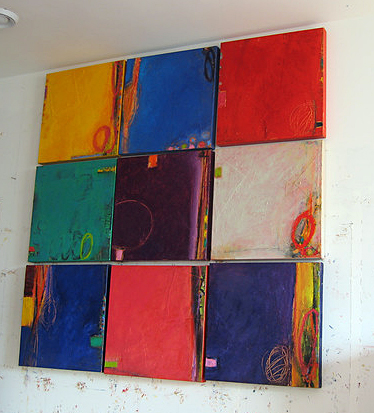
Then there is a nine-squares piece on the wall, but I’m not sure about that. And one of four squares, each thirty inch square, but I definitely am not sure about that one. So I’m eager to start something else, something big. Something satisfying, I assume. I recently put a three-panel piece up in my living room over the piano. The side panels are five feet by two feet and the middle panel is five feet by three feet. So it ends up being five by seven feet. Big. Once I put it up, I realized it still needed more work so I’ve been working on it slowly right where it is. It’s too big to move back downstairs to my studio. (And it also doesn't look like what you see below.)
But what I decided (this morning in the tub) to do (with my paintings) was to take two panels, one five by two and one five by three, to make a five by five foot piece. So I started two that size this morning. It’s exciting to be at this stage again, starting something new, a new size, new format, new paintings.
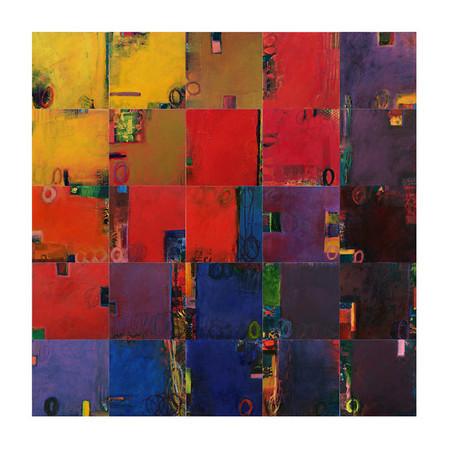
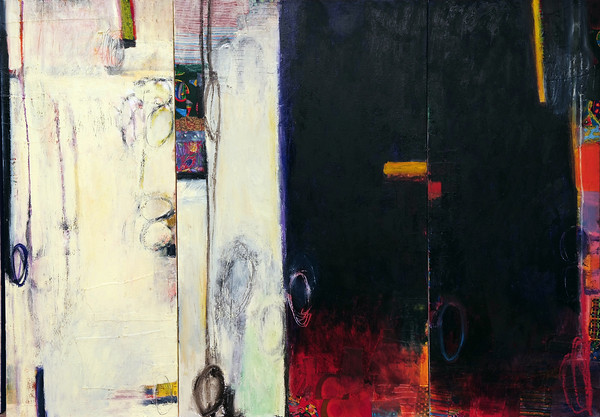
I recently had some photos taken of my new work. It seems sometimes I need to have the photos taken so I can see what I am doing, so I'm able to take a step back, have a different perspective, a different point of view. As a result, I need to rework several paintings, of course.
But here are a few I think I will not be changing:
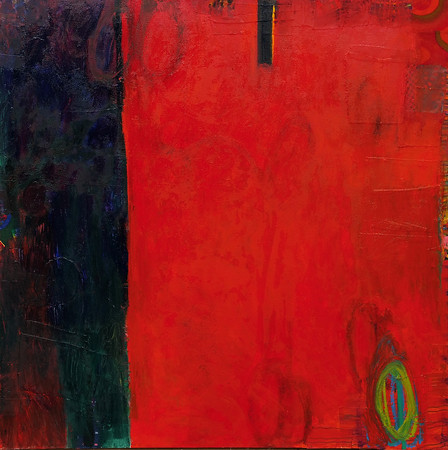
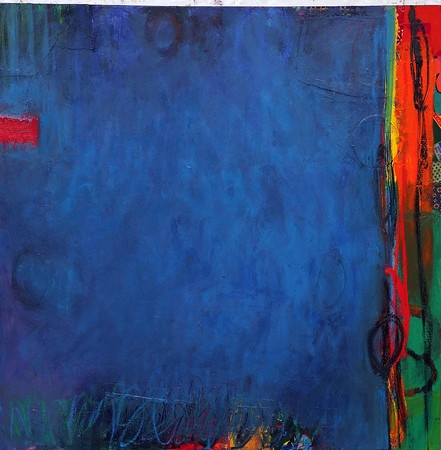
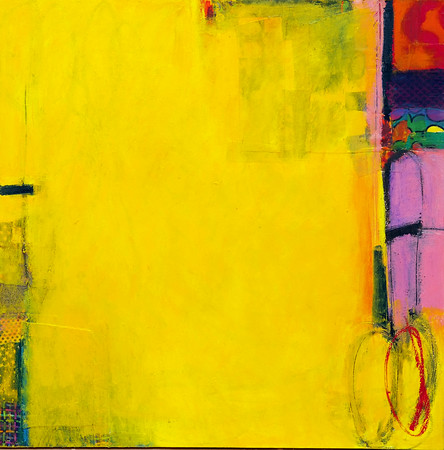
Last Thursday in my T’ai Chi class, several people commented that my hair looked nice. And I had been thinking it was one of those bad-hair-days. So, whose to judge? Whose opinion counts, mine or the one who looks at me?
And, more important, what about “judging” good (or bad-hair days) in artwork? My answer there would be it’s up to me to know when the work works. But time is always the true test.
Also, in my T’ai Chi class, Jenny, Dr. Wu’s wife, told me they had noticed a lot of people here have poor posture. She wondered why. I’ve thought about it since then and surmise that good posture is not part of our culture, certainly not as it is in theirs. From an early age, they have been involved in body-flexibility exercises. Dr. Wu told us his 80 year old T’ai Chi teacher could bend backwards, almost to the floor. And when over 100, was running up and down stairs, no problem. All I can say is Very Inspiring!
My friend Jody gave me a small sketchbook, hand sewn with Japanese binding, for a Christmas present. On the cover was some small typed out writing. (I don’t know where it comes from and will investigate, but until then,) this is what it said:
It is Art that makes life, that makes Importance. I know of no substitute for the force and beauty of its Power… Art is the only way to run away without leaving home. ARS LONGA, VITA BREVES… You know you have achieved perfection in design * not when you have nothing more to add, but when you have nothing more to take away… Every great work of art has two faces, one toward its own time and one towards the future, toward eternity… WHAT IS ART BUT A WAY OF SEEING?... I don’t want life to imitate art. I want life to be art… Sculpture and painting have the effect of teaching us manners and abolishing hurry… each of the arts whose office is to refine, purify, adorn, embellish and grace life is under the patronage of a muse, no god being found worthy to preside over them… Art washes away from the soul the dust of everyday life… THE ARTIST’S VOCATION IS TO SEND LIGHT INTO THE HUMAN HEART… Art is the signature of civilization … . . .
I wish I’d said that!
I heard on the radio a few days ago (I don’t remember the show but it must have been in the morning because I was painting in my studio and of course, it was on CBC) a discussion of what makes a good, lasting novel. The consensus was twofold: a story needs to have ambiguity and needs to be beyond nostalgia.
Ambiguity invites you to read and reread, telling you new things with every reading. Gives the sense of mystery that is life, the constant unfolding of news, surprises, deepening of understanding, new points of view.
To be beyond nostalgia gives you that universal quality, where anyone, anywhere, from any background, knowing different experiences, can relate to what is happening. Nostalgia, sentiment are limiting.
These same qualities are necessary for great art in any format: music, literature, theatre or any of the visual arts. This thought reminds me once again of the idea that there are two ways to make art. The first is to start with a universal theme, idea, and make it personal. The second, to start with the personal and make it universal. Art needs to transcend the personal in order to be great, to be read again and again, to be looked at over and over, to reveal its secrets over time but never completely, for there always to be more. And more. To be beyond.
After trying via several friends to get the video clip of my TV interview in Denmark last June edited and reformatted for North American use, I finally took it to a professional digital copy shop. A friend was then able to post it for me. So now it is up on my website! (It's under Media on the top bar.)
The questions the interviewer asked me were, first, what inspires me and second, do I having a problem letting go of the work once it is done. Now, because I have been painting for so long, feel more confidant in being able to paint a good painting, one that satisfies my intentions, I not only have no problem seeing a painting go off to a new home, I am eager to empty my studio as often as possible. But there was a time, when I first started painting, when it was much harder to let go. At that time if I did a few good paintings a year, maybe three or four, they felt more precious. I didn’t know if another one would follow.
This morning I went into my studio and planned to prepare canvases to work on, to put down the collage materials. I bought a large number of small stretched canvases when they were on sale recently so I have a lot of work to do to make them ready to receive paint. But it was hard not to pick up an oil bar and start working. (I must admit, one painting insisted I work, just a little, on it.) So my mind is churning for tomorrow’s studio time. And my studio is filling up again.
My friend Sean Kennedy, the one who taught the Irish Studies course at the Halifax Library the past few months, has been talking about the unthought known: what we know without thinking, what is inherently known, intuition perhaps. He mentioned, after seeing my new work recently, that “perhaps the unthought known is that which knows us; are we thinking or being thought? Painted or painting?”
So often I feel I am being painted. The work dictates to me what it wants, how it wants to proceed. I respect my training, yet the exciting part is when I just go along for the ride. I enjoy the struggle as well, those times when the work does not come together easily. I enjoy the challenge. But there is nothing like the experience of being involved with a painting that seems to paint itself.
It does take stepping out, being willing to climb the tree to the top, step out on a limb, leap to the next tree. Even if it doesn’t work at first (or even eventually), if I make poor decisions, it’s worth the trip.
I'd like to believe, like Plato, in absolute beauty, absolute truth, but I'm constantly reminded that it's only a concept. It just doesn't work that way. The other day a friend came into my studio and saw a painting I was working on—and saw it very differently than I had. It was going to be a triptych—three panels, the middle one being five feet by three feet, the two end ones, five feet by two feet. I had been trying to have the five by two panel exist as a single painting but that shape does not feel right to me. So I was making it a part of the other two panels. My friend saw the newer panels as one and the original five by two as a separate painting. I took another look and agreed: it looked right as a diptych. Later I continued to work on the newer panels and now the piece has come together as a triptych. But the thought of a diptych in that particular pattern lingers as a future possibility. Because someone else saw it for me.
A few years ago I was asked if I would sell a triptych (a Naples yellow painting I really loved) but the buyer wanted the first five by two panel turned on its side to put over the coffee table and the middle five by three panel to be beside the couch (or vice versa—I don’t really care to remember). That would leave one panel lonely. I said no. That painting is now back in my studio, all three pieces.
The recent exhibition of my paintings in Switzerland looked good. Evelyne’s sculpture in the gallery worked well in the space with my paintings. It all looked very elegant. This has been a very fruitful relationship. Evelyne is a superb gallery owner, honest, forthright, good with sales, a excellent business woman. I have great respect for her.
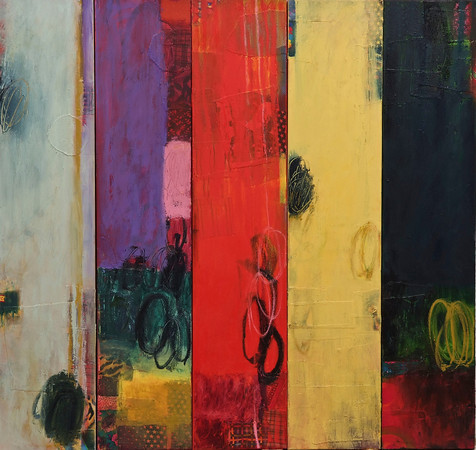
I did, however, want the five panel piece to have each panel touching the one next to it. It makes the painting much stronger—with the pieces being more intimate, being able to talk to each other. That is the way it was conceived. I couldn’t convince Eveyne to hang it the way I would have preferred. I had sent her a photograph, I wrote, I wrote again and when I got there, she had hung it with about an inch between each panel. It didn’t look bad but it wasn’t the same. What it did, in my mind, was make the piece more decorative. And that is not how I feel about my work.
When I came home I couldn’t stop thinking about it. Felt indignant, not in control. I decided to write her and state my needs (again) regarding my work. Yet once I realized I could tell her that as much as I appreciated all she did for me, and it is a lot, I need to have my wishes regarding my work respected, then, at that point, I stopped thinking about it. Just let it go. In the greater scheme of things, it just isn’t that important. She has her way of seeing my work, I have mine. I cannot control how people see.
I just finished reading Still Life by A.S. Byatt. She writes: “We all remake the world as we see it. . . We always put something of ourselves—however passive we are as observers, however we believe in the impersonality of the poet, into our descriptions of our world, our mapping of our vision.” I can only offer you my vision and hope, as well, to see what you see.
I traveled from Rome to Zurich by train, with a day and a half stop in Venice. I love traveling by train, seeing the terrain change from round to hilly to flat to the mountainous Alps. But by the time I arrived in Zurich, I was very shaky from so much travel, so many new sights.
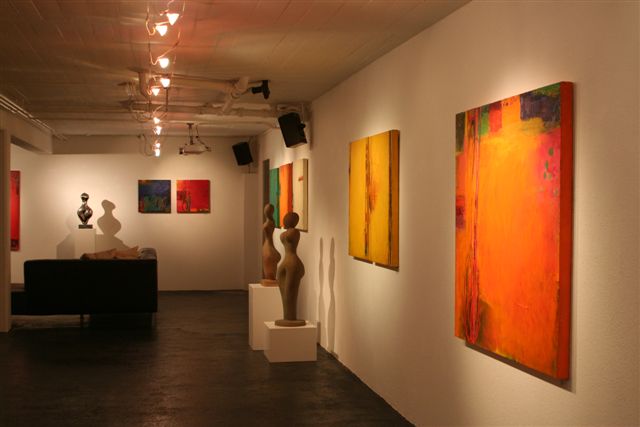
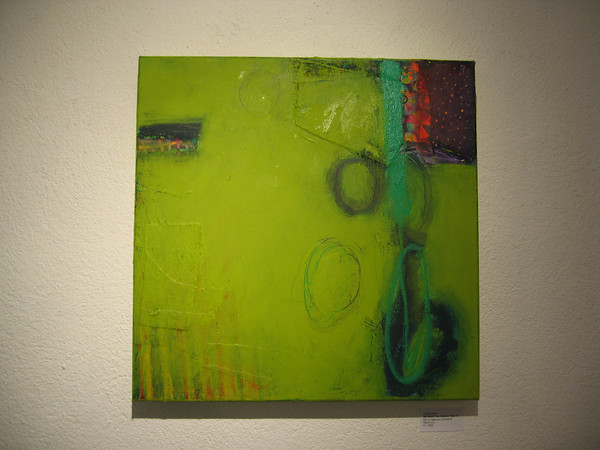
This was my third exhibition at the Halde Galerie. This particular show was to celebrate the fifth anniversary of the gallery. My paintings were on the walls and the sculpture is by Evelyne Brader, the owner of the gallery. I was honored to be a part of this exhibition. The opening reception-party-celebration was the first night I was there and was enjoyable. The Canadian Consul came, talked a bit with me, gave a little speech. He’s from Quebec. Lots of other people talked to me as well. Usually they don’t bother because I don’t speak German. So it was nice. The party lasted way into the night.
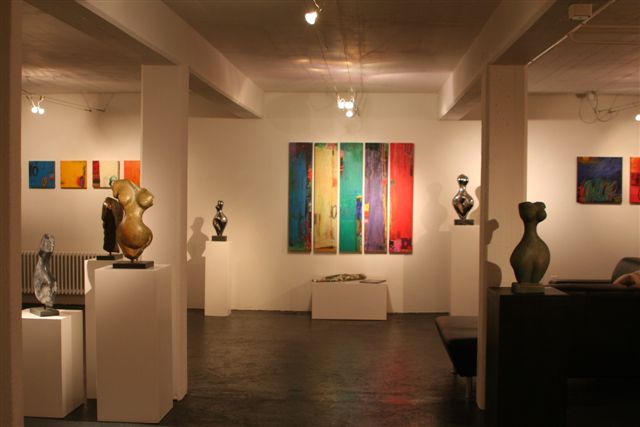
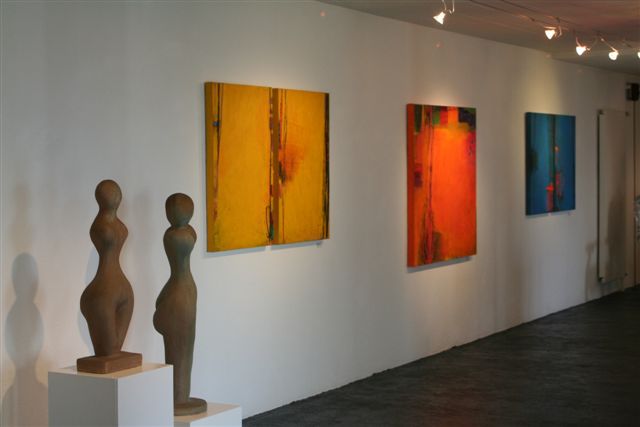
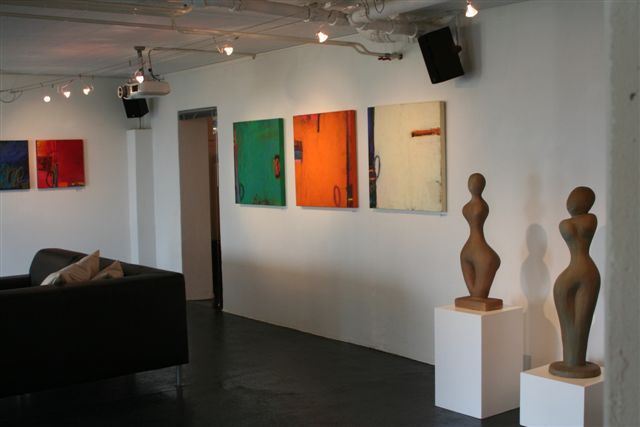
The next day I met a friend of Ann’s for lunch in a Japanese restaurant where the food goes around on a dolly and you take off the plates that appeal. The food was great. Ann’s friend plays violin in the Zurich opera orchestra. I could have gone to see The Marriage of Figuro but I was just too tired to work out the logistics and of course, regret that decision now.
Before and after lunch I walked the charming streets of the old town part of Zurich. I also went into the Kunsthaus, the art museum and saw their permanent collection. My memories of it are better than the current show but it was, nevertheless beautiful.
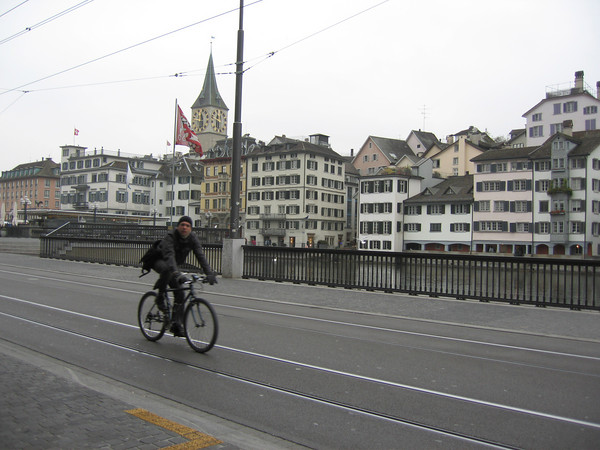
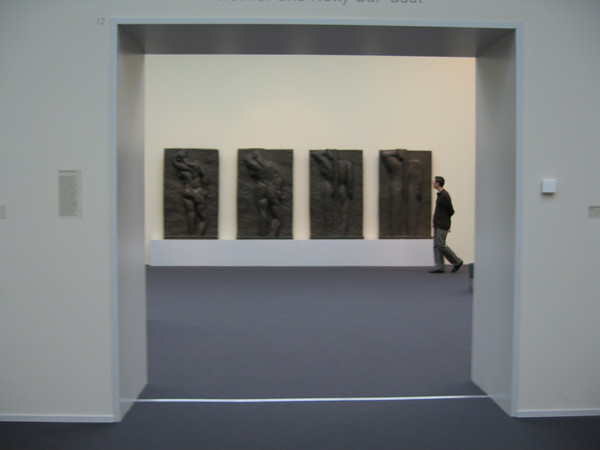
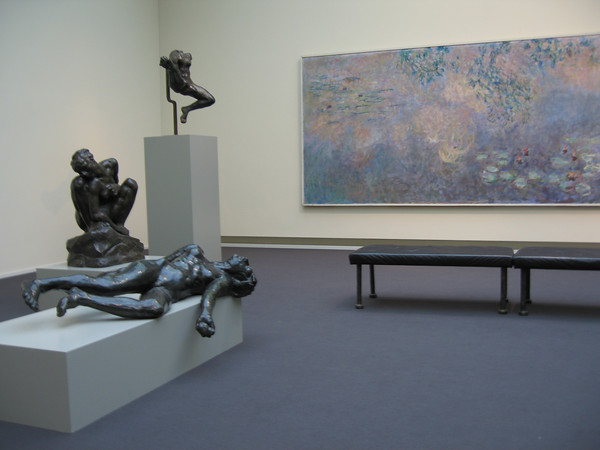
On the way home, I took the wrong train and ended up far away, had to retrace my tracks, literally. I took an early morning flight on Monday and was/am happy to be home, painting again, filling up my studio, And using a Western English keyboard!
So that’s my trip! I expect I will be staying home for at least a couple of months. Then . . . who knows!
I’m off to Switzerland today! By way of Rome! I may be able to post here while I am away, but . . .
My exhibit opens in Switzerland October 26. I’ll be back the end of October with plenty of stories and photos!
. . . from the exhibit at the Secord Gallery that didn't get photographed. The first painting is 48" x 50" (each panel is 48" x 10"), the second is 46" x 46"
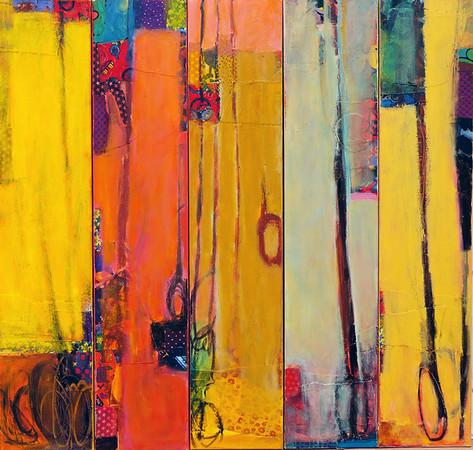
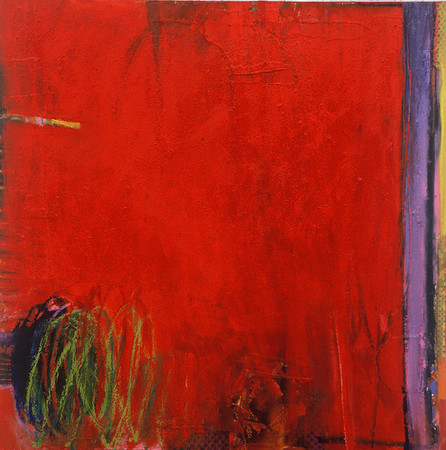
Now that my studio is almost clear of finished paintings, I've been stretching and priming more canvases so I can start new work. I've been working on a four panel piece, each panel 30" square, making a total of a five foot square painting. It's harder than I expected. I want the final piece to work as one painting, not as separate panels yet they will necessarily retain their individuality. Right now the painting is mostly red. I've tried introducing a yellow panel but the yellow keeps getting less and less. As usual, we will see what happens next . . .
Brian came over and helped me pack up my paintings last Thursday. The four (large) boxes were picked up by the shipper on Friday. On Tuesday they cleared customs in Zurich and were delivered to Halde Galerie on Wednesday. Fast!
So my plans are: I leave here on Wednesday, the 17th of October, fly to Rome, stay a week with my niece (who plays violin in the Rome Opera Orchestra), explore the area well for a week, see the opera Wozzeck by Alban Berg (I had bought the records to this opera fifty years ago—fifty! So when Ann told me it would be playing October 24, I was excited and she was so pleased to have my travel plans made around a musical offering.) From Rome, I will take a train to Zurich to be at the gallery for the 26th of October reception. This is the 5th anniversary of the opening of Halde Galerie and I am honored to be in this exhibit, along with Evelyne Brader, sculptor.
I will stay in Switzerland until the 29th. Then I'll be come home for Halloween, to go out to dinner and a movie with Yoko, our annual "let's avoid Halloween" treat.
So . . . in just two weeks, I’ll be in Rome! Not bad!
The opening reception Friday night at the Secord Gallery was great—very crowded, friendly, lots of very appreciative people. The arrangement of the works (by Phil Secord) was perfect. He had mixed Elin’s and my paintings, matched them by size and color tonalities. It worked well.
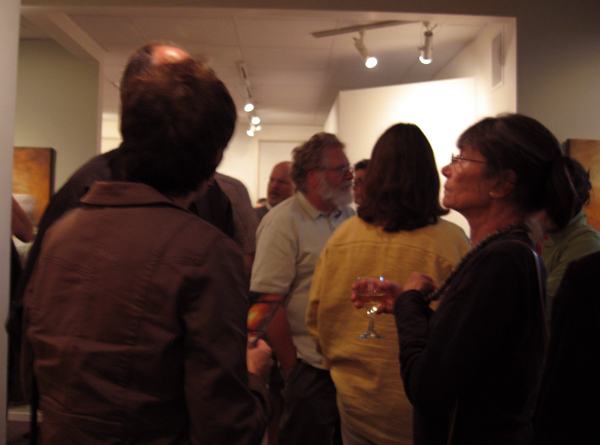
The exuberance spilled onto the floor, a perfect party.
I need to go back and take photos of the exhibit but right now I’ve been slowed down by a bad head cold. The kind of nuisance that actually feels right—makes me rest a little (although I’m not really resting too much, just thinking I about it!).
P.S. My shoes were a big hit. They are actually bright red--not sure if that shows up in this photo!
My exhibit with Elin Neumann at the Secord Gallery opens this evening. (hope you can come, 7 pm!) From my sneak preview yesterday, I must say it looks really good. Phil Secord has hung the works so they compliment each other, hers and mine. The abstract landscapes and the abstract abstracts. I am very pleased to see our work together. I hope to have photos soon so you can see what I mean.
Meanwhile, I spent the day cleaning house (a luxury sometimes) and giving Lila a much needed bath. Also, I’ve been thinking about a blog entry about creativity, or more precisely, about originality. The post (when I tried to find it again, I couldn’t, so sorry!) focuses on the old adage: there is nothing new under the sun. Nothing is unique. There are always references. We are not isolated in our thinking, doing, making. We are always, it seems, reinventing the wheel, with all the possibilities: new rims, decorations, sizes, combinations. But they all (all the wheels) need to function in the same basic manner: they need to make movement. So when someone says “I’ve never seen anything like it” perhaps they just haven’t seen that combination.
Elin’s work may originate from the outer landscape and move to the inner one: mine may move from an inner experience to create something totally outside my personal being. Both approaches end up in paintings. How they relate to history, to what has gone before and what will happen next, is an ongoing experience. It’s movement.
If you are in the area, do stop by! After spending some lovely days in Denmark with her, I am very happy to be exhibiting with Elin Neumann here in Halifax. Her work is great and it will be interesting to see our paintings together in the same space.
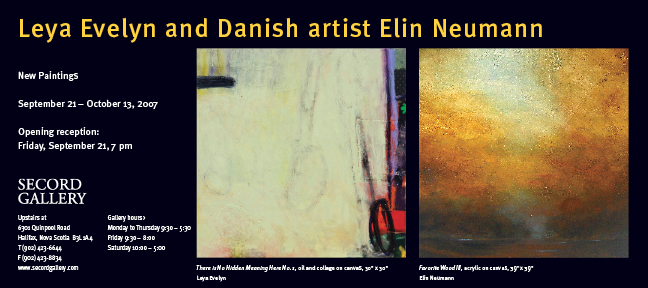
The gallery in Denmark sent me a copy of the review of my exhibit there. It was, of course, in Danish and I didn't have a clue what it said. This week a Danish friend of mine translated it for me. It's a good review. The reviewer obviously looked closely at the work, wasn't just parroting back what I or other people have said about it.
PURIFIED AESTHETICSLeya Evelyn’s paintings create resonance with everyone caught in her pictorial world. The abstract paintings reach and move all with an aptitude for aesthetic pleasure. In her paintings, Leya Evelyn is working from inside outwards. Inside, or firstly, she has glued pieces of fabric onto the canvas. Some of these pieces of thin fabric, whose strong colours and patterns are allowed to peek through, are strengthened by the art work’s further colour choices. Other of the collaged fabrics are pieces of thick canvas of various sizes cut into geometric shapes. The pieces are completely covered with paint, but their forms become visually distinct as shadow effects. These fragments are therefore included as important components in the overall composition of the art works. The layers of paint are many, and even if the colours must be said to be primarily strong and expressive, there are, in every coloured surface, an infinite variation of nuances.
These are strong contrasting colours but the result is never garish. Leya Evelyn seems to have an almost intuitive perception of all the colours' ability to interact. The composition of these art works can, in general, be said to have been built up by geometric, angular forms. But these are, at times, softened by circular movements, often in contrasting colours. In reality it is perhaps wrong to comment separately on colour, form and composition in Leya Evelyn’s paintings. It is clear that for her there is a great coherence, and that all parts are mutually dependent on each other. The art works testify to Leya Evelyn’s repeated experimentations with and investigations of relationships between form, colour and composition, and that she, through these, has reached her very own expression and pictorial language. The works are simply wonderful. One can only hope that this is not the last time that paintings will be sent from Leya Evelyn’s Canadian studio to Denmark.
By: Alice Bergholt Nilsson (kultur@nordjyske.dk)
At a time like this, when I am busy getting ready for two exhibits, one here September 21 with Elin Neumann and the one in Switzerland, October 26, it's good to feel my work is appreciated. I also spent about a week in front of the computer screen (not fun) preparing photos for perusal and use by the galleries. The hardest part is picking titles. I'm also busy stretching and priming canvases because there is no more room in my studio to paint. I'll be glad when I can ship some paintings out. The freedom not to be teaching has definitely helped my work, not only in amount but quality. So it will be interesting to see what happens when they are on public display.
I went to my mailbox on the way into town yesterday. This is rural delivery with all the neighborhood boxes in one place so I don’t stop by very often, maybe once or twice a week. I had a feeling it was time for my last grant application results to come in, so I was visualizing the proper size envelope as I was on route. And there it was: a sizeable grant from the Nova Scotia Arts Council. A very happy camper here!
This is a peer judged grant so it feels good to know my fellow artists voted for me. Last time I was turned down I called the person in charge and asked why. He said, as usual, if there were more money I would have been next, or near next. But he also said there was one person who commented my paintings are too formulaic for that person’s taste. I found that difficult to hear. That is the farthest from what I consider to be my working mode. Granted, I do have a handwriting that is obvious in all my paintings, certain marks do keep reoccurring. But basically, I work from intuition, spontaneity, chance. At least, that’s how I see it. So I rearranged my grant proposal, placed emphasis differently, and sent in a wider variety of images. I guess it worked!
The first thing I did when I got to town yesterday was turn in the signed acceptance letter. Then I went to the Art College and cleared out my locker. It was hard to let go of teaching (and the income); I kept thinking maybe they would change their rules. But it is not very likely and I am very happy to paint every day—and to be able to concentrate on it so completely. A new phase of my life.
Speaking of serendipity: the man who worked on my website (the technical side, Aaron did the design and original setup but doesn’t have time to help with the maintenance) came by last night to pick up a painting he wanted (I had told him to come get it quickly before I sold it to someone else as it is a new size, tall and thin, 5’ x 2’, and it seems a very appealing shape and the painting worked, all a surprise to me, so I think I will be working in that size again.) He arrived just when I was struggling to play the DVD sent to me from the gallery in Denmark of the TV interview from when I was there. It was very frustrating as they use PCs and I have a Mac. So the formatting didn’t work. He downloaded a program that works on both systems and now I can play it. Very cool!! He is also going to put it on my website and also make me an email copy so I can send it to people. Very Cool!!! So as soon as he does this, I will let you know.
Meanwhile, after four days of houseguests, I’m back to my usual routine of painting and playing with Lila. (Being a very sociable animal, she misses our company! Me too!) While working this morning, I kept simplifying, taking things out, turning paintings around, upside down and changing the focus. A few days away and everything looks different. And I want it to change. It doesn’t work for me to keep using the same solutions.
My digital camera is in for repairs so I can’t take photos of the paintings yet, but I’ve been using my (twenty-five year) old Nikon, and I must admit, I could get addicted to it. It’s a beauty. Metal casing, solid, good lenses. I can have the negatives scanned to a CD and get prints for very little money. If it weren’t for the weight of the camera . . . I don’t know . . . Maybe . . .
Leaving Denmark (so to speak) for a while, here’s a photo of me in front of one of my favorite paintings, taken in the gallery in Saltum.
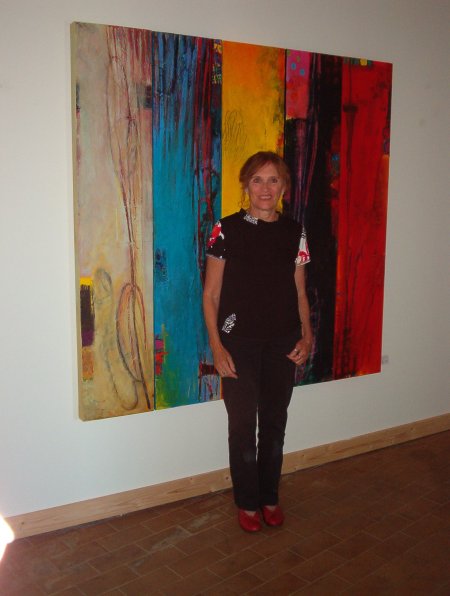
I’ve since been working on two more paintings using five panels each with each panel being a different color. (My digital camera is in the hospital for repairs, having contracted sand on the lens from the beaches in Denmark. So, no pix yet.) It was hard not to repeat the same pattern of color change as well as hard because the size was slightly different, less tall. My (almost) final solutions have been to have one of the paintings to be very bright colors, the other more muted.
Another difficult part is the elimination of marks/ideas—not to have too much activity in such narrow panels. As usual, I have put down a lot of “information” and the task is, as usual, eliminating excesses. Choices. Over and over. So that the geography of the painting is concise and clear. Direct. Just right.
An interesting experience with this (above) painting is that, when I first saw it in the gallery, I felt uneasy about it. It didn't look as good to me as it had in my studio. I couldn't figure it out. I then asked them to hang it just six inches higher. And it looked much better. It was fighting with the floor. Interesting what just six inches can do.
Or rather, one of them:
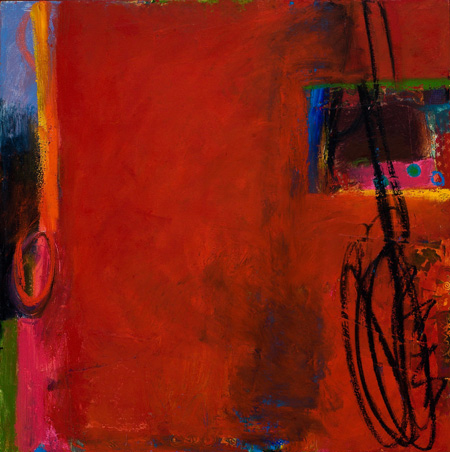
The last two weeks I’ve been painting (almost) every day. At first when I went into my studio I thought: I don’t want to paint, I don’t want to do this, I don’t have anything to say. But as soon as I started, picked up some paint sticks, the paintings just worked themselves out. It’s been exciting to see the way they can still change, still have a life of their own, separate from me, from what I am thinking and feeling.
A couple of months ago I put a series of small paintings, 12” x 12”, around the room. Because of the size, the imagery seems bigger. So it looked like a series of circles. Every painting had one or more prominent circle in it. I had once said I’d Never Do Another Circle. Imagine that. Circles. No circles. Sometimes it feels like it’s not my choice; I may have some thoughts but the painting chooses, has the final say.
My friend, Sean Kennedy, recently wrote about my paintings on his blog on MySpace. What he said is closer to what I feel about my work than anything else I’ve read. Sean should know. He has several of my paintings in his home instead of a TV and he watches them change with the changing light throughout the day (and night). I was so impressed with what he wrote that I asked him if I could reprint it here;
Every Leya Evelyn painting carries a wound. A wound that, in turn, carries the painting. Often they are vaginal. Sartre, giving full rein to his misogyny and resentment of the female form, described the vagina as obscene, a gaping hole, "an appeal to being". His sense was that the vagina, like any gaping space, an open mouth at Burger King, demanded to be filled, satiated, and, by the same token, contained. If he was, perhaps, wrong in most of what he said in this, one thing rings true in the current instance. The idea of the wound as an appeal.In the case of Leya Evelyn's canvasses, there is no shouting, no hysteria, and certainly nothing of Sartre's all-too-easy misogynistic philosophy. But each painting carries a wound. And the wound is an appeal to being. A muted scream. When you first see one, all you can see is the scream, the difficult corner that will not go away. After a while, when the painting has agreed to be around you, the scream is the place you return to again and again. Like a tongue to a jagged tooth.
To try and explain how and why Leya Evelyn's art articulates any or all of this is not so much to mix metaphors as to simply intrude verbally upon a process that is written in, or on, or by and through the body. Samuel Beckett never got over the fact that he had to work with words, and all of their sullied etymological history, when his friends, Jack Yeats or John Beckett, could draw on the purer medium of the note or the brushstroke. These seemed cleaner to him, whereas words carried everything with them. Hoarders of hurt and history both. "I love you". Like putting your heart into a left luggage locker in Kings X and expecting it to be found by your intended. "I love you too".
Of course, wounds are everywhere. But nowhere more beautifully transposed than in Leya's canvasses. They don't just scream, they also sing. Sometimes they sigh. Often, they say nothing at all. They are, in fact, nothing more or less than ourselves. Hurt, hopeful, beautiful, and in search of redemption. Or, to use Leya's own word, resolution.
Not resolution in the sense of a neat and fitting end. Not solution. More like resolution as in the strength to go on, the resolve to continue. Courage. The courage, perhaps, not to lick our wounds so much as hear them out.
Well, I’m back! My physical body, that is. I’m not sure about the rest of me! It was a wonderful two weeks, touring beautiful Denmark, graciously hosted by Elin Neumann, meeting many fascinating people and ending with three amazing days in London.
So, needless to say, I have lots of photos (many hundreds) to sort through and stories to tell. But that will have to wait until my mental body catches up with being home. Meanwhile, I’m very happy to be back with Lila, to sleep in my own bed (although I still wake up in the night and wonder where I am), catch up on the news of friends here and weed my overgrown garden.
Here are a few photos (more to follow of my trip) from my exhibition at Galleri Saltum in Denmark, far far away just a couple of weeks ago.
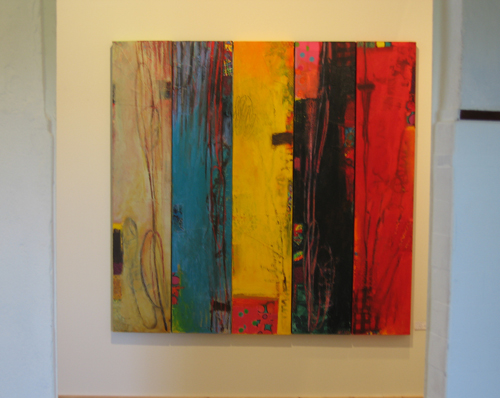
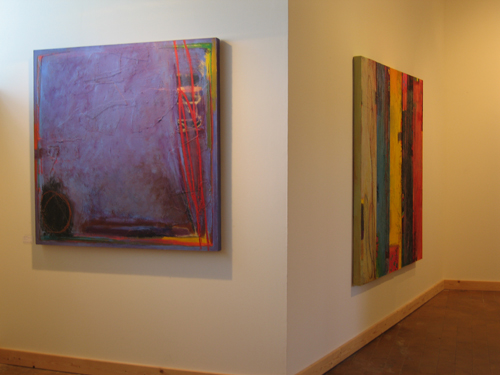
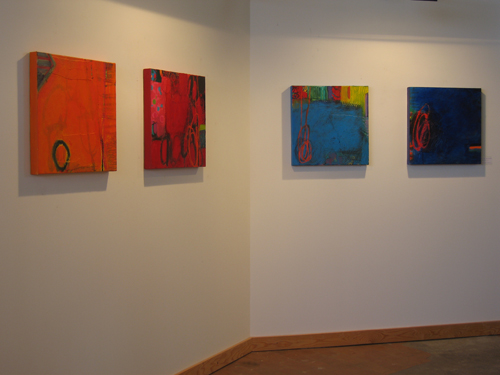
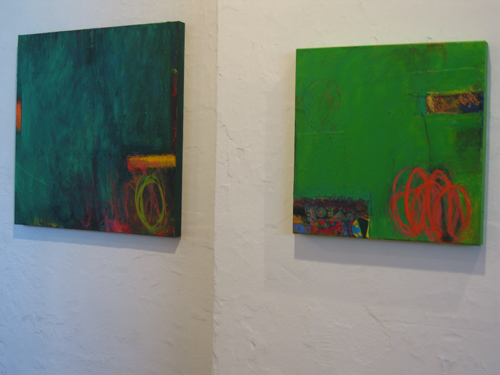
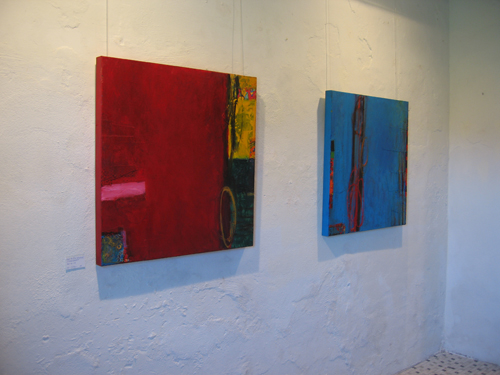
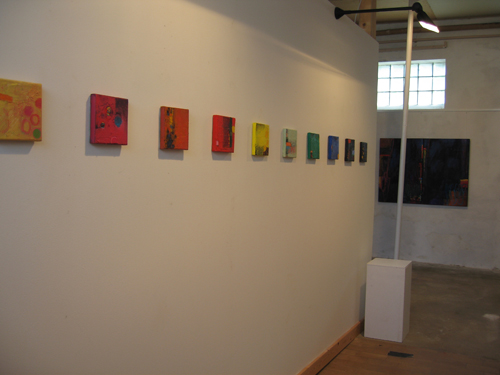
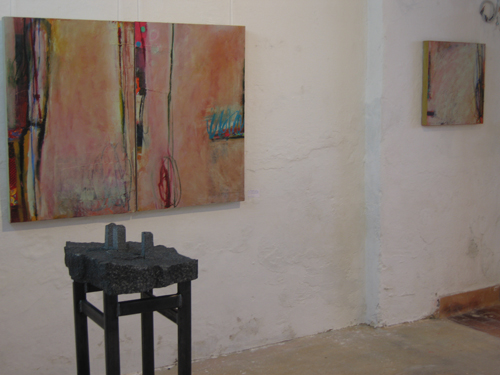
Today is Day 1 of Studio Rally! I, along with ninety-some other artists and artisans in Nova Scotia, have open studio today and tomorrow, from 10 am to 6 pm. So get out your maps, folks, put on your wheels and come on by!
One of the best things about Studio Rally is my clean studio! If only it would stay this way on its own!
On the radio the other day, I caught the tail end of a musician being interviewed. His comments at the end, as I heard them, were that “All music is political.” This because we make music (art) in order to express the truth as we see it. Therefore it is political.
I understand his point but that’s quite a broad step—from truth to politics. I don’t generally think of politics as speaking about truth. Truth, to me, is inalterable, is totally itself, is not a concept, doesn’t need to be proven. Relative truth, what we know in order to understand, can change as circumstances change. But it is not an opinion.
Politics generally are directed towards a desired outcome. The outcome, as it is derived from the truth as the artist sees it, is, to me, not intended to influence people’s opinions, but to connect to feelings. For that reason, abstract art is so meaningful to me. It’s about truth as I see it and is not my opinion.
This reminds me so much of John Keat’s poem, Ode to a Grecian Urn with the final two lines
'Beauty is truth, truth beauty,—that is all
Ye know on earth, and all ye need to know.'
I can go for that.
At a party last Saturday, someone asked me what I’ve been doing, how my painting is going, how is it changing. I couldn’t really say. I’m too close to it. I told him to ask Dahlia, my talented, perceptive fifteen year old artist friend and student. It’s hard for me to talk about what I am doing, especially when I am in the middle of “it.” But Dahlia has a good eye; she will know how to describe “it.”
But if I had to describe “it” I would probably say something about how the under-painting, the images that I usually put down and cover up are now more visible, becoming more a part of the final painting, although still under the final resolution. So I the general feeling is more of openness.
Now that the paintings are in Denmark, I’m feeling like taking a mini-break. Not not painting, just not painting anything big, nothing ambitious, just small pieces, intimate paintings, ones that will make me feel quiet inside, not take as much physical effort. Yet even these are changing. And changing how I work on larger pieces. And that’s exciting. So really, there is no “break.” It feels more like a “lull”, a slowing down. A time to think, to wait and see.
This is a twenty-four hour seven days a week job, whether I’m in my studio or not, painting or not, working big or working small. I’m always thinking about it, feeling it, moving into and through it. In fact, I’ve been so focused on painting, I have found it hard to write anything much here. Or even to answer emails. Since January I’ve been painting almost every day with a focus so intense, it’s been hard to think about much else. So maybe it really is time for a mini-break, if I can do it.
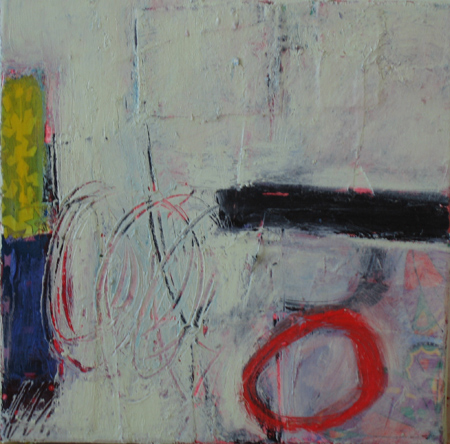
Monday I packed up my paintings to go to Denmark. It was a hard decision—what to send. At the last minute, on Tuesday, I pulled a few paintings out, rearranged the boxes and felt better about the selection. So my paintings are in flight over the ocean. And I follow next month!
I’ve been totally obsessed for the past few weeks about the shipment. Making sure the paintings went well together, complimentary and enough variety in colors and sizes, and dry enough to send. Once everything was packed and out of my house, I felt that empty, lost feeling I’ve often felt after an exhibit is up. Then, appropriately, I received an email from another artist, David Hinske, who happened upon my blog and then my website when he googled “post-show depression” (which he was experiencing after a very successful exhibit). It felt good to connect to someone else feeling that same strange feeling.
But the next morning I decided to go into my studio and clean up the big bad mess I had made from so much painting and packing. I did some cleaning and then, just couldn’t resist, started painting. So much for my post-packing lull! Just can’t keep away. The best cure for me is to paint. I’m stuck with it!
As David wrote me this morning:
Not exactly on point, but I'm paraphrasing Van Gogh who said something like the only way to get past painter's block is to paint. Isn't it an amazing thing to watch the picture take form? Even when I'm not painting well, it is still transporting. O'Keefe claimed she never started a painting until it was fully and completely formed in her mind - we all come at it very differently.
That’s very true. I prefer to be surprised by what happens during the process of painting. Not know until it’s finished what that particular painting wanted to be. And also—preferably pleasantly surprised by how they will look in a new space.
This past weekend I taught a workshop in Clare, the French shore of Nova Scotia. It was a wonderful, enjoyable, exhausting experience. I took Dahlia with me, my talented fifteen year old friend and student (she’s been taking classes with me at NSCAD for four years).
Friday night I gave a talk on my work, using slides to show an almost fifty year painting career. (How did that happen!?!) It’s always interesting to see again what I have done, where I began, how I progressed. And how I've come full circle from where I started, only with more understanding of what I am doing. The group asked lots of questions and I talked a lot. Talked a lot. They talked; I talked.
Saturday morning I talked a lot about color and then gave some color exercises. The first was to rule a piece of paper with six one-inch squares across and six one-inch squares down, giving thirty-six in all. The challenge is to fill in all the squares with color in such a way that no color dominates, pops out. Then I had them do some free form color studies using solid color papers cut from magazines. The afternoon was talking about pigment sticks or oil bars (what I use) and some work with them.
By the time I left I was tired and feeling satisfied. Teaching a workshop is good: I go there, teach, and leave. No grades to mark. I like that. It is so hard to put a grade on creativity, art production. In the greater scheme of things, a grade is meaningless.
Then we went to Annapolis to visit Wayne Boucher and his family. Annapolis is a hopping place. There’s always something happening there. The weekend before it was a benefit for the Public Gardens. This time they were having an International Feast Night as a fund raiser for some charities. The food was Mexican, the art was local. I came home with a car full of animals: a wood-cut rabbit, a photo of a puppy in Thailand taken by a twenty-five year old who is part of a My Photo project, a dog from Wayne’s dog series and a “spiritual giraffe,” also by Wayne. Then I picked up my own dog (at her doggie resort), whom I missed very much.
Yesterday I was on the end of a yo-yo string. My friend Mindy called me in the early evening to tell me that mandatory retirement had been made illegal in Nova Scotia. With a few exceptions: firemen, policemen, etc. At first I felt hesitant. Do I really want to go back to teaching? It’s been so amazingly fruitful, and peaceful, not teaching. Having so much time to paint, think, walk with Lila, meet neighbors. But of course, I was excited about the idea of a steady income, spending time with students, talking about art to budding artists. So yes, I was happy about it. Then I checked on-line at the CBC News site. The exceptions to the rule included Collective Agreements. Which, of course, meant me. So no teaching job. And to tell you the truth, it doesn’t feel bad. Not right now.
Today CBC News on-line had a very interesting article about retirement.
Retirement is big business for banks. Bankers believe people hate their jobs as much as bankers hate theirs, so they set out to convince people that retirement - Freedom 55 … Take This Job and Shove It - is the solution to worry and the road to happiness.And yet, and yet … many people enjoy their jobs and dread being forced out of them merely because they have turned 65, which is a lot younger than 65 used to be in the 1920s, when pensions began. Someone turning 65 today is expected to live another 20 years.
It has been shown that those with the most education tend to enjoy their work and are reluctant to be turfed out at 65. Do you think for a moment that when Margaret Atwood turned 65 - on Nov. 18, 2004 - someone told the illustrious Canadian writer, "Jig's up, Atwood. No more novels for you."
"But… "
"Sorry, Peg, you've been at this game a long time. We need to make room for younger writers."
Yep, age is everything. To some people.
I’m going to Denmark! Imagine that! Wow! And all because I had deer in my garden. I met Elin when she googled to find a cure for deer in her garden (June 2005). She came up with the recipe I had posted. Then she said: “Could this possibly be the same Leya Evelyn who shows at the Agnes Bugera Gallery in Edmonton, Alberta where I am about to have a show?” The rest is history (which includes a lot of emails and sending photos back and forth).
Elin arranged with Galleri Saltum for me to exhibit a few paintings there last summer. My solo exhibit this year is June 4 to June 26 with the official opening reception June 10. And of course, I’m going over. I’ve been working on flights and to my surprise, it is cheaper to go to Europe than to Montreal or New York! And VERY easy (and inexpensive) to get around there. So of course I am going. (I know, I’ve said that before and I will probably say that a few times more!) For two weeks in June.
Meanwhile, when I can keep my feet on the ground, I’m stretching and priming canvases, putting on the collage elements, preparing them to paint. It’s hard, this part of the process. My hands are eager to put paint to canvas. I have enough work ready to send to Denmark (and a few more) but there is nothing like actually painting. Soon.
Also, my hands are itching to get into the ground and start gardening again. The soil looks so tempting. But it is still below freezing at night. A bit too soon to play in the dirt.
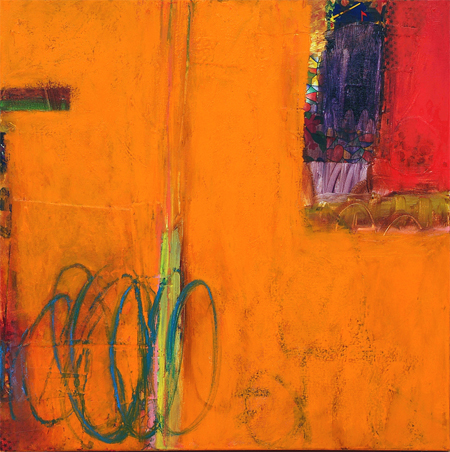
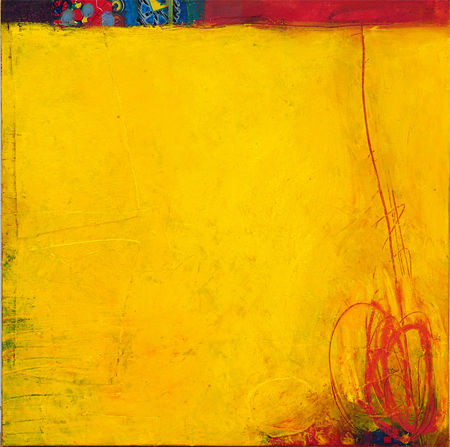
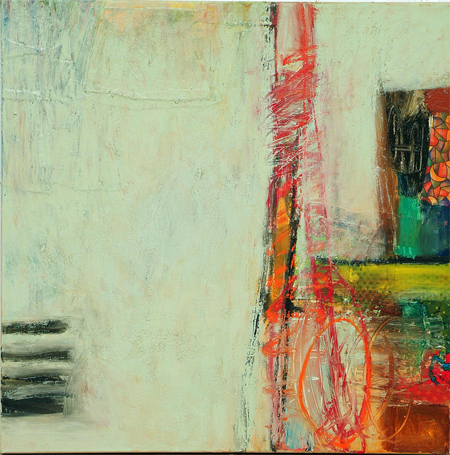
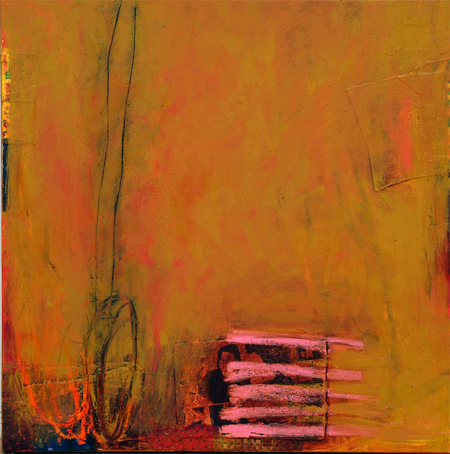
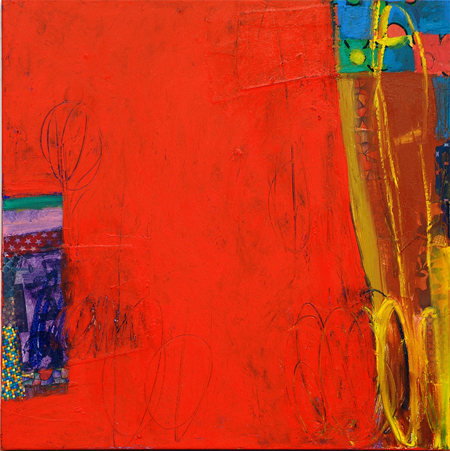
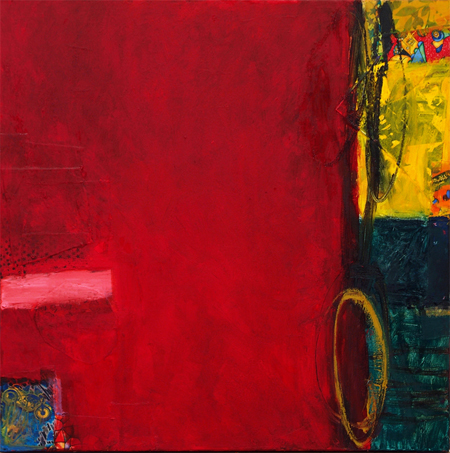
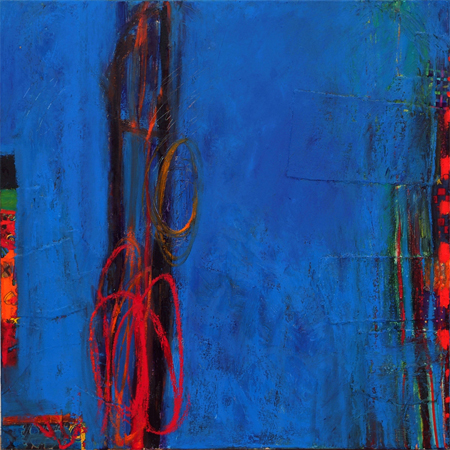
I'm plowing along through the 30" square pieces. It's very exciting working on so many at once (twelve!). It gives me the opportunity to experiment more, to try out images and painting ideas without the pressure of making the painting "work." It's almost like it was when I worked a lot on paper. But I enjoy canvas so much more, so it is even more exciting.
Yes, I guess I am more relaxed, even though the financial stress continues. I just don't think about it too much. I'm doing everything I can to make this "retirement" work. Teaching is much more stressful than anyone can say. Just not having to get up early and be on the road by 6:45 am no matter the weather is a relief. I'm even sleeping much better. Although sometimes I have dreams about being asked back to teach and feeling torn. I don't know what I would do if it happened soon. I feel I'm just getting started on a very real journey to some place I've never been before.
My exhibit in Denmark is scheduled for June 6. so now I have to start thinking practically, about what would look good there, what sizes, etc. Yesterday and today I started working on about six 30" x 30" paintings. When I start them I don't have a solid idea of what color they will end up being, but when working for a show, especially, I need to have a variety. I started one this morning that looks like it wants to be green. I've been told several times by various art dealers that green is a hard color to sell. But if the painting wants to be green, it will be. Time will tell. We will see.
When I've done multiple panel pieces before that aren't just vertical but need nails in the wall, I've put nails in, but if I do use four of these canvases in a multiple 60” square, the pieces will be heavier, being 30", not 20" square. And even those, the 20" ones fell down sometimes. But I guess that's just the chance I have to take if I'm going to do it. So far, I just want to get some 30" square pieces on their way so I can have a better idea what I might show in Denmark. I'm really excited bout going there.
We’ve been having real winter weather for the first time this year. Snow, rain, cold, and icy road. Our dog class was cancelled last night. Thankfully. Besides the snow, one of her dogs is about to give birth so she wants to stay home. I was relieved. I stayed here today too, cancelled my piano lesson. Environment Canada said to stay off the highways if possible. The roads are not nice. There have been a lot of accidents. Another day to stay in and paint. What luxury!
I've been busy gluing pieces of canvas and fabrics onto my new blank canvases for the past week. This morning I was able to put some paint on the canvases, It felt so good. There is so much to do to get ready to paint. It's always such a relief to start painting for real. But I love the anticipation, of what might happen.
I think I'm going to try arranging four 30” x 30” canvases together into a 60” square. The only problem I foresee is how to hang them while I am working on it. I'll have to put nails in the wall and hope the paintings don't fall down while I’m painting.
Without teaching, time feels so different. Bigger, broader, more air in a day. It feels good. More time to paint. More time to worry. (But I'm working on not worrying!) I’m finding time itself very satifying. Just time. Very real.
I went to see The Freedom Writers this afternoon. I’ve never cried that much in a movie—ever. I was choking on my tears, trying not to make noises. The friend I went with didn’t hear me, thought I was sitting there stone silent, unmoved. Just shows how well I can hide my feelings, really. The movie was so good, the story, the acting. Very inspiring. Makes me wish I was still teaching, having some effect on how people approach their lives, their work.
And give up my new time—not yet.
Finally, studio time. Last week I was able to begin the first stage on some canvases, the collage part. I bought a dozen 30” x 30” canvases and a dozen 20” x 20” as well as some 12” x 12” before the holidays (they were on sale at Loomis!). So I have a lot of prep work to do. A friend was here on Saturday and suggested I put the 30” square canvases together in a group of four, making it 60” x 60”. Interesting idea.
Today I was able to put paint to canvas for the first time in almost a month. But only on some pieces I had almost finished previously. It always amazes me how much more clearly I see the work when I have been away from it for a while. One piece I had been struggling with for weeks, just told me quickly how to bring it together. And it worked.
Last week Linda Fairchild, my gallery owner from San Francisco, brought someone here to my studio to look at my work. (Linda has family in Nova Scotia so I see her here a few times a year.) The woman she brought responded well to my work and ended up buying the first piece she looked at. While we were talking, she apologetically told me there was one thing that was disturbing about the piece: the center line, down from the top, looks like an open wound. I said, yes, I know. Then she said it also looked to her like female parts. I said, yes, I know. I just couldn’t paint it out. It seemed to belong there. She bought it. Her boyfriend loves it. And I’m glad it found a good home.
Below are photos of Jackie's studio and of her. Her studio is so different from mine. It's much more organized. Or maybe she just straightened up for my visit. I love going into different artists' studios and seeing how they work, how they organize, what materials they use. To see work in progress. I always find it inspiring. Creativity is infectious.
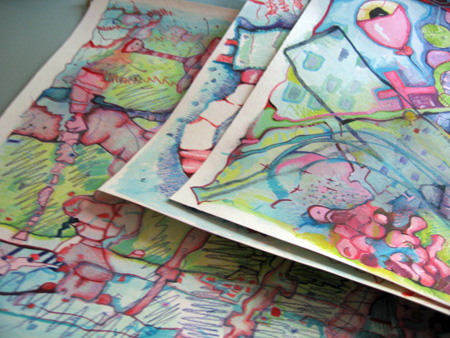
The last day I was in Ottawa I went to visit my friend Jackie. She was a student of mine a few years back. We got in touch again some months ago when she emailed me after seeing a video I was in on TV. It was being aired on BRAVO. A production company in Moncton, New Brunswick had given me some music composed by a musician in Manitoba and they had given him a painting of mine. (I think it was in the summer of 2002.) He was to create some music to my painting and I, a painting to his music. It was a lot of fun. They had shots of me in my studio painting, some talking about my work, and also some swimming and boating. Ultimately, I didn’t like the painting I did, so it has gone through many changes and become something else.
It was so good to see Jackie again, to see she is painting a lot, very good work. It’s exciting for me to see students mature, especially if they are still making art. I think I’ve mentioned the statistics before. But, here it is again: of the graduating class, ten years later, 10% will still be making art. Of those 10%, 10% will be making over $10,000 a year from their work. Roughly, 1% succeed financially. The rest? Good question! It’s not an easy life, trying to make a living making art. Teaching is a good gig. Nice work, if you can get it. (And keep it.) Given the proliferation of galleries in Manhattan, it feels like more than the 1% are exhibiting.
Most artists need a good “editor” in the early years. And maybe later too, come to think about it. I suppose that is what school is, but that kind of mind needs to become part of the working process. So many times I have thought I had a really good painting only to look at it the next day and wonder what I was thinking. The real test is, as always, time.
I don’t mind being away from my studio at times. It is nourishing to be in another environment, especially with my children and friends. Making art is a twenty-six hour a day job. And I take it with me wherever I go.
From my aunt’s apartment in the Village, I went to the Museum of Modern Art. I was eager to see the Brice Marden exhibit. I had always loved the richness of his encaustic monochrome paintings of the sixties and seventies, the sensitivity and strength of them but have a harder time with the snake-lines of the eighties and nineties. Seeing them in person was more rewarding than from reproductions, of course. Seeing how he searched and discovered the painting, seeing his painting process. But I came away feeling that it’s time for him to move on. I want more. I want that early richness in his paintings to come back. (But then, I do love density, intensity.)
In my painting life, until I moved to Nova Scotia in the early 80’s, I found I changed my working methods about every four years. I covered the bases until I finally came home. Tried all kinds of media and methods. Once I started incorporating collage into the paintings, it has been more of a straight line towards a still unknown goal, a search leading forward, not sideways as it sometimes felt. But the interesting thing to me is that when I look back on my early paintings there is so much there about what I am doing now. The same intense interest in color, in an active color field, in gestural lines. With Marden’s work, the shift he took from a solid color field to snake-like lines came after ten years of what he considered a creative abyss. I’d love to see the work from that period. So much can be learned from what doesn’t work. It would be so interesting to me to see how he came to where he is now.
From the museum, I went back to my friends’ loft in Soho and hung out for the evening. Had an amazing meal, reminisced and caught up on our lives. I lived on the floor below with Tamar, Aaron and our golden retriever, Miranda for a few years. That was about twenty-five years ago. We were young and liked to party. Many memories. I don’t mind getting older. I just don’t like my children to get older too.
Tamar met us the next day and we had a nice lunch in Soho. We will all go into the city again, probably Wednesday. Meanwhile, I’m feeling very laid back, enjoying the lack of pressure, not making too many plans.
There is a bit of glamour in saying “I am an artist.” Everyone wants to be an artist. Why not. It’s a good life. Creating, using the imagination, massaging the spirit, as a job. In school we were encouraged to say, “I paint.” More modest. But it takes great confidence to make art, to keep going. Not to doubt. Even when the work is not going well, not becoming what is wanted by oneself, by the public. That’s when it is most difficult to be “an artist.” I have a friend who is very ill with advanced cancer. She uses all her available energy each day to paint. Her work now is acrylic on paper, and very exciting. I already knew her for quite a while before she was a student of mine at NSCAD. I and the other students consistently admired her work and especially her integrity. Her work was about searching, seeking and finding. She has abundant talent, always did interesting, exciting work, yet she was also always doubting herself. But it has taken near death for her to tell me she finally is confident she is an artist and has been all her life. I always found her directness and questioning admirable. But too much doubt is unhealthy, especially in the production of artwork.
I’m very lucky, live well. I’m able to do many things other people of my income level can’t do, just because I am an artist. I pay for my massage with artwork. My vet too takes art, as do many other services. I’ve had haircuts and clothes and garden help for paintings. If only the gas stations would realize they need art on its walls to bring in more customers. If only the grocery stores would understand how important art is to nourish their patrons. If only. . . So far I’ve managed to land on my feet. I left a difficult marriage with two children, a fish tank, two cats (who quickly became eleven then three), and then added a dog and another fish tank. (I’m sure there were some gerbils in there too somewhere.) Moved with this menagerie around Manhattan and with one child and one dog, to Nova Scotia. . . with major immigration hassles and no job.
Right now I’m about to open a new door, one I’ve never seen before. I have no idea what’s behind that door. Perhaps it’s a tiger. Maybe a lion. We will see. Soon enough. But I’ll always be painting. I have no doubts.
Some paintings come easily, some not. This painting was first one pale yellow five feet high, three wide. It was boring. So then I added the two side panels, each two feet wide. They were more exciting so then I worked on the middle panel and changed the yellow altogether. The end result, from there:
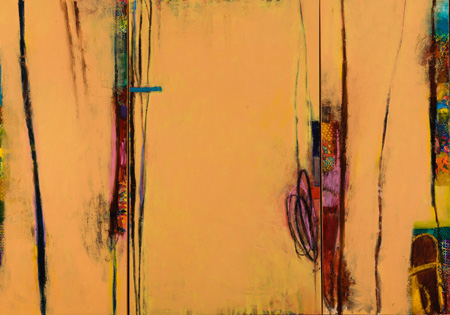
to here:
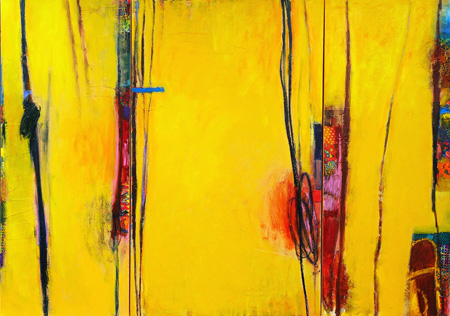
I don't think I will make any more changes on this one. This is it!
Sometimes making art is hard work, a struggle, work. Those paintings, when I stay with them, eventually bring great joy. Or they get put in a corner for bad behavior. Yet sometimes a painting just paints itself. I don’t feel I have too much to say, it just happens. I don’t know where it comes from. It just does. It exists on its own.
Like the five panel piece, this one also painted itself. Those images at the top are new and not new. They've been in other paintings, but I usually paint them out. Here they demanded to stay. So that's were they will live.
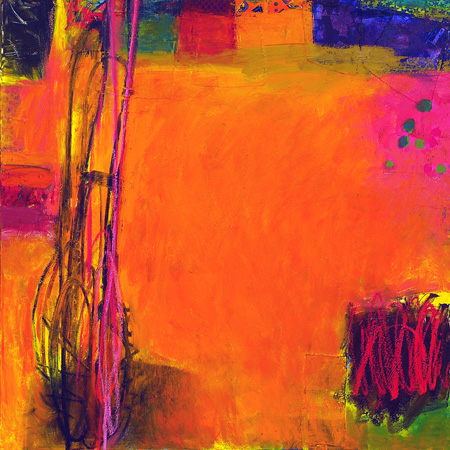
A few weeks ago (November 14) I posted a photo of a painting I was working on. The five panels work well together even though they are each so distinctly different colors, something unusual for me. The response I received to the painting was overwhelmingly “don’t’ touch it; don’t do any more to it.” But I have, of course. It was just the beginning stage, and yes, it did look good but it was not yet where I wanted the painting to be. (I may still do a small bit more to it, but it won't be a noticeable/major change.)
I thought a lot about why people wanted me to leave the five panel piece as it was and why I didn't want to. Mostly it was about the sense of mystery that I felt it needed. It was all too obvious. I liked it too but there is a level of complexity that I look for that wasn't there yet. I'm excited about the final painting and don't think it has lost any of the qualities it had before, the spontaneity and excitement, but has even more to it.
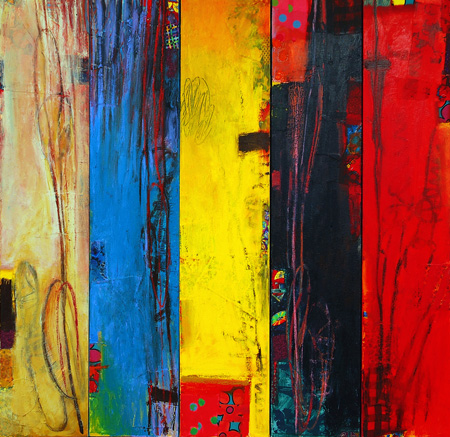
A bit hectic lately. I have a lot to do in the next few days. And then I go away. This seems to be the pattern. Every time I schedule a trip, my life here intensifies. I need to pack up some paintings to send to Switzerland by Wednesday. She’s having a Vernissage December 1 and is very eager to get some new work from me. But before I can send anything, I must go to Truro on Tuesday to pick up it up. Some of the paintings are here in my studio. I wrapped them up today. I also need to get some work back from the gallery in Annapolis Royal and include that in the shipment. So It’s going to take a bit of coordinating.
I think I will be very happy to get on the plane on Thursday. This trip is pleasure. I’m going to Cleveland to visit my sister. Tamar and family are coming too. They are bringing my sister’s son who lives in New York. Her other son lives in Cleveland with his wife and three children. It will be a big family Thanksgiving. A welcome change from the next few days.
Right now, this morning, I've started (finally, after much thought and preparation) a painting composed of five 5' x 1' panels. The size, and idea, were given to me last summer by my Independent Studies student. (Her's was horizontal; mine is vertical, of course.) I'm making each panel a completely distinctly different color from the others. It's looking good. For most of my creative life, I’ve been giving each painting a solid field, one color. This is quite a change. I can see more areas of solid color blocks (in contrast to, or laid into, a solid field of another color) coming into all my work lately.
The other paintings I’ve been working on are 46” x 46” and a lot of smaller ones, 20” x 20” and smaller. I'm planning on sending them to Switzerland soon, along with some 30" x 30" that are in the Truro show. (I pick those up on the 21st and am looking forward to another walk in Victoria Park with Lila when there.) Switzerland seems to like the bright, primary colors. That's fine with me. I like all colors now, but especially the bright ones.
I've also been doing a few very dark ones, ultramarine purple or indigo. It's very satisfying for me. I would feel stifled if I couldn’t do a full spectrum of colors. Light, bright, dark, and everything in between. I'd love to do more all indigo and purples (and probably will) and maybe exhibit them all together, all the “dark” ones. Sometimes I think I would like to have a show of all red paintings. That would be interesting.
I’m hoping to get some good photographs taken soon. My studio shots are so lousy. But here’s one of the five panel piece (in progress, just the very beginning stage) anyway:
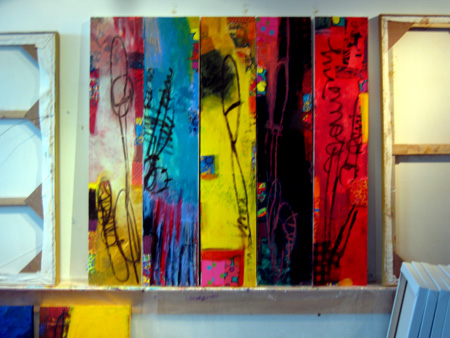
One of the more interesting things about my exhibit at the Marigold Centre was (while Lila was running around amusing us with her squeaky toy) seeing how the room expanded when the paintings were on the walls. The room itself is quite small for a gallery. Fifteen feet by twenty-one. But once the paintings were in the room it felt quite large. It was a major transformation.
Here are photos of a few of the small pieces. These paintings are six inches by six inches. Each painting is complete, not a study for a larger painting. In fact, they wouldn't work on a larger scale. They are what they are:
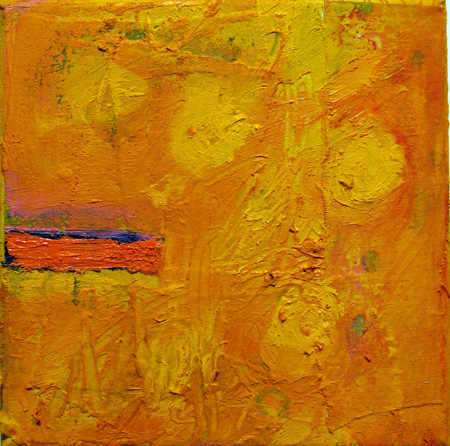
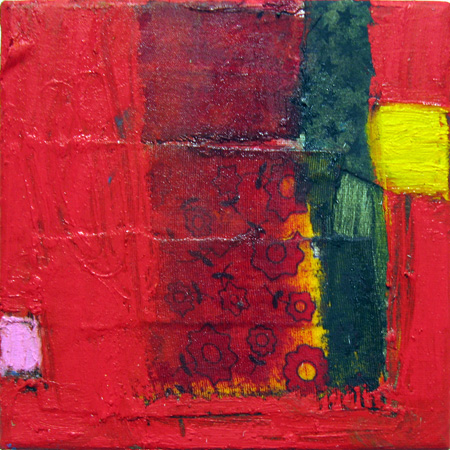
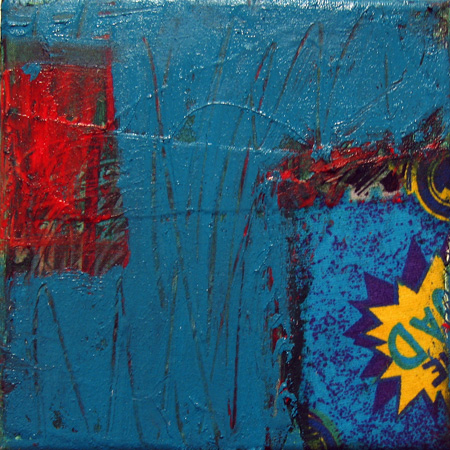
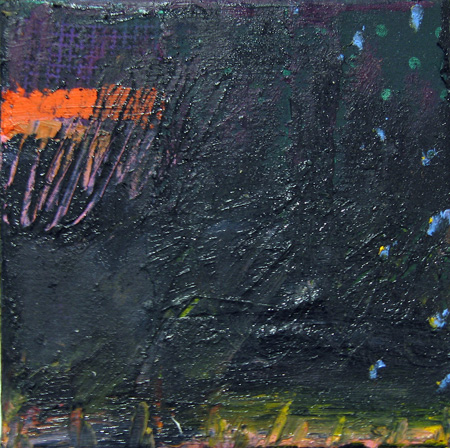
Tuesday morning at 8 am, Lila and I left here with my Element loaded with paintings. When we arrived at the Marigold Arts Centre in Truro, we unloaded the paintings (we being the people at the Centre and—Lila helped by entertaining everyone by being so very cute and lively.
While the crew were hanging the exhibit, Lila and I went to Victoria Park for a hike. It was a stunning autumn day, sunny and crisp. The trees and scenery were spectacular. The park is so beautiful (a thousand acres) I wanted to take it home with me.
Later in the afternoon we went to Sarah Campbell’s (the curator of the exhibit) home for an early dinner (she’s a great cook!) before the opening. She has a nine month old Golden Retriever. Needless to say, Lila was in heaven all day.
The exhibit looked great. I included the nine panel painting that was in the Anna Leonowens exhibit in June. I thought it would look good on the end wall. And hope that other people will be as enamored of it as I am.
Here are a few photos of the exhibit:
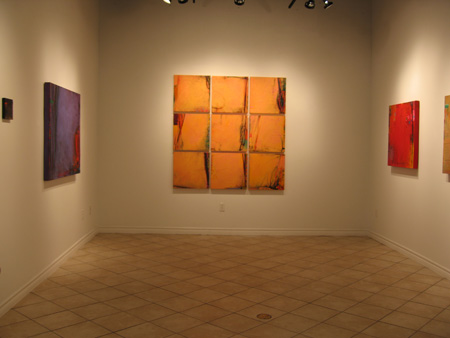
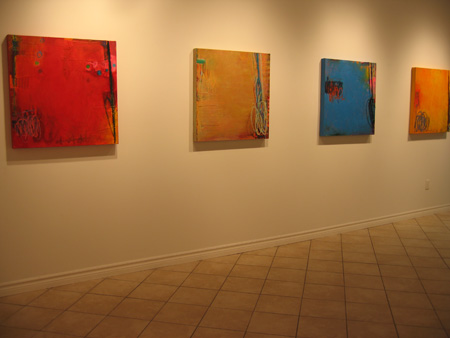
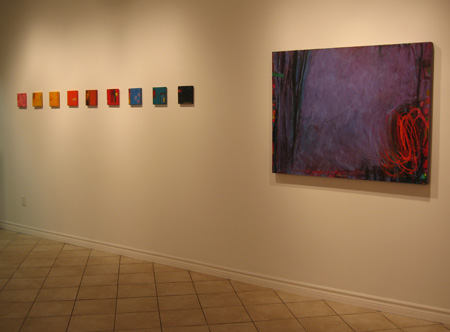
For the last few months I’ve been incredibly busy thinking (and not writing) but I do feel I will get back to it very soon (in fact, probably after tomorrow). But tonight I am off to an obedience class with Lila (she’s made it to the advanced class!) and tomorrow Lila and I travel to Truro, NS for an exhibit of my paintings at the Marigold Art Centre. We are taking the work in the morning, we’ll hang out in parks, and then dress up for the evening event. (I suspect Lila will be staying in the car at that point!)
If you are in the area (one hour north of Halifax), do stop by. The opening reception is at six pm. The show will be up until November 20th, I think.
I had an interesting visit today: a couple from Germany. They’ve been touring Nova Scotia in a rented RV, are taking a plane tomorrow to Montreal, and then a boat back to Germany. My parents did something like that in their early sixties. They took a boat over, bought a Volkswagen bug (before they were popular cars here), tooted around Europe, camping most of the time, and then flew home. They had a wonderful time. I think they were away five months.
This German couple saw my work on the Studio Rally Map (a map of artists in Nova Scotia), and stopped by. They are interested in buying a very recent painting, a diptych, 36" x 48". I will ship it to them when they return home in a couple of weeks. If they decide it doesn't work in their house, I told them they could ship it to ship it to my gallery in Switzerland, or to Denmark, or back here, but I do think they will want to keep it. In which case, there will be no problem!
Their English was not bad, certainly understandable, although often they conversed with each other in German, and then translated for me. At times we would search for the right word together. I enjoyed their visit and we plan to meet again either at my show in Switzerland next year (November 2007) or when I go to Germany at that time, or both. The funniest part of this was that I almost didn't answer the door. She had rung the bell at my studio door and I thought it must be a solicitor, someone asking for a donation and I just didn't want to hassle. But Lila was making such a racket I thought I would send her out as ambassador. I'm glad I didn't listen to me!
All those (many) times when I paint with no definite exhibition near, just paint because it feels right, make sense on days like this. It’s Canadian Thanksgiving today and I have a lot to be thankful for.
The last couple of days I’ve been stretching up canvases. The paintings I’ve started recently are too wet to work on. So this gives me time to look at them and think.
I’m preparing the one foot by five foot canvases inspired by my student last summer. The ones she did were put together (all five) horizontally. It made sense with her work but I am feeling that, for me, as usual, the canvases will end up being vertical. That is one habit I’ve tried enough times to break but don’t think I will this time either.
I taught a workshop all day today. It was advertised as Color and Abstraction. It's been a beautiful clear sunny day, perfect for gardening. Nevertheless, it was a good experience. I began by having everyone draw a circle and put in colors that, to them, were harmonious. There is no right or wrong, good or bad here. What was obvious was that no two people (of the twenty there) did the same color combinations. Every one was different. Color is so personal. And so relative. It depends so much on what is around it, how much (amount), where (placement). I then gave them several exercises placing color in squares, trying to have all the colors of equal intensity. Again, everyone had different choices.
In the afternoon I had them work with words (describing various emotional states) rather than images, describing them with color. Several people commented on what fun it was and also, isn’t this therapy. I told them you have to start somewhere. And the point of using emotions takes it away from known objects. From there, to make a strong painting, it has to go beyond the personal. Transcend that. Be able to speak on many levels.
They did some very interesting work, some of it quite impressive. They were a good group. One woman said if she won the lottery she would go to The Art College. I said if I won the lottery I would get a new air purifier for my studio. Another woman told me she had gone to NSCAD many years ago but had to leave because of the toxic environment. She has MS and it was very bad for her health. That was twenty/thirty years ago. For the first ten years of her illness she was in and out of a wheelchair many times. Now she has been in remission for ten years with no episodes. She said she keeps herself healthy with good living and a positive attitude. Depression is the enemy of the immune system. How very true. If only I could have convinced Robert of that. But then, just as with color, everyone has their own path.
Brian also delivered some more canvas stretchers he built for me yesterday. So now I have plenty of work ahead. Stretching and priming, a variety of sizes, but none too big. I really prefer to work on large pieces but need to work smaller right now. Maybe in a month or so I’ll start some larger ones.
Meanwhile I’ve been working on eleven (cheaper by the dozen but they only had eleven at the store so they gave me the discount anyway) 20” x 20” pieces. My gallery in Switzerland wants more bright colors: reds, yellow, blues. Here they seem to go more often for the softer ones. Even though it is more grey here and more sunny there (at least when I was there). I’ve been at them for a couple of days so I’m not sure what they will look like ultimately, but at this point I feel things are changing. Possibly more in the middle, not just pushed to the edges. Definitely more active energy. But then, as I said, there is still more to do so I will have to wait and see.
I did sell a bright red piece to someone here who had previously bought a pale green. This person has an uncanny ability to zero in on seminal pieces, to choose ones where something new is happening. And best of all, he uses my paintings as his home entertainment (rather than having a TV). This is inspiring to me. I call this painting I Am; You Are for obvious reasons.
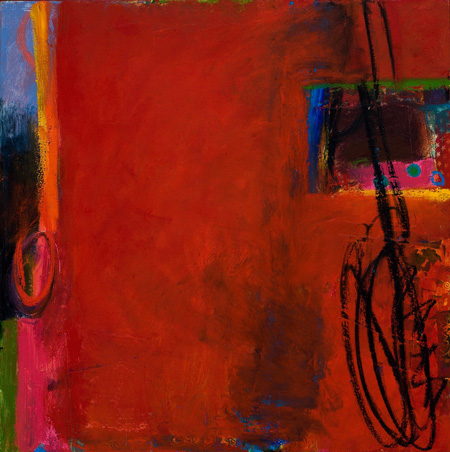
After talking about age (more and less) with my Wednesday class, I told them the curator of my exhibit in Annapolis Royal a few years ago put the comment “now in her early sixties” in the catalogue and my response was “Don’t say that!” And he said I could be a role model for younger female artists. So I said “Okay.”
Conductors are known for longevity, healthy strong bodies and minds. The constant energetic movement must be good for people. The same with art. And I think the state of mind, one of being constantly open to possibilities, to change, to circumstances, keeps the artist young.
Here’s me, playing with paint, in a photo taken last year by my friend Heidi. (I’ve posted it on my website as well.)
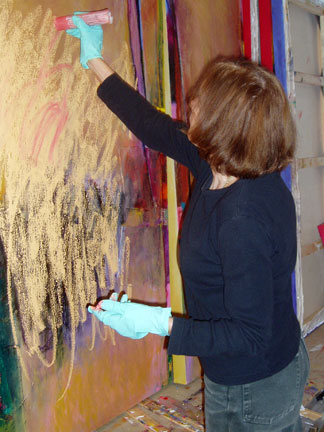
I’ve had three good days in my studio. Three good mornings, I should say. The afternoons have been spent swimming and boating, enjoying the beautiful warm days we have been having. But as I was about to say, it has been good uninterrupted studio time. The paintings are piling up again. Lots of little ones, medium ones, medium large, and not enough large ones. The urge to paint larger just grows. I only hope another opportunity like the one I just had here (at the Anna Leonowens Gallery) arises soon.
Fortunately the paintings are drying faster due to the R&F blending stick with drier I have been using. In fact, I used up all the ones I bought and need to get more. I figured out the stretchers for the canvases are about thirty dollars each so if I were to use my student’s idea (five canvases butted up together), the stretchers alone would be $150. Then there is the canvas and the paint (and I use a lot of that). Even if you don’t count a salary for me (which I don’t get), painting is an expensive occupation. So sales are greatly appreciated. The money just goes right back onto the canvas.
Maybe I need to slow down . . . Not a chance!
Beginning to study jazz piano reminds me of when I began to paint (or try) abstract paintings. It was hard. I knew before I went to art school that I wanted to do abstraction, but my studies in school were all based on learning, using color, to create form, mass and space from objects placed before us, as students. The focus was on color, using it in ways that we choose, in ways that would create an object in actual space—the space part being as important as the object. What I wanted to do was to use the same understanding of the elements without the external references.
People often think abstraction is easy: no image, no thought. But it is very difficult. No image; no references, nothing to fall back on. Just what’s on the canvas. Just the paint itself. When there is something out there, an image to represent, it’s more about the image, even if it is distorted, rearranged, inverted. It’s still a familiar image. There is often nothing familiar about an abstract painting. Except, perhaps, the history that brought it to fruition and, perhaps, emotions it generates. But then, everyone’s emotions are different. There isn’t one “proper” reaction to “no image.”
With jazz I’m having to learn scales again, just like I’m beginning music lessons for the first time. Then there is the basic “rules” of how harmonies work in a jazz piece. Then there is the “putting it together” part. I’m used to reading two lines of music at once, the bass and treble clefs. Here I am given just one line, the melody, and the rest is up to me. It’s definitely opening up some new brain cells. After my first lesson, I thought I could come home a play some jazz pieces. That was mistake number one. I might have some understanding now of what the elements are that make up a piece of jazz music, but I have a lot to learn, AND REMEMBER, before I have any fluency in the process. Interesting.
Although we had (yet another) heavy rain storm last night, we’ve been having glorious summer weather the last few days. Perfect swimming weather. Lila is great fun to swim with. She usually goes from one person to another (when there is more than me in the water) and checks on them, to make sure they are okay. Very reassuring.
Meanwhile I’ve been painting when I can [when no one is here, as usual, because the builders are still painting the outside, although I think (maybe, quite possibly!) it’s the final few days]. After all these years, it’s still an interesting process, seeing the way a painting changes from beginning to end. As always, I have no idea what a painting will look like when I am “finished” working on it. But I find myself wanting not to repeat the same solutions I’ve been using. I can see new, raw elements demanding to stay, not be painted over. And I can feel the impulse to “tidy” the paintings up. Most of the time I can resist, can stay with the new unexpected elements. Sometimes I can’t.
I have an Independent Studies student this semester, a painter. She’s naturally drawn to abstraction (pun intended). She works hard and does some amazing pieces. One of them is an idea I would like to use. It’s a multiple panel piece but each panel is a distinctly different color. Stealing from my student! O my! And she said she wouldn’t mind if I did. There are just so many possibilities and so little time to paint. Sometimes I feel like I am just starting to figure it out.
Tomorrow is the BIG DAY: a friend is coming over to help me clean up my studio! Because of all the rain, my house is still being painted (on the outside) so there is some paint in my studio that isn’t for my use. But we can work around that. There are lots of things that need to find a proper resting place—plastic wrap, bubble wrap, work clothes, rags, etc. Once bookcases are moved back and storage areas sorted out, my studio will be more useable.
Nevertheless, I’ve been carving out little spaces and little times to paint. Whenever no one is here [i.e., weekends and rain days (of which we have had plenty!)], I’ve been in there working. I’ve started some medium large pieces and some very small ones and some in between. As usual, the beginning stages are exciting. And I have no idea where they are going. But it seems they are going well.
I shipped off ten paintings to Denmark (Gallerie Saltum) last week. Two 46" square, three 20" square, and five six inch square pieces. So I have to replace them! With such a long, frustrating period when I couldn't get into my studio, the energy has built up and is bursting to get onto canvas.
Last Friday I went to Annapolis Royal. I had some work in a group show at the Leslie Erickson Gallery. I hadn’t wanted to go. It’s a long drive and I had to teach in the morning, from 8:30 am to 12:30 pm. But it ended up being a memorable visit. I stayed with Wayne Boucher and Terry Roscoe. Lila was a good traveler and an energetic guest, terrorizing their dog and cat and looking for trouble in every corner of their house. But they are very relaxed people and it was contagious for both Lila and myself.
The exhibit was good; the opening reception crowded and lively. I enjoyed meeting the other artists, seeing new work. After the reception some friends of Wayne and Terry came over. The next day we went to their friend’s house and swam in the lake. And later had brunch. By the time I left I felt very mellow. Sometimes I don't realize how tense I've been until I relax!
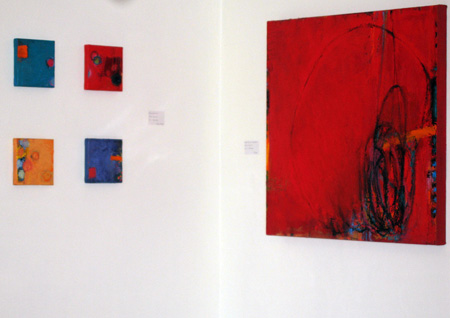
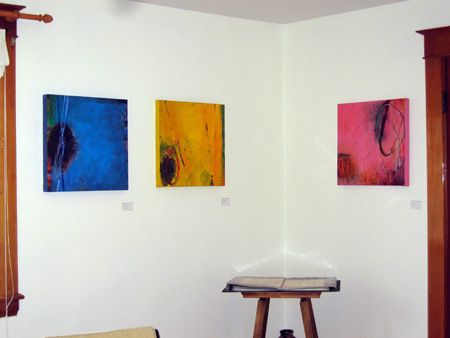
Some reasons why I enjoyed being there:
Galleri Saltum, in Denmark, just wrote me to say they sold all five of the paintings I sent to them just a few months ago! Exciting! (This is the gallery Elin Neumann so generously connected me with!) So now I can send more paintings over. Great inspiration to paint! (This is the kind of enterprise where profits go right back into the business!) I’m so glad it is the weekend and no carpenters are around. (They really are almost finished and it looks wonderful!)
Meanwhile, here are a few photos taken by the NSCAD University photographer of my exhibit there. I like the way she set up the room. It feels like it did during the exhibit.
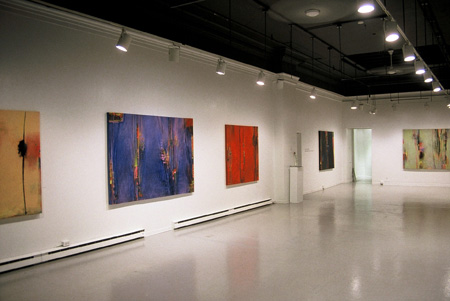
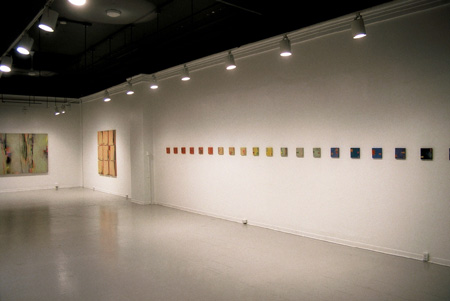
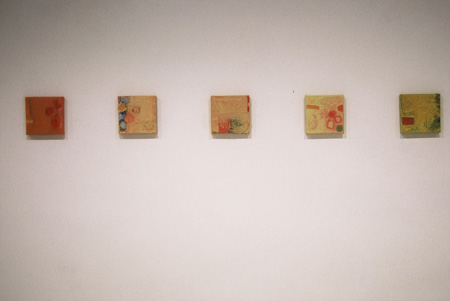
It’s been a productive Canada Day weekend. Four days in my studio! The first intensive stretch of time I have had since my house has been under reconstruction. (They are not finished yet because of the endless rains we have been having. Three times the usual amount in June!) Because of the long weekend, no carpenters were here so I was a happy painter!
Friday D. came out to help with the preliminaries. I had primed about ten canvases of all sizes. We glued pieces of (silk-screened images on) canvas and fabric onto the stretched canvases. I really enjoy her curiosity. At one point, she asked me what I think about when I am choosing pieces to glue onto the canvas. I, in my usual terse way, said “Nothing.” But she persisted, saying, from what she knows about design principles, I am definitely thinking about something. Because even before putting paint to the canvases, they look right (a right mixture of balance and tension). So, I must admit, I do think about things. I think about what the bare canvas looks like as it is filling up with pieces of images and various shapes. And I think about what it might look like with these pieces and shapes underneath a layer (or three or four or more) of paint. So there is some foresight involved at every step of the way. I do know what I like to have happen, ultimately, so I put things down that will most likely lead in that direction. What I don’t know is how it will end up: what will stay and what will be buried. And the process is very intuitive. There is no script.
D. had wanted to come watch me paint from the very beginning of the process to the end, to see how I work. But I couldn’t do it. The first steps I go through, when starting a painting, are just too personal to share with anyone. What I put down with paint at the beginning is for no one but me. Along with putting down some colors and possibly drawing some images, I write what I am feeling at the moment, words that come from the images, from things I am thinking. Random thoughts and feelings. I do not censor or challenge them. I don't make them nice if they don't want to be that. It forms, for me, a very personal relationship with the canvas. It’s my secrets revealed, but only to the canvas itself. From there, I transform this intimate beginning into something that is not me, not mine.
Of course, the carpenters are coming again tomorrow and they walk through my studio to get things they need to store there (there really is no other safe place for their tools) so I have to place the canvases with their faces to the wall. I hope they (the paintings) don’t mind. It will just be for the next few days. By the weekend, when the carpenters will not be here, I will have some time to release them. Then, perhaps, I will be ready for D. to see what I am doing.
.
Over the past couple of weeks, with no new paintings started and an exhibit up, I’ve stretched and primed ten canvases. Tomorrow I begin putting the collage onto them. Then I can start the painting process. It’s been a long time since I started a fresh canvas. Faced a blank one. The usual post-show ungrounded feeling has kept me feeling keen to begin painting again. The builders have been back again this week, to finish up some trim. They won’t be here for the long weekend so I have some solitude and time to get back into my studio.
It was interesting how obsessed a few people were (when I was talking in the gallery on the 21st) with what I write on the canvases. I’ll never tell. It’s only for me. One person asked if it was like Method Acting, getting myself charged up to paint. I don’t think so. I am always charged up. It’s only a very personal approach to beginning painting. It’s my response. For me. Ultimately, it’s taking a very personal relationship to the artwork and making it universal. The end, the final painting, is not about me.
Another person asked if I ever feel fear when facing a blank canvas. No. Never. I am so eager to paint. And I’ve been doing this a long time, over forty-five years. At the beginning I did feel fear and in those years I was able to achieve very few satisfying paintings. Over time it’s become a very natural thing to do. Like breathing. Usually the expectation of possibilities is a prime motivator to get something, anything, down quickly so I can discover what is going to happen. So, I’m looking forward to the weekend.
I have had some problems receiving comments recently. Tamar and I tried to limit the comment spam but it backfired. Real comments (not spam) were being loaded into the Junk folder. She’s fixed it now and also retrieved some that might have gone unnoticed except for her vigilance. (Thank you, Tamar!) So. To answer some of Jackie’s questions in her comment
So is this proof that a problem painting can be resolved? Have you ever had a painting that drove you bananas from start to finish and then still haunted you?
Yes! But usually I can wait even if it takes a few years to resolve them. That happened with the nine panel piece in this show. I thought it was finished a couple of years ago, but mostly because it was driving me nuts and I wanted it to be done! And I had an opportunity to exhibit it. So I did. But never quite liked it. Now, two years later, after working on it for several months after that exhibit, I do really feel good about it. And am glad to have another opportunity to show it in it’s maturity.
And some technical issues Jackie asked about: I use a Black & Decker heat gun. It has variable heat and different nozzles. With all the rain we had last week, the painting didn’t dry as well as I would have liked. But it was serviceable. I just bought some blending sticks with drier in them. Of course I forgot to use them when I was working on the big blue painting a week before I had to put it in the exhibit!
My oil sticks are the R&F Pigment Sticks. Very pricey but worth it. (I should get a commission: I've turned so many people on to them!) They are so beautiful, the colors so rich. Sometimes it seems like they don’t really dry completely, although the company says they do. Some colors dry glossy, some matte. Some colors take months to dry, some days. I keep a list of drying times posted so I know what colors are best to put down first, but often I am too impatient to mind my own advice.
I gave a talk about my work at the gallery Wednesday. The director of the gallery, when hearing me tell about how I rework pieces, said “So then, it appears you are a very prolific painter, but in actuality, it’s the same paintings reworked being exhibited!” Sometimes, yes! But usually, no. What seems to be happening, which makes me feel very excited, is that I can resolve a painting much sooner and with more certainty than ever before. My vision and decisions are closer, know each other better. It’s a better marriage. And the result is more immediacy (and to me more power) in the work itself. But of course, it does result in a lot of paintings ready to find homes!
Been down with a bad cold. Bummer. It started Monday evening with a bad sore throat and blossomed Friday when I had to teach all day. Two classes. My own in the morning and a friend's in the afternoon. (She had taught for me when I was in NYC.) I think I did okay. A burst of adrenalin got me through the afternoon. It was a screen-printing class. I had done some prints with the instructor and I focused on transferring an image/idea from one media to another. I showed slides of my work and also brought in my prints and told them what worked and what didn't. I enjoyed it but was very happy to go home and put myself to bed!
Because I was nursed on Abstract Expressionism, for many years I thought each painting had to come from an original impulse. No preliminary planning, thinking, drawing. Just spontaneous insight. When I was offered an exhibit at the Henri Gallery in 1981, and I had no paintings, just some new handmade paper pieces, I agreed to the show and told her what paintings I would exhibit. Described them in detail. She never knew that I hadn’t been painting on canvas for at least a year. So at that time I used the paper pieces as mockups for the paintings. I tried to transfer the images directly to canvas. But the change in texture made it a challenge. For the most part, they were successful.
The next time I decided to do something like that, I didn’t keep the original colors. By changing the color, I was able to keep more freshness in the paintings. Now I find I can use an idea/image but it is best if I use it only as reference point, not as a literal translation. For that reason there are a few pieces I continue to like to have around as source “information.” They are usually pieces that are successful in a way that I can still learn from. Maybe that’s what I like so much about making art: it is a continual never ending process of discovery.
The reception last Monday was exciting. I was a little nervous, yes, before I walked into the room but I was so happy with the installation, nothing could have marred it for me. For the first half, the room was very crowded and buzzing with talk. Then it thinned out a bit. When I left the gallery Monday evening, my voice was hoarse.
During the reception people were picking favorites, naturally, and often asking me which one (ones) is (are) mine. I must admit, I prefer the largest ones. There is just something about the freedom they give me. Another comment I was asked frequently is if the color spectrum of the small (six inch square) pieces was planned. No, it wasn’t. It just happened because I had wrapped them that way (all the reds together, the yellows, etc.) and when I unwrapped them, they lay on the floor in that perfect order. Nothing was moved. They knew where they wanted to be without my thinking about it. And there was a perfect spectrum because I usually do paint thinking about a balance of colors in the sizes I am working with. So many reds, so many blues, etc. Otherwise all my paintings might be red! But honestly, I like to balance the colors I use rather than becoming too weighted in one area.
It did take a little bit of thought where things would go overall in the room, but once my (wonderful) helpers made the suggestion we used, it was easy to see it was right. I'm not good at those kinds of decisions. I can tell if it is right, if the painitngs are shown to their advantage, but the big decision of which goes where is hard for me.
Wednesday I went to the gallery to take some photos. (They will give me some better installation shots soon but I was impatient.) Some of the comments in the guest book were very positive, enthusiastic. But a couple were quite rude. “Boring” or “If gluing things to canvas and throwing paint at it is art” etc. I found it very amusing. It was in a childish handwriting, but I have no idea who wrote it. On the other hand, I received an email today from another (very good) artist saying how my paintings made her feel she had come home. And that she “was very moved by those powerful and warm canvases!” I would like everyone to feel as she does. I don’t have much say about that, how someone else feels. But I try.
There is great sadness for me now that I cannot share this experience, these paintings with Robert. He was always so supportive and interested in what I was doing, especially proud of the recent work. I think he would have enjoyed this exhibit.
I have lots to say about my exhibit, the reception, my feelings. But until I can formulate the words, here are some photos:
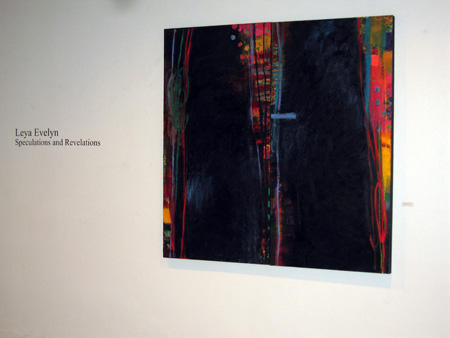
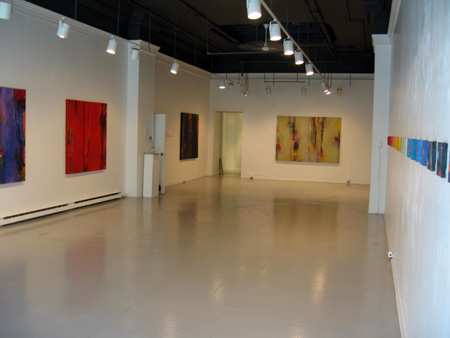
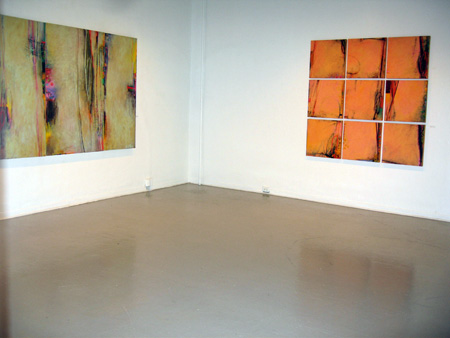
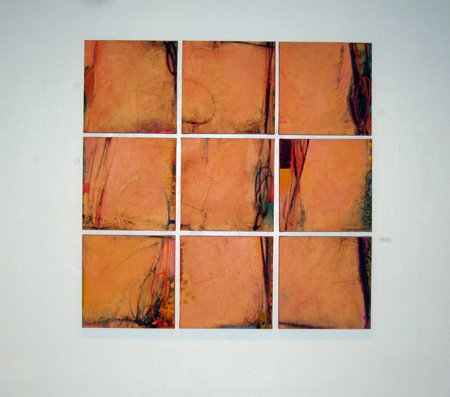
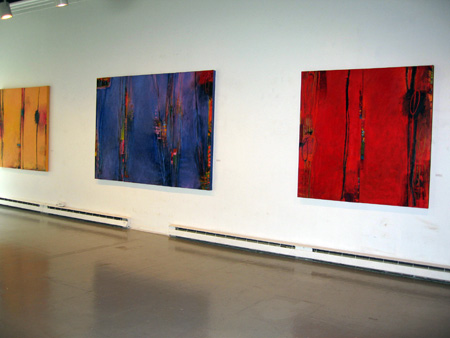
and last but not least, the twenty-one six inch square paintings:
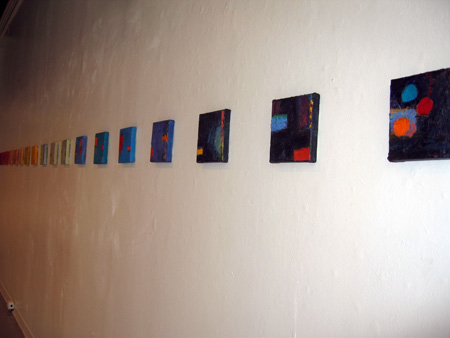
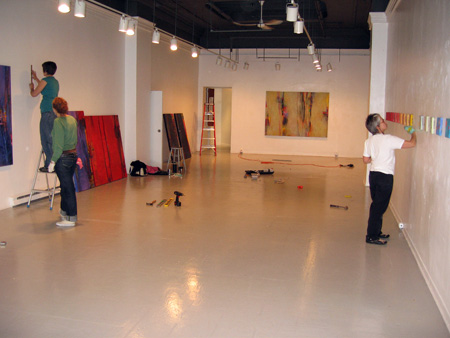
We hung my show this afternoon. Two NSCAD students and a very generous friend. It looks good. The blurb I am putting on the wall with the paintings reads:
Speculations & Revelations . . . because that is what painting is to me: explorations, possibilities, imaginings and openings. I've chosen to work abstractly, to consider the painting process, the marks, the color, the impact of these, to be the image itself, without literal references. It's not about representational images. What you can experience is an exploration of possibilities, an opening to an inner dialogue between the painting and yourself.
I’m looking forward to tomorrow: the opening reception is 5:30 to 7 pm, at the Anna Leonowens Gallery, 1891 Granville Street, Halifax. The exhibit will be up for two weeks, until June 24. (I'm giving a gallery talk, noon, June 21.) Do come by if you can!
So, I was finally at last (with great enthusiasm!) able to get into my studio this morning to work. The place had been cleaned up for last weekend’s Studio Rally. And there were no workmen around today! With my paintings to be wrapped on Wednesday, picked up on Thursday, of course, today I decided to work (extensively) on one of the large pieces in the exhibit. The large blue painting that has been a struggle from the beginning. I’ve already photographed it, thinking it was finished, but never felt completely comfortable with it. It worked but didn’t feel right to me. It just felt too busy. I’m happy with it now, I think. I’ll know tomorrow when I look at it again. And I am grateful to the heat gun I recently discovered as a way to get the paintings to dry. (I use oil paint sticks and the heat helps set the wax in them.)
The other day R. was also saying artists (who are successful, showing and selling) like to talk about themselves, their work. It’s more of a public obsession for them. They want to show their work and they want to talk about it. It took me a long time to want to talk about my painting. But I’ve learned it is important. Not everyone can look at a painting and be satisfied with just looking/feeling/sensing. And in a way it does help me to put it all in words, have a point of view, a perspective on what I am doing. And not only the “what” of it but also they “why.” It is, after all, a non-essential service by conventional standards. But it’s one I wouldn’t want to do without.
When Tamar and I were talking about art (the arts, creativity) the thought kept coming up: “How do you know if your work is worthwhile?” So many people devote their lives to making art, to writing, to playing music, and maybe they receive positive feedback, become successful, maybe not. Maybe they are “recognized” by one generation and not by another. Time is the great equalizer. But still people keep creating; and to have that devotion, it is necessary to believe in oneself. And not only to have that confidence, but also to project that out into the world, let other people know that “your work is the best.” To have people take you (your work) as seriously as you do yourself!
I was talking to my friend R. yesterday and she was saying how she doesn’t enjoy exhibiting her work. She is a much less shy person than I am on a personal level, but the exposure of her creativity, even though she does receive positive feedback, makes her uncomfortable, even shy, embarrassed. Whereas I feel on top of the mountain when I exhibit my work. Somehow, knowing the work is done, finished, on its own, I feel separate from it yet proud of it. Like my children are grown, have lives of their own and I like that. It is also good to be able to see the paintings in a clean space, one that is intended to show the work at its best. And I like people to see what I have done; I paint so that other people can see it. It is communication.
In my first years of painting, I wasn’t as eager for people to see the work. The need has increased with my confidence in the work itself. I did always feel that I would (eventually) make good art, maybe even the best. It was always that feeling that kept me going, even when I was not happy with the work itself. And many times I thought what I was doing was the best, only to look at it a few years, or maybe even a few months later and see that it was definitely lacking.
About fifteen years ago I was in an exhibition with Richard Mueller and Wayne Boucher. We called it Three. As usual, I thought my work was good and was pleased to be showing with a couple of other artists I respected. But when I saw my work on the walls at St. Mary’s University Art Gallery (here in Halifax), I thought it looked dreadful—uptight, rigid, systematic, i.e., Bad. Next to Wayne’s bold fearless black and white abstractions, mine paled. And that was good to see. I wouldn’t have seen this quality so easily if I had kept working without reference to Wayne’s paintings, just kept the paintings in my studio. I am grateful to have seen this. It fostered an entirely new direction in my work. We showed together again at York University and by then, my paintings had changed enough that I felt good, they could hang there with pride.
So now I am eager to see how my new paintings will look when I exhibit them June 12. To see what they really look like. Right now they are stacked in my studio waiting to breath in a public space. In a little over a week.
It’s been a hectic few days since returning home. Thursday aftrnoon I wanted to get away from the building project so Lila and I went to visit some friends: an artist friend for me and a dog friend for her. We both came home exhausted, her from puppy play and me from non-stop travel. Friday was school (I’m teaching a Foundation Drawing II class all summer) and more building stuff in the afternoon. As well, This Is Studio Rally Weekend Folks!!! So Please Come Visit!!! I spent a couple of hours yesterday with the building crew rearranging (several times) the furniture, putting back the rug (finally—I really missed having it, my beautiful oriental carpet that makes my living area so comfortable. I bought it at an auction at the airport. My friend Suzanne and I were going to go to a lake for a walk and a swim with our dogs—this was eleven years ago, before my house was built—and I was talking about wanting some oriental carpets to soften the concrete floor in the living room and she mentioned the auction, which was Persion carpets stopping in Halifax on their way home from the Tulip Festival in Ottawa—and I “got lucky”). Then I moved my computer desk a few times, rearranged the plants and books and still have more to do. And my studio is workable again. But I will have to undo everything to paint the walls soon.
Today several people came in the morning, which was nice. I live so far off the main road, I don’t expect a lot of traffic. This afternoon it’s been just Lila and me, catching up on correspondence and gardening. My studio is looking good—almost finished, almost ready for painting, both the walls and the canvases. Looking at my work which has been hidden away for the past couple of months, I feel eager to get back to it. It's usually good to take a break, let things percolate. But this has gone on long enough! I’ve only been able to work on the six inch square pieces (all twenty of them looking good now) in the time my house has been torn apart. So by next weekend, it will be production/productive time again!
It feels good/strange to be here. Just a week away and everything is different. My garden is blooming, bursting with flowers—the rhododendrons are more full than ever before, the asparagus have sprouted up, as have the weeds. The building project progresses, nears the end, but not over yet. I picked Lila up as soon as I could, went directly from the airport to her Doggie Resort. She had a wonderful time playing with other young dogs. Apparently she was a perfect guest, full of energy, very entertaining. I missed her a lot and am glad to be back together. She seems to have settled into our routine here again easily.
I did get to the Metropolitan Museum of Art on Tuesday. It was a warm sunny day and I sat on the steps (with many other tourists and native New Yorkers) for a while and called home (the builders). Such a luxury, cell phones! Inside the museum were many memories (as well as exhibits). One of my first jobs was selling Christmas cards (in October!) there. I spent a lot of my breaks looking at the art, roaming the halls. I would also hire a sitter and go there often when my children were young. This time I went directly to the Betty Woodman exhibit. She had spoken at the Art College graduation ceremony and I was eager to see what she had created instead of making beds and washing dishes. It was impressive. Large decoratively painted vessels, grouped together to form conversations. The wall pieces did not appeal to me as much. I overheard people talking about the interesting glazes she used but I know nothing about ceramics, so that was over my head. I personally prefer less decoration. The shapes themselves were enough for me.
From there I went to the modern art section. It was a feast of interesting paintings: some Guston, Stella, Kline, Klee, Twombly, de Kooning, Rothko. It made me feel good to be painting, to be part of that history of expression. Tamar and I had gone together to the Hirshorn Museum in Washington on Sunday (while Dan and Damian went to the Air and Science Museum). We stopped at each piece of art and told each other how we felt about it. Mostly we agreed, which was interesting to me. The ones we didn’t feel the same about were the more refined, meditative pieces of Agnes Martin and Cy Twombly. I always wonder if my education, coming to these paintings with a sense of history, affects the way I see them or is it just a difference in perspective. I feel the same way about Ellsworth Kelly. I love his work, but I know that if I were to see some of it (like the plain color panels) today without having seen what preceded them (or having seen them together in large installations) I’m not sure how I would feel. Sometimes, it seems, the history comes along with the artwork. I would hope that a painting could stand on its own, like a Rembrandt or Vermeer, forever. But in those paintings, there is a familiar subject matter that acts as a reference to daily reality. To take that leap into the visual unknown of abstract art, let go of logical reference, step off that cliff of the known into a ocean of feeling response . . .
A friend of a friend saw a painting of mine in my friend’s house. His first comment was, “Oh, wow!” Then it was, “Hmm, interesting.” And then, “Hmm, it’s like a wasteland in the middle.” And he didn’t “understand” that. He was attracted to the color, he liked that, but he felt the middle was empty, wasted space (my interpretation of his comments). It seems he didn’t see what I saw. To me that space in the middle is very full. That’s the major part of the painting, where “nothing” happens but where it is full with possibilities.
But I don’t want to tell you what to see. A painting that “wears well,” has longevity, is a continuous exploration, a continuous revelation, never stops telling you it’s secrets. The “ideal” painting gives you new insights into itself, over and over, year after year. It is never tired, never rests, but gives qualities, impressions, experiences that only belong to that particular painting.
I frequently hear people say they don’t know anything about abstract art and therefore they don’t understand it. What they mean, usually, is that when they see something unknown, they freeze. The first thought may be “Wow,” but the second thought may involve trying to put one’s own version, one’s own knowledge and concepts onto phenomenon (in this case, a painting). It can be hard to stay with pure perception, that first impression. I prefer to make art that is not based on a concept, is not logical in the mundane sense, not created by prescribed rules but opens up space, time and the unknown for the perceiver. A good painting, to me, is timeless and continually giving birth.
School started yesterday. I’m teaching one day a week for the whole summer. Foundation Drawing II. There are sixteen enrolled. A good number: not too many, not too small. But it’s Friday mornings at 8:30 am. Actually any morning class is a good excuse for an excuse. And Friday is a good excuse. As is Monday. And I suppose you could add in Tuesday, Wednesday and Thursday, if you like. So my job is, mainly, inspiration. Especially when it is a required course. Summer helps. It’s more relaxed. Students are usually taking a lighter load. But most of them have part- or even full-time jobs. There’s a lot of pressure on them.
But I still wonder all the time what drives someone to go to art school. There certainly isn’t much job security waiting for them. It seems a lot of the students come to the Art College because they think it is going to be easy, fun. And maybe it is for some. Maybe they don’t know what else to do after high school. But for a lot of them, it’s a shock that making art is work. For me, it’s my job. A possibly stressful job. A job with a lot of uncertainty. A job I love, certainly.
I met a fellow instructor in the slide library last week. She was returning to teaching after adopting a seven year old girl from Columbia (she already has a seven year old boy with her Columbian husband). She had been on maternity leave and decided to go back to teaching this summer because she was experiencing post-partum depression. The heavy load of the reality of taking care of a new child in the family, even though she was adapting well, and the lack of studio time for herself, was contributing to her feeling low. But she feels fine now, so she was wondering why she didn’t continue on maternity leave as long as she could. I suggested just the decision to get back to work helped her overcome her depression.
Work can do that. Especially work you love. Although I can still do a little (very little) work in my studio when the builders aren’t here, I’m looking forward to having my entire studio back soon. When my children were young and I was irritable, they used to tell me to “go paint.” They knew.
Thanks everyone for the title suggestions. It really helps me to see what you see. Your offerings are percolating in my thoughts and I will let them brew for a while, until I have to make that inevitable decision. Titles are very important. They lay a claim to the work.
I wrote an entry a while back (January 2, 2004) titled What’s in a name. . . . A lot! At this point, I like titles that are imaginative and not specific, not a literal reference to the painting but more a suggestion of possibilities. Since I am very prolific with my work, I've been giving paintings titles in series, usually by the size. I doubt I could think of twenty titles for the 6” x 6” pieces that will be in this upcoming exhibit. But I am sure some of you could!
Meanwhile, here are photos of the three diptychs that will be in my June exhibit. These pieces are each about five feet square. (Hint: I need titles for these as well!!!):
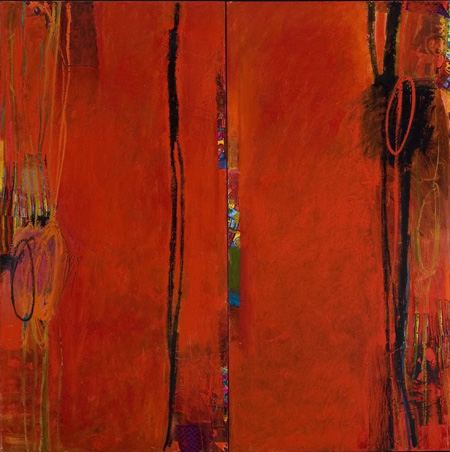
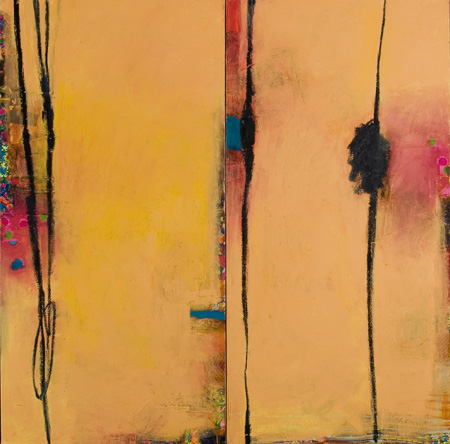
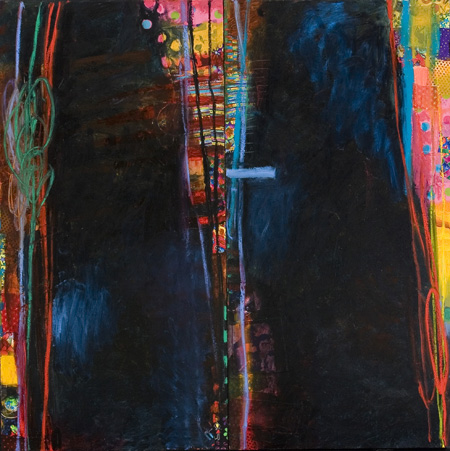
Last week I had some photos taken of a few of the pieces that will be in my exhibit in June. Then I took them to the Anna Leonowens Gallery and Tonia, the exhibition coordinator, designed the invitations. I should have them next week. Because she is putting four cards on a page for the printer, we used four different images. Very cool!
Here are three images of 6” x 6” paintings. Now I have to think of titles (not my favorite activity!).
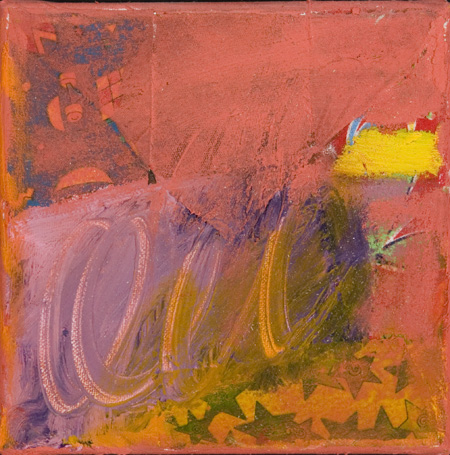
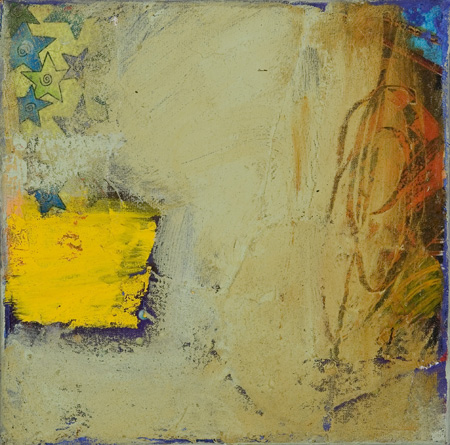
I was able to get into my studio this weekend (move the builders’ supplies aside and take the plastic protective covering off my paintings) and work on the sixteen little (6” x 6”) paintings I started a few weeks ago. I’m finding myself simplifying, sometimes more than I expected, and then maybe going back and adding. The imagery is not the same as on larger paintings. It can’t be. There isn’t enough space, obviously. The arm movement is different so the imagery has to be different. But you can still tell I did them. They have my handwriting on them. I’m always surprised when they work, when all the pieces fall in place. Mainly because of the small size, not being used to working in this format. It’s a challenge and I like a challenge, for sure.
There seem to be some things I just don’t question. I accept as fact that painting is a necessity, that astrology and feng shui work, that reincarnation happens. I don’t even know why I don’t question. I do know that all these “things” are open to misinterpretation. That astrology can be a crutch or even used as a weapon. As can a lot of alternative therapies and pacifist ideology. Just about anything can be twisted, if used inappropriately.
Painting feels right. And it would be hard to continue painting if it didn’t. It’s a solitary occupation with no job security or built-in benefits other than the reward of doing it. I keep saying it’s not therapy, it’s not about me. But it is, up to a point. Then it goes beyond that, transforms that, takes the personal and makes it universal. Otherwise it isn’t worth it.
A year and a half ago Aaron made me a handsome promo email. He took six of my paintings, formatted them together with my website address in the middle. Clear, concise and to the point. All I had to do was write a few words of introduction about myself and my interest in the gallery I am querying. For a year and a half I thought about it, mulled over what to say, gathered a few email addresses of galleries around the world I might be interested in pursuing, and did basically nothing. It sat there on my desktop, waiting.
Then this past week, because my studio is invaded with builders and building supplies and my entire house is in a state of upheaval, I sent a few out. I’m not completely satisfied with how I introduced myself, will have to tweak it some, but it is better than not sending it. My first impulse was to say, basically, “I’m a strong and unique artist; take a chance on someone you don’t know.” But I didn’t, of course.
Self-promotion is difficult, at best. Not something I enjoy. Most of my gallery connections have been through direct contact or recommendations. One gallery owner in New York saw my work at a framer’s and we had a fairly long, good relationship, until she shifted to show only Fluxus artists. Several others have been through friends. One enduring connection came from a gallery owner searching on the internet. It is still difficult for me to initiate the business part of making art. But it has to be done. And with the added pressure of needing to pay for fixing my house, I was finally (finally!) able to send out some promo emails.
(The "still in progress" blurb goes at the top!)
Sue left what was, for me, a thought provoking comment recently. "Being actively engaged in the world is an anti-aging activity." So then my mind started churning, when going down into my studio alone to paint, "I am working for world peace. I am ending the crisis in the Middle East when I paint alone in my studio, stopping global warming when I paint alone in my studio, ending the possibility of another World War when I paint alone in my studio." And I do believe this.
Painting, and all the arts, are not at their best as social statements alone. They work on a deeper level, affect people in unseen, unspeakable ways. They are a necessity for a decent society. Artists work not for the money alone but for the money to be able to continue making their art. Art is a profound element of communication.
And I can only remind myself over and over now as the mounting cost and stress of fixing the criminal mistakes of the original builder of my house continues: I’m lucky to have such a beautiful house in this amazing setting and to be able to be making paintings here. It could be much worse.
My house is wrapped in blue plastic; it’s been raining off and on for a couple of days; Lila and I have had three days away from the excitement of my building project; and I’ve been working every morning in my studio. My main focus right now is sixteen small (6” x 6”) canvases. I want to include most of them in my exhibit at the Anna Leonowens Gallery June 12. I have time, but I feel pressure because there is little possibility that I will have much freedom to work over the next few weeks. These little paintings are going well. I’m finding I am enjoying working on these pieces. After my seven foot canvases, the size feels good. And the square format is much more suited to my sensibilities (in this size) than the 3” x 5” pieces I had been doing (for auctions and donations). There is something about a square that appeals to me. Not sure what it is. Maybe it’s the ability to turn it, and turn it, and turn it until it settles down.
Thora, the director of the Gallerie Saltrum, sent me a photo of my paintings hanging there. It’s the gallery Elin connected me to in Denmark. I am eager to follow the paintings.
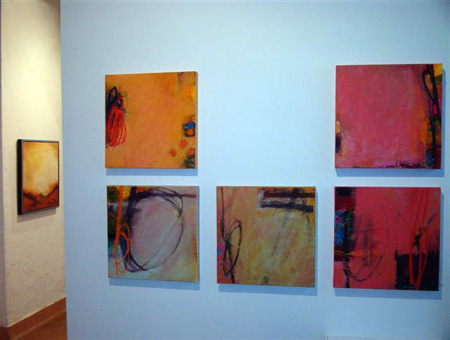
Elin has also started a blog about art: ARTFORMUM. Well worth a stop in for a chat. (I think that is her painting around the corner in the gallery.)
Synchronicity is a strange thing. I made a commitment to exhibit my large paintings (and I have quite a few piled up now) at the Art College’s Anna Leonowens Gallery in May or June (not sure of the date yet). And I decided I needed something different to go along with the usual colors (red/blue/yellow/green). And decided on Indigo, which seems to be black (but IS Indigo). And of course the association is to Robert and his recent death. And of course I think about him when I am painting and always have. He was such a strong influence. He often gave valuable critiques and was also very enthusiastic about my work, especially the recent paintings. I’d send him photographs and we would talk about what was happening in the work. It was always helpful. But in typical Robert style, he didn’t understand why I valued his input so much.
I plan to put this “black” painting in the exhibit. I have also been working on a pale green painting. It’s a triptych. I will have the green and a blue triptych (which was a long struggle in its production) and three diptychs (the black, a red and a yellow; all pieces came together quickly). And then some small (very small: 6” x 6”) pieces. (I think the contrast will be interesting.) At this point, even with only a month’s notice, it feels like the colors and sizes of this exhibit will be balanced.
Meanwhile the green painting has been an long obsession for me. I’ve asked several people who’ve seen it for input. The main question has been about one area that felt too busy but was, in itself, very interesting. Most people liked it, but I still felt uncomfortable. So today, I bit the brush (so to speak, especially since I don’t use brushes!) and calmed it down. And it looks so much better. The bottom line seems to be: when I need to ask, obviously it is not right. When a painting is right, it feels right and that’s it.
Michael Enright has been conversing with Bruce Myer (a professor of English at the Laurentian University BA program at Georgian College and an instructor of literature at St.Michael's college at the University of Toronto and author of six volumes of poetry) in a series about poetry on his Sunday morning program. The final installment was about how poems read. Myer said that poetry is “the art of the impossible.” It has a sense of transformation: one thing can become another with hidden meanings (or, I might add, hidden meetings). You fill it out according to your own personal experience. You meet new experiences with your own history.
As I was listening I kept relating what he was saying to painting. How we bring to our world, see it, through what we know, our own personal experiences. Painting, like poetry, is a conversation: we pick up threads of thoughts, take it into our hearts, and transform it through our own point of view.
Something is like (or as) something else. The same in painting. A red line becomes (a bird/a circle/a luscious/severe or harsh red line) something more than just a red line as it is played off against something else (a blue field/a sunset/a green square).
I’m thinking of ordering the Poetry is Life, and Vice Versa CD (as of mid-april from the CBC Shop at 1-800-955-7711 or on the internet on the CBC.ca website under the title Poetry is Life). It was a very interesting series.
About a week ago I mailed five 20” x 20” paintings to Denmark. Elin Neumann connected me to Galleri Saltum where she exhibits her work. I hesitated talking about it because I didn’t know, once the paintings arrived, if they would translate into reality from photographs as well as they expected.
The paintings arrived yesterday and Elin tells me Thora, the gallery owner, is pleased with them and eager to hang them in the gallery. I will post photos when I get them. Now I would love to find a gallery here that would exhibit Elin’s beautiful paintings! That would be so cool, to be able to visit back and forth with artwork! And all because I posted my recipe to keep deer from my garden!
It’s been a few good days in my studio. I’ve started some new work and that always feels full of possibilities. But the biggest change is that I had a professional organizer come help me clean up my studio on Friday. We spent four intense hours sorting, bagging, tossing “things” that have been hanging around for years and years. Some of it was never unpacked from ten years ago when I moved in here. I just moved in, pushed things aside, and started painting. But it seems more cost effective to clean up (with some professional help) than build an addition (and probably clutter that up as well!).
I must say, though, when I go into my studio the last couple of days, it feels strange to see the floor so bare! It just doesn’t seem like my studio. It’s too clean. But I’ll get used to it. And hopefully, keep it this way.
Wouldn’t you know it: just when I have a free week to paint every day, I get sick! Laid up all week. And it’s hard to take care of a puppy when you don’t feel well! Fortunately I have had some wonderful friends who have helped me out: with groceries and puppy-walking. And puppy, who is growing at the rate of two pounds a week (now over twenty pounds!) is becoming quite the long-legged beauty (just like Marlene Dietrich!). But she still is has a ways to go. My friend Gwen came over yesterday with her standard poodle and next to Kiku, Lila looked so small. And my pup was in awe of the bigger/older dog. If all goes as planned, she will get into a puppy group this week. Spend more time with her own kind.
So what does an artist do when not painting? Sit around thinking about it. Some artists I know regularly spend time in their studios thinking. Looking and thinking. My usual mode is to work non-stop when in my studio. This week, not being able to work, I walk through and think. Carry images in my head. Sit there and think. Mentally paint. At least the impulse is there. The marks will come soon. Along with school and other responsibilities this week.
Some pix below of Lila attacking a rosebush (it wasn’t a thriving bush and I was planning on removing it in the spring, but it looks like Lila is doing the job for me!). It was just beginning to snow that day:
And then the bush fights back, tackles her:
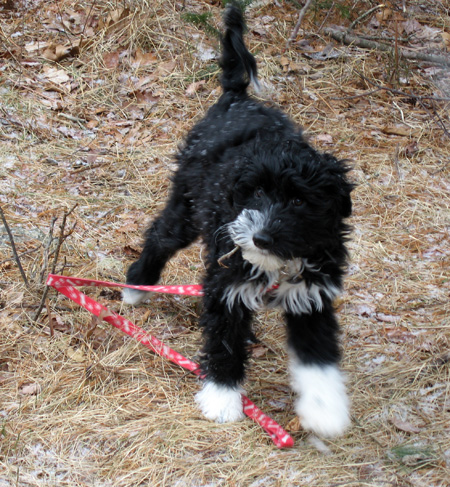
I’ve had a couple of good paintings days (and this is reading week: no classes! So I will have more time to paint!). I am beginning to understand why I have so much trouble putting something in the middle of my paintings. I think it has to do with the image feeling too literal, like it IS something. When the image has a broader feel, when it is pushed to the edge, it feels (to me) more universal, transcending the personal, which is my primary motivation: to make the painting go beyond the impulse that creates it.
Yesterday I was working on a small (30” x 30”) red painting. It began with trying (once again) to put the image down the center of the canvas. But (as usual) I was uncomfortable and started painting it out, erasing the image, losing it. So I made some bold black lines in circular shapes taking up the whole canvas (small as it is, anyway). And this pulled the canvas together for me. Then I felt I understood what I was looking for, why the middle of the canvas has to be so solid, and this solidity works best for me with color, not form.
And as for the horizontal: as much as I appreciate a good landscape painting (such as Elin Neumann’s), I don’t feel comfortable when my paintings refer to external landscape. In an abstract painting, the horizontal too easily refers to landscape. What I want is to create an internal landscape. And perhaps the vertical represents the human body better in my lexicon.
In her comment on my (Shipping news) entry, Heidi asked me: “If your paintings could make sound, what sort of sounds would they make?“ My first thought was what kind of music: my immediate thought is jazz. I love to listen to jazz, blues, rock & roll, but mostly pure jazz, the old stuff, and some of the new music. I was introduced to jazz in art school: Miles Davis, Nina Simone. I listened to my few records late into the night, over and over again. Fortunately my neighbors in the slum tenement where I lived in New Haven didn’t complain. (That apartment introduced me to cockroaches; I thought they were cute at the time; I learned!)
I think of jazz first about my painting because it is mainly improvisational. I don’t know before I make a mark exactly what it will be. I don’t know exactly what color a painting will be. I test, I experiment, I play. There’s a theme that does run through all my work: an excitement about using color to communicate form, space, mood. Then there are the marks and colors that come and go, build up, get taken away, return. There are the layers of thoughts, motifs, melodies, sound.
By coincidence, Michael Enright had a section on his program this morning about jazz. Many people write in to him complaining about his choice of jazz as music on his show. He had Montreal’s Katie Malloch, host of CBC Radio’s “Jazz Beat” and Toronto’s Jowi Taylor, host of CBC’s “Global Village” and “The Wire” debate the pros and cons of jazz. And even they didn’t agree on what was “good” jazz. It seems jazz is one of those controversial topics. Some people love it; some people hate it, and those who hate it are more outspoken than those who dislike classical music. Perhaps it’s the same with abstract art. It takes an open mind to “see” it, not come to it with preconceived “ideas’” of what it is “supposed to be.” What jazz and my painting have in common is a basic structure that is the foundation of the work and then the improvisation that makes it what it becomes.
But then I hear an Aarvo Pert piece and feel completely connected to it. When Yoko and I play duets, it’s the Satie that I enjoy the most. The spareness, the feeling that every note counts, is just where it has to be, and often, the wonderment of how did he ever imagine this! Although I play classical piano music, I’ve always wanted to play jazz but don’t have the understanding it takes to play it. I would have to develop that. My painting seems to be enough improvisation so far.
But if I get away from music as sound, think of the sounds that surround us every day, I could see my painting in the sound of the brook that runs by my house—the constant movement, the water rushing over the rocks underneath, the constant churning as it becomes one continuous note uniting everything that moves below the surface. The sound of my painting could be the sound of water as it permeates everything, a necessity for life.
Heidi’s question has me listen to the everyday sounds in my house: the intermittent hum of the refrigerator, the sound my computer makes when I turn it on, the clack of the keyboard as I’m typing, the gentle drip of my mini-fountain, the tick of the clock, Lila chewing on a bone. All subtle sounds that make my house my home. These sounds could be my painting sounds: familiar sounds put together in their own unique way. Crossing the line from one art form to another, from one area of life to another, from one art form to an area of life, opens up a whole new world of possibilities. Thanks, Heidi!
Brian came over this morning and helped me pack up paintings to send to Harbour Gallery in Toronto. I would like to say my studio looks bare, but there is still a lot of work hanging out: some finished, many to be worked on more, some to be started. I’ve had several people in Halifax say they were interested in work but no one has made a commitment. So I am glad to be able to send some pieces to where I know they will find homes.
My packing list includes two large triptychs (shown below, titled Some Like It Blue, one peach, one red, each 60” x 84”), one yellow triptych, Three (60” x 72”) four cowboys (a 30” x 30”series I titled When I Was a Cowboy”, and thirteen Tomatoes (each 12” x 12”). (You’re probably wondering where these titles come from. So do I.) The five boxes will be picked up tomorrow.
The smallest pieces are often the hardest to feel resolved. My arm movements apparently are very important in my painting process. And I use large oil bars for paint: fat paint sticks. The small canvas restriction is a challenge. But I find working on the variety of sizes helps clarify ideas, marks, impulses.
Brian also put up some baby gates for my baby: one at the top of the stairs going down to my studio, one at the top of the stairs on the bedroom level. One more step to puppy-proofing my home!
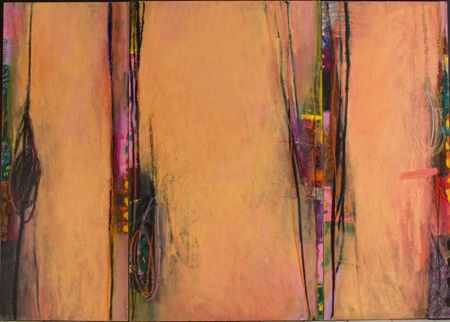
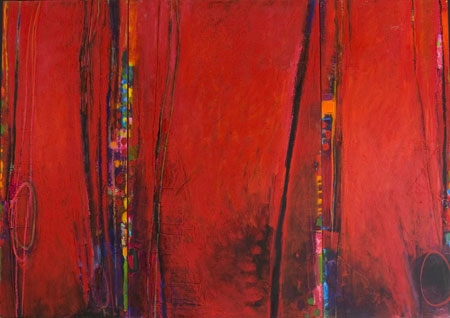
Here is a studio shot (not a professional photo) of what I have been working on. The horizontal lines, what I had been trying to keep, gradually disappeared. (They are whispering beneath the surface.) The paintings seem to have a life of their own and I just follow along!
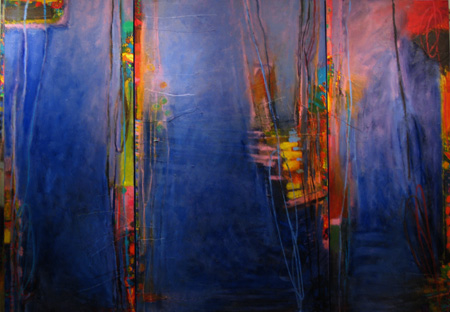
A few months ago, back in November, the 14th to be exact, I started a blog on Journalspace with the intention of writing about my painting, just painting, nothing else. I called it Speculations & Revelations because that is what painting is to me. The blog is about what I do in my studio. It was interesting to expose the thought processes that go into painting, to talk about the mundane (stretching canvases, crating, cleaning up) and the inspired (painting). At this point, though, I want to include what I have become used to writing about there into this blog. Not have two separate blogs. I think I needed to separate these areas of my life because, in the past, it has been so hard to talk about my painting. I would say that the paintings should speak for themselves. I still feel that way, but I have enjoyed writing about what I do in my studio and I want to write about it here now. It is a different kind of writing, when it is about my working. I will try it for a while and see what happens.
Even when I was in school it was hard to talk about my work. Especially then. I remember the last day of classes; my instructor sat down with me to review my paintings. At the end, with me being silent for the entire session, he said “You still have trouble talking about your work.” I nodded and he said “That’s all right. Just paint.” He also said not to look at others’ work, just paint. That part would be too hard, like taking a lollipop out of the mouth of a child (or a meat bone out of Lila’s mouth). So I look; I paint. And now I talk. I talk in school. I learned to talk in school because I have to; it would be impossible to teach without talking. And I talk here.
So . . . in that vein, I had a very productive morning in my studio. I’ve been working on a couple of triptychs, 60” x 84”. One was intended to be blue and has turned into a mix of light purple and blue. I think I have resolved the painting but I will wait a few days to see how I feel. In this painting, I had tried to keep some horizontal lines I put in at the beginning. But. I don’t seem to do it. My usual visual mode is vertical.
In the other triptych, there was a large area in the middle that felt too dark in the context of the rest of the painting. I’ve been trying to keep some imagery in the middle of my canvases. But again. I don’t seem to be able to do it. One of the reasons I enjoy working on multiple panel paintings is that my usual tendency to push imagery to the edges of the canvas moves into the center of the painting when I put the panels together. In this painting, when I subdued the heavy part in the middle, another area became too bold as well. But I didn’t want to lose it. I felt the painting would lose some of its vitality if I did. So I added some black in strategic places: at the outer edges of the piece. I think it works. I will know when I look at it again, when time has done its work. Still, it does amaze me how just a little mark, a small amount of color in the right place can effect a piece so profoundly. Often when I am teaching, I enjoy showing a student the power of a small mark or just the way you end a line. How important the “little” things are.
To sum up, I can see that there are two things I feel I “should” work into my paintings but when I try, it feels uncomfortable and I paint them out. One is the use of the horizontal; the other is being able to put something in the middle of the canvas (and keep it there!). Everything seems to go off to the edges and most of the horizontal lines get painted out. But I will keep thinking about it. Trying. It’s a challenge and I like a challenge. And that (the challenge, the things I “take out”) bubbles underneath the surface of the painting, quite literally actually.
And tomorrow I hope to have some photos of what I am talking about here.
I had an “interesting” phone call last Saturday. My art dealer in San Francisco has a client who is very interested in my work. That’s nice. But. This person wants to buy part of a triptych: the middle panel and one of the side panels. She will use the middle panel upright (as it is supposed to be) and then she wants to place the side panel on its side (and hang it over a coffee table, or something like that). I said no, of course. No. No amount of money is worth destroying the integrity of that painting. It happens to be one of my favorite pieces, something I feel very strongly about, and would never want to see it broken apart and turned inside out. Maybe it would look good to the buyer, but certainly not to me.
There’s a section titled “Canines at the Artist’s Easel” in Stanley Coren’s book The Intelligence of Dogs. He relates that in 2002, the National Arts Club in New York held an exhibition of a dog’s “paintings.” The works were actually collaborative, having twenty-six artists “finishing” a piece Tillie the dog had started or incorporating Tillie’s painting into a larger work. A professor from New York University gave Coren his appraisal of the artistic merit of the works: “The intent of the artist has little to do with whether the production is deemed to be art by those who look at it. It is simply the eye of the beholder that determines the artistic value.” And this man had his eye (and possibly/probably his affection and open wallet) on a particular painting.
That really speaks to the vicissitudes of the art market. To the instability, uncertainty of production. To the fickleness that plagues this precarious vocation. I would hope that my intentions in my paintings are respected. But I can never be sure.
Then later on Saturday a friend called to tell me she had received a newsletter from an artist in Vancouver saying in China there is a company pilfering painting images from websites. Unbeknownst to the artists, they are making inexpensive reproductions and selling them at a very low price, between about $16 and 46 ($U.S.). They also frame and ship. Quite a deal! They have about 2800 artists, about 800 from Canada. I happen to be one of them. Apparently Chinese copyright laws say this is legal until requested by the artist to remove their works from this process. But some artists have requested such and not been respected, yet.
Well, this does make the work visible. But I am not receiving any royalties. I know how musicians must feel about downloaders of free music. The music is being heard, but no royalties. And where’s the respect. And for all I know, my images are being turned sideways, upside down and inside out! Obviously we have some homework to do here.
PS: The newletter ends with: "The superior man understands what is right." (Confucius)
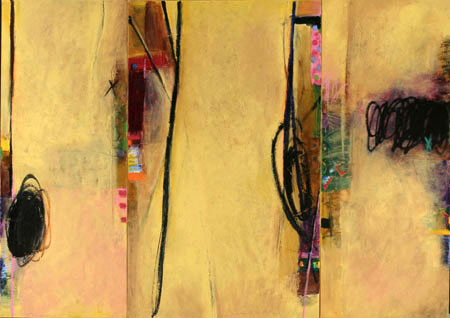
I started another blog. I didn’t plan it at all. My friend Elin wrote me that she had started a blog on Journalspace. When I went there and wanted to leave a comment, I had to sign on which seemed as if I was starting a blog. So I started thinking about it. There is something I had often wanted to do: document what I do in my studio, how my paintings happen, how I feel about their progress, what I think about before, during and after painting. So that’s what it is. The mundane thoughts and activities of a painter in her studio. I'm calling it Speculations & Revelations because that is what the painting process is to me.
So I put my sign up on the road a few Friday’s ago. It says “Leya Evelyn Studio”. Standing on the road supervising the installation of the post, I met several neighbors. One with a beautiful seven year old golden retriever, another my neighbor who had recently moved in next door. But next door is so far away I hadn’t realized I had new neighbors there. That particular house has had four sets of residents since I moved in here nine years ago. For the first time in my life, I’m the one that that seems to be staying.
That particular house also seems to be one that is friendly to pets. The first people had a dog and a cat. The next family loved and cared for Katie when I was traveling (and had a couple of cats). The next couple had three dogs and we met in the lake as she was exercising them. This current family has a couple of dogs (I hear them barking and sometimes they come over to inspect my property) and at the time we met, she was walking their big fluffy cat on a leash, taking him to the car to go to the vet. So we didn’t have much time to talk. But she did say that she is an artist as well.
Everyone wants to be an artist. It IS a liberating experience, creating something from nothing. And it is hard work. I haven’t seen my neighbor since and I have no idea what kind of work she does. Recently I have again begun teaching my small group of adults (Buddhists), a painting class. Some of the people in the class have had a lot of experience, some none. Most of them have worked in related art fields, close to, but not, painting. Sometimes I don’t think I am a good teacher for beginners. It’s hard. I don’t remember beginning instruction. It feels like I never began. I just did it. After my intense and valuable year of art school, most of my “education” has been self-taught. If I want to learn something, I investigate. I have become good at critiquing work because I have to—because I teach and a teacher critiques. I am willing to learn. And there is a lot to learn, in regarding making art and also how to teach. And that is one of the (many) things I love about painting (and teaching).
My friend Heidi and I went traipsing around to a few galleries in town last week. There was a fairly big drawing exhibit at the Dalhousie Art Gallery, a strange sculpture show at St. Mary’s University, and Janice Leonard’s well executed landscapes at Studio 21. The artwork was interesting but not earth-shaking which I suppose is good, considering the various natural disasters we have already experienced lately. But it felt more as if most of the work was ideas yet to be hatched. Heidi suggested there be a website where a person could put up an idea and have people comment, make suggestions. That way maybe more fully baked ideas would be on the menu.
When I was first learning to cook, at around twenty years of age, I asked my mother how long it took to cook a pot roast. “Until it’s done,” she told me. I can laugh at this now, but then it was too confusing. Maybe, ultimately, experience/time is the best teacher.
One of the (many) repeat programs I�ve been listening to on (the now semi-crippled) CBC was one about �cuddling� with Shelagh Rogers. No, not cuddling with her, but with her moderating a discussion. And yes, you can imagine she would be a big cuddler. But the upshot of the discussion was basically that (most) women are much more comfortable cuddling with each other, even sitting face to face, legs up, on a couch with feet in each other�s laps, than men would be. And this was very obvious to me at a dinner party I went to this week. Hugs and kisses all around with the women. We even ended up sitting in the hostess� washroom (bathroom, lavatory, toilette depending on what country you are in) talking. I don�t remember how we ended up there, but it was a pleasant, large room and we congregated and chatted as if it was just another Nova Scotia Kitchen Party, but not in the kitchen.
One of the guests at this party asked me how to start an abstract painting when faced with a blank canvas. It was to be his first. He didn�t know if it would be better to start with a concept or just paint what he was feeling. Of course, I told him not to be concerned about a concept. Some people work better that way, but if it wasn�t natural to him, not to impose one where it didn�t want to be.
I�ve never, personally, been attracted to working with concepts. But when I see people�s work that embodies sociological ideas, I am very moved, feel challenged, admiring, yet still, know that I cannot do that with my work. Definitely I want my paintings to transcend the very personal, intimate beginnings, the personal internal conversations that generate the first marks, but if they stay there, it would be disappointing. A good piece of artwork transcends the personal, reaches beyond what we think and know.
I suppose that is why Susan Feindel�s work was so fascinating. I went to hear her talk last week about her work that is now in an exhibit entitled Scan at Dalhousie Art Gallery (until October 2). The exhibit, which explores the marine environment, includes paintings, videos, bookworks and mixed-media installations. The work examines the fragile structures off the Scotian Shelf and the impact of human presence there, including the severe tracking marks left by trollers, these marks becoming strong imagery in her paintings. As well, she includes actual soil from the places of her investigations. The curator, Susan Gibson Garvey comments �how the sensuous and tactile nature of the work itself acts as a counterpart to its clinical and scientific sources, creating a poetic tension between what is known, what is sensed, and what is impossible to know.�
Susan Feindel and I had exhibited together (along with Wayne Boucher) at the Agnes Bugera Gallery in Edmonton last March. Her work in that exhibit was abstracted landscape. Knowing the background of her marks and color choices does help see the message, yet the emotional impact was evident even then, before I knew the history of her work. And that is what makes good art.
and was chatting with another artist, one of those people who has enormous talent and intelligence but not the discipline necessary to produce the work, a common problem, unfortunately. And the amount of time you have to spend alone in order to paint is hard for him. He is thinking about teaching, a good choice for this person, and he started asking me how I teach. A difficult question to answer. It depends a lot upon the class. I told him I try to configure a progression of assignments so there is development in the process. And I focus as much as possible on process, not product. Then he asked me how I was taught, how I learned, basically how come I have the necessary discipline and did everyone in my school work the same, were we taught to mimic a style. I was taught to see how things worked, to get into the process of creativity, the process of making things happen, to think more about how I was working than what I produced and also, no, we did not all work alike. I think differences were respected but there was definitely the development of a self-critical eye. It did take me years after leaving art school to know what I was creating, what I was looking at, how (if) it did or did not work.
Then he asked me why I left art school, didn�t finish (if such a thing does actually happen, finishing studying, that is!). I have two answers to that, the superficial answer and the more in depth answer. The first is that I spent the summer in Manhattan and hung out with practicing artists and liked it, wanted that life, one of painting and not being in school. It was a wonderful summer. The man (painter) living in the loft below the one I was subletting told me the best way to meet people in Manhattan was to give a party. So he called up his friends and we had a party. In those days �everyone� hung out at the Cedar Bar on University Place. And a phone call to the Cedar Bar brought the rest of �everyone� to �my� party. For the next couple of months it felt like I belonged there. Sometimes I would hear that Barnet Newman or Mark Rothko (or another famous painter) was at the Cedar Bar and I�d go down there, chat with friends, and stare at the revered artists. (Years later I met a woman who used to call up her artist idols, such as Louise Nevelson, and hang up when she answered. Just wanted to hear her voice.)
That summer I had part-time jobs with a temp agency but found it harder and harder to be locked up in cubicles all day. Eventually I got a job at the Metropolitan Museum of Art selling Christmas cards in September. Despite the magnificence of the Museum and the joy of eating in the staff cafeteria, only a few people buy Christmas cards that early and the job was very boring, By October my attitude was not what they wanted and I was fired. Meanwhile I found it much harder to paint on my own than I expected. Winter was coming and my friends were busy with other things so my romance with Manhattan was challenged. It took a while (many years) to sort things out, to learn how to be a self-motivated, disciplined artist.
The other reason that I quit art school is, maybe, that I had done extremely well in school and was afraid that I couldn�t live up to their expectations of me. So here I am, many years later, teaching and trying to tell students self-discipline is the most important thing I can teach them, that they know best what they want, and they are the best critic of their work, yet it takes discipline to develop that kind of knowledge to a place where it is a constant. And I am painting and putting the work out in the market place. I still wonder what it would have been like if I had continued with art school, finished the program. But I�ll never know for sure.
The other morning on Sounds Like Canada (CBC radio, of course), they played a rerun of an interview by Sheilagh Rogers with two (very outgoing, lively) writers. The topic was exuberance. On (yet another) grey morning, my first impulse was to turn it off. But I didn’t. And also didn’t find it as irritating as I had the first time I had heard it. And then the sun came out—and lasted all afternoon.
And along with the sun came an old friend I hadn’t seen in four years. And coincidentally a friend who is the most exuberant person I know. Sitting by the lake talking after a long swim, conversation turned to confidence. It surprised me to learn that such an exuberant person has some doubts, insecurities. Hers were more about her artwork. I have few doubts about my paintings. Even if I have some difficult periods, I know, always, that it will come together at some point. Usually it does. I can remember only one time when I thought I would quit painting. A friend had come into my studio and said it reminded him of his mother’s studio. I don’t know why, but it hit a chord that snapped and I said: “That’s it. I’m not painting any more.” But that didn’t last long. Two weeks later, I did start again, with a new way of working, and I haven’t taken a break (emotionally) since.
I’m not an outwardly exuberant person. But I do have intense passionate relationships with people and things that I love. My insecurities are about other things than my artwork. I’m working on that. It’s never too late! I do think that it is important to have confidence in what you do, especially as an artist. It would be too difficult without it. It’s what drives the engine.
Michael Cunningham, author of The Hours, (which was, incidentally, to me, one of the few books that was better as a movie than as a read) said in an interview on the radio (CBC of course), that honorable failures are important to creativity. He is not afraid of taking risks, making mistakes, and making them big.
I do understand this. One of the most important turning points in my life was when I had some work in a three-person show at St. Mary’s University here in Halifax. The other two artists were Wayne Boucher and Richard Mueller. The year was 1989, I think, and I had a part-time administrative job at the Buddhist center that took up a large part of my time. The other part of my time, what was left over, I painted. My artwork was fairly successful then, especially the work on paper. I had developed a system, a method, a procedure: organizing the chaotic first impulses, the first creative marks, by honing them down into triangular boundaries. It worked, I thought. But when I saw my paintings in the exhibit, next to Wayne's exhuberant large black and white canvases and Richard's experiments with materials and ideas, I saw my work as an “honorable failure,” one that looked awful, tight, limiting. Yet this public exposure forced me to realize that I was organizing my work into a corner and I had to break out of it.
After the exhibit, feeling totally irritated at my “system,” the triangles self-destructed and a whole new world, a more organic process opened up for me. And it keeps opening every time I dare myself to take a chance on something that challenges my preconceptions, preconceived ways of working. There is, it seems, no safe corner in this world.
This is Studio Rally Weekend. That means around one hundred artists in Nova Scotia have their studios open for visits between 10 am and 5 pm, Saturday and Sunday. It also means that I am one of them (page 11, number 17 on the map), hanging out here waiting for you to come visit! So if you are in the area, pick up a map and wind your way through the back roads to my studio! Looking forward to showing you my latest paintings!
I�m off to Switzerland today! For an exhibition of my paintings at the Halde Galerie in Widen, near Zurich. The opening reception is Friday night. Then I will take a train (so I can see the countries I am traveling through) on Sunday to Amsterdam, check out the museums, galleries and such there and then fly home on May 5. Needless to say, I am very excited and eager to go. Just need to zip my bag up and turn of the computer.
I think the main reason I am so excited about this trip (besides my obvious love of travel and exploring!) is that I am going alone. Not that I haven�t traveled alone before: to Mexico for a month, to Santa Domingo for a week, and to other places. But this is different. The first time I went to Europe I was with two children. Tamar was eleven and Aaron was five. We were in London for two weeks and had a wonderful time, the three of us. We stayed in a B&B in Bloomsbury, near Sunny Googe Street. They were good travelers, enjoying the pigeons outside the National Gallery, watching the horse races on TV in the B&B, going to museums with me and generally, being in a new city. Then my husband-of-those-years came over for the rest of our six week trip. We took a boat-train to Paris, then rented a car and drove down through Chartres, Aix-en-Provence, the Riviera, Sienna, Florence to Rome. The last day in Rome, I said to my then-husband, �Let face it, our marriage is not good.� He asked what I wanted to do about it. (We had already had a round of marriage counseling.) I told him I thought we should split up when we got back to NYC. And we did. And I have never regretted that decision.
The last trip I took to Switzerland, two years ago also for an exhibit, I had a traveling companion with me whose very subtle, passive ways made him hard to be with. There is nothing like traveling with someone to know how you relate! This time I am going alone!
So. . .more later, probably in two weeks, maybe sooner!
The NSCAD University graduation ceremonies were this morning. The distinguished sculptor Claus Oldenburg received an honorary degree, along with his partner Coosje van Bruggen (who unfortunately couldn't make it to the ceremonies) and also Kasper Konig (who was present). When Oldenburg was speaking, he said that he had asked Coosje what he should say to the students. They were sitting on the beach in Santa Monica watching a bug slowly crawl to the ocean. She told him (and he spoke with a strong, expressive voice, arms gesticulating): �Tell them to throw your diplomas into the sea! Liberate yourselves! It is now up to you!�
Tuesday night I was teaching my group of older students. There is one person who is painting for the first time since he was in the sixth grade at Catholic School. (And not good memories from that experience! He is very brave to put himself in with a group of people who have been working at this for a while.) I had put out a big, healthy Indian rubber plant for them to paint. The plant has big leaves so it is easy to see their differences but there are many of them it is can also be confusing. My assignment: to paint with no drawing involved, using color to create the forms. To think about the space as a major component in creating the forms of the plant.
When we were looking at work towards the end of class (our usual ritual), he commented that this (painting) is hard. He sounded surprised. I asked the others if they found it hard. Everyone said yes, it is. Then why do IT? For those times when it all comes together, when that unique feeling, that great joy of creating something, the magic that comes at unexpected moments from unexpected places and lives on without you being there. All that discipline of �working at it� over and over. And then it is all just magic!
And it is great to be home, even though I was very jet-lagged yesterday, had a hard time concentrating. It is a good thing I have such an enthusiastic group of students Tuesday mornings! I don't have to work too hard to fire them up. They do it all by themselves.
It was a good trip, good show, good people, lots of fun. The gallery owners are wonderful people, met me at the airport, took us out to dinner to a great Thai restaurant (this was a three person exhibit, Wayne Boucher and Susan Feindel as well as myself), went to a party afterwards, etc. On Sunday I went to the studio of an ex-Haligonian and saw lots of other Edmontonian artists' work (in the same building) and then we went to the Edmonton Art Gallery. Fun & Games.
After that I went back to the B & B and watched a couple of movies (The English Patient�had read the book but not seen the movie�and The Divine Secrets of the Ya-Ya Sisterhood�light, fluffy and entertaining enough) and read (The Confessions of Max Tivoli--more about that later, a strange and unusually good book). Very relaxing considering it was such a short trip.
Fortunately I get Friday off from teaching because of Easter. My Friday class is not the best, very good students but unusually quiet. I can never know what they are really thinking. I�ve never had a class this reticent. But they do work hard and that is good.
Right now I am looking forward to some uninterrupted time in my studio. And now that the weather is turning milder, to some long walks in the country where I live.
Here are some pix of my part of the exhibit:
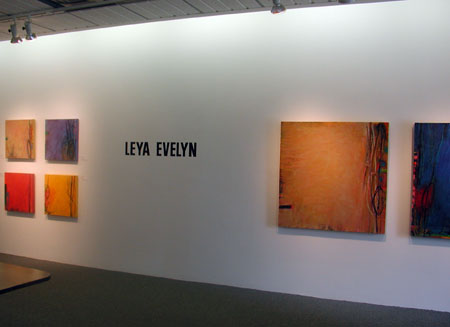
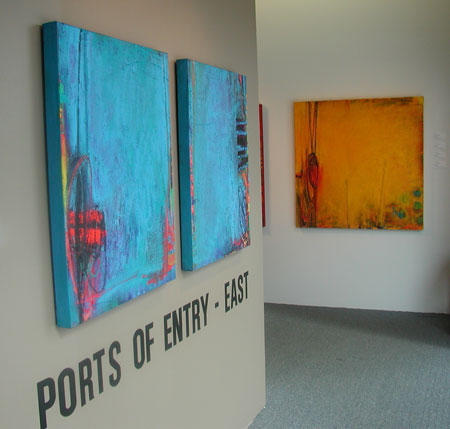
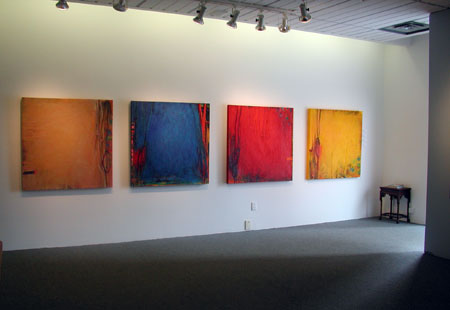
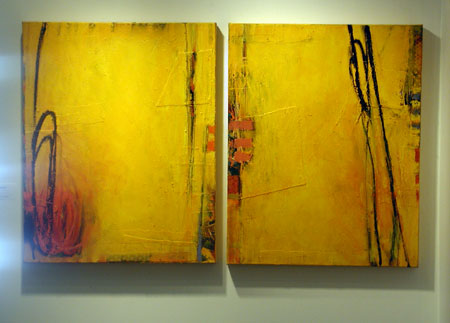
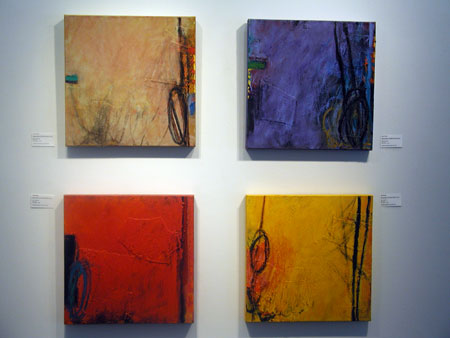
I’m off to Edmonton tomorrow morning early. For the opening reception at the Agnes Bugera Gallery. (With the three hour time difference, I leave here on a 7 am flight and arrive there at the airport at 11:15 am, making it possible for me to teach my afternoon class today. Cool!)
If you’re around, do stop in: Agnes Bugera Gallery, 12310 Jasper Avenue (phone 780-482-2591), Saturday 2 – 5 pm. See you there!
When in NYC I saw a lot of bad art and a little good art. Being busy with family and friends, I only managed a couple of half days checking things out but was not too happy with what I did see. I went to the newly renovated MoMA. It was so crowded there were lines to get in. That�s good. People lining up to see art. (And paying the $20 admission fee!) I was fortunate in that the friend I was staying with gave me her membership card so I could bypass the lines. I also got in to see a photo exhibit that was opening the next day (a sneak preview for members!). A German man, Robert Denton. He had constructed (mostly interior office) scenes out of colored paper and photographed them, then destroyed his constructions. The photos were very large (like most these days) and very eerie. Everyone in the room was walking around with questioning expressions on their faces. The photos seemed real and not-real at the same time. Intriguing.
The Museum was, besides being very crowded and having an admission fee of $20, not as intimate. Monet�s �Waterlilies� definitely suffered from being in a room too large for it. Previously it had been in a much tighter room which gave (me) the feeling I was in the same space as the pond. It was lost in renovation. As was any welcoming quality that the Museum used to have.
As for the art, except for a few of the (mostly older) pieces, most of the contemporary exhibition seemed to be very heady, intellectual, lacking heart, without passion. To me, very sad. But that is the way most of the art I saw in NY seemed. Went to a few (very disappointing) exhibits in Chelsea as well. They too seemed like intellectual exercises, nothing more.
Then I heard some artists talking here about their work and felt the same lack of passion. When asked why they paint, what influences them, they said things like "other artwork," "the problem solving" aspects of painting, "seeing what paint can do." Yes, these things are important components of making art. But what about the passion that drives great art! Without that, without the feeling of necessity, that this piece of art (or writing, or music, or dance) has to be, has to exist, has to be what it is and nothing else, than it is just another piece of art. And there is plenty of that.
Recently I put a large painting in a hair salon/caf�/art gallery in Halifax. It is a very beautifully designed space and the artwork is enhanced by the high ceilings, large room and spare d�cor. My painting is a three panel piece, measuring five feet high and seven feet long, a mainly yellow/peach/flesh colored painting. I called it (as part of a series of three paneled pieces) Some Like It Blue, No. 2 and when people ask me about the title, as they inevitably do, I just say �It�s not Blue.�
I have some work there along with a few other artists. One of the other artists is the man who has been copying my paintings for quite a few years. I had spoken to him about it previously and he understood that I found this upsetting. (August 13 and 30, 2004 entries.) He had called me before the exhibit to ask if I was okay with his putting a painting in the same show as mine. I thought it would be a good idea to let people see both together so that they would see the (major) differences. I find his work thinner in every sense of the word, nothing like mine as far as I am concerned, but it seems that people don�t always notice. The painting he put in the exhibit is blue.
Friday night at the opening reception for the Rodin exhibit at the Art Gallery of Nova Scotia, I had an interesting conversation with a woman I have known for a long time. She was a practicing artist for many years but hasn�t done anything with it in quite a while, maybe even ten years. She mentioned that she had seen my work at Fred�s. And she especially liked my blue painting. At first I thought she was making a pun on the title, but then she said she liked this one better than the other one (of mine), I knew she had been fooled.
That�s what makes horse racing!
Just two weeks ago nothing was happening with my work. There were stacks of paintings lined up like soldiers in my studio, just waiting. Nothing scheduled. Nothing happening. And I thought I might never paint again anyway. Now, as of this afternoon, three large crates of paintings are on their way to the Harbour Gallery in Toronto, I have a three person exhibit, with Wayne Boucher and Susan Feindel, scheduled for March 18 at the Agnes Bugera Gallery in Edmonton, Alberta and an exhibit to open April 28 in Switzerland at the Halde Galerie in Widen, just outside of Zurich.
I love those times when nothing is happening. That blank space where anything is possible. Of course if nothing happens always than nothing more happens and that happens to be not good (considering that I need to have something happen at some point in order to continue working, to be able to buy art supplies, to be able to have people see the work, which is, after all, why I do it). Not having specific deadlines does not affect my working habits. I just keep painting. Now I am glad to clear some space, some physical space, so that I can make more paintings.
Although my house is back to order, more or less, I just found my studio shoes today (the ones that I use in my studio, the ones that look like a Jackson Pollack painting). So much stuff still to sort through and put away. I think it will take months. If I could only bring myself to dedicate another day to cleaning up, maybe I could do it. But I�d rather paint.
After a month�s hiatus, this week, finally, I�ve been back in my studio. That�s a long time to be away. When I first came home from my travels I wondered if I would ever want to paint again. I was busy rearranging my house, making my nest comfortable. I didn�t feel the necessity to paint. That was a strange feeling. If I define myself as an artist, I should feel the desire to paint every day, no? But actually, I am just someone who loves to paint. A label, even one as romantic as saying I am an artist, can be limiting. Painting is my profession and I am much more than what I �do.� I am what I feel and think and how I react to life. Of course this is all colored by my seeing the world in such a way that makes me then want to paint.
When I first started meditating daily, about twenty-five years ago, I found I couldn�t paint. My mind was blank; the desire was gone. This was unsettling, confusing, not to be able to work. At that point I felt I had to revise how I thought about myself, how I lived with me. After several months (actually nine long months), when I finally was able to work again, the flow of creativity was so much more even, so natural, not forced, not a label, just what it was, the joy of working. I was able to get out of my own way.
Last week, when time opened up, it seemed like the most natural thing to do, paint. And as usual after being away from it, the first day is so exhilarating, almost like the first day ever, almost like falling in love with it all over again.
An interesting thing happens with a break from the routine of working. Somehow it is like my mind learned so much when I wasn�t working. It felt, somehow, that the paintings that I had left unfinished, in various stages of �not working� or �not successful,� were able to talk to me and tell me exactly what to do. The process felt so precise.
One quality I work towards is where I can feel that this painting, this particular one, has to be the way it is. Nothing in it can be any different than what it is. Then it is finished. Sometimes this does happen easily but usually it does not. No matter how I get there, that feeling of the piece being right is indescribable. Visual communication from the painting to me, from me to you.
When chatting with Heidi at lunch yesterday, talk inevitably turned to how to get your artwork out in the world. She asked me if I believed in doing "The David Bowie.” Apparently, Bowie wanted to be a universal rock star so he acted like a rock star, even before he had that status.
Of course, yes. Do "The David Bowie." But then when you look beneath the surface of that, there are two things that are important. First, to act like you are a star, or to act successful, you have to have confidence, real confidance, to believe in yourself, in what you are doing. It's hard to fake. It's transparent. Secondly, that confidence should be well placed. Quite simply, the quality of the work is of utmost important. All the strutting in the world without a real body in the suit would just be another Emperor with No Clothes.
The few days that I wasn’t painting before coming here for the holidays, I found my time opened up. It’s not the physical act, the time it takes; it’s the focus of the mind that takes up all the space.
Another (very good) student asked me Thursday during crits if I thought of my work as feminist. She and a friend had been looking at my paintings either on my website or on the Harbour Gallery site and they had been thinking about their own process, how they worked from their own personal lives and in that way, being female, they thought of it as feminist artwork.
That’s an interesting perspective. One I have pondered often and also, not at all. If I were to think too much about being a female painter in what has been over the centuries a very male-dominated occupation, then I would either stop painting (not very likely!) or gear my work to address an issue that I feel would be limiting. I prefer to paint because I am intrigued by the process, because I have a vision that transcends the personal, transcends me and my life.
As I see it, there are two distinctly different ways to approach making art. The first is to take a very personal idea/feeling/thought and make it universal; the second is to take a universal idea/concept and make it personal. I, of course, prefer the latter. That is in many ways what attracts to me abstract art: that I am not in the painting. I start out with very personal imagery and feelings: photographs (of people who have deep significance to me) silk-screened onto canvas that I collage onto the larger canvas. Then I write on top of that whatever thoughts are generated from the photographs. Obviously all this is nothing that I want anyone to see! But I do want the feelings to generate the painting. And for it to be “read” without my personal “life” as part of the story that someone else reads. (Something like the novelist writing from his or her life but not telling that story, just using the energy of their life.)
In NYC there was a well known artist who sews (and I don’t know if he still does) his paintings. They are very good paintings. For a few years in the 70’s, even before I became acquainted with his work, I did some sewn canvases. At that point I was looking for a way to clean up my paintings, to make the “statement” of the work clearer; they had been too “fuzzy,” no definite imagery, just a color field with some faint lines. In the sewn pieces, I would stain canvas (with thinned acrylic paint), cut it up and sew it back together in more obvious forms than I had been using. But people would usually comment on the fact that sewing equals female (even though most tailors have traditionally been male). If you want to push the point, I use male/female imagery now: circles/lines. But I don’t think much about that part of the painting, just about what feels right, what works at that point, what makes a painting sing, more about what kind of song than who is singing it.
I told my student that I used to think that the best thing to be, as a female artist, would be black (and tall……I just hit five feet which actually usually surprises people as my paintings are big and have boldness that belies my size, I am told). As a (tall) black woman I could proclaim ME, but as a short Caucasian, I don’t really think it is worth talking about. It is not the uphill battle of race discrimination, along with gender, for me.
And what I really feel most (strongly) is that the paintings REALLLY should speak for themselves!
They’ve painted the walls again at school. The washroom looks different, for sure. Right away one student (I assume it was a student, not faculty or administration) wrote “I miss the free reading material.” That too was painted over quickly. But some of the previous writing still shows through the new paint and another student wrote: “The pen is mightier than the paint.” I wonder.
The quote beside the mirror at the Art College—“Watch out for the two way mirror”—reminded me so much of my pre-teen years, when I had a serious crush on a young man and almost convinced myself that he could see me when I looked in the mirror in my bedroom. So I studiously avoided looking in the mirror. And still don’t much.
But my figure drawing students have challenged me to do a self portrait. This because I told them my self-portrait stories. The one I mentioned on March 31 was a turning point in my life. Not because of the portrait but because of the paint. I discovered a love of painting. Another experience I had with drawing a portrait that was revealing to me was when I was about fifteen. There were a pair of girls, very pretty twins in our school. One of them was in my art class. As I was a very jealous little teenager, I decided I would draw her and show all her imperfections and thereby let everyone know she was not really so attractive. So I set to this task, focusing on what was not so beautiful about her. And in the end, my drawing looked exactly like her. AND, she was beautiful in my drawing. So I learned the reality of perfection, that it is not perfect.
I also saw an article in Newsweek or Time magazine a few years ago that showed photographs of famous people, like Elizabeth Taylor, Ted Kennedy and so forth. In these photos one side of the face had been duplicated onto the other, so that both sides were the same. And surprisingly it was hard to recognize the (famous) faces and also they were no longer as attractive. So once again, imperfection rules.
Nevertheless, I’ve been, finally, drawing my self portrait and it is not so painful as I expected. It’s coming together and I just might like it. I definitely like doing it.
At a dinner party last night (and by the way, the meal was fantastic, delicious broiled salmon and other goodies) I was asked if I ever do work on paper. (The person asking had actually purchased a piece of mine on paper that was a donation to a charity auction, a situation which all artists are called upon and consider somewhat painful after too many requests but now I do very small pieces just for that situation.) I think the question might have referred more specifically to drawing but I answered it more in the context of painting.
I do paint on paper, but less and less often now. In my beginning painting days, paper was less frightening, not as much of an investment, financially or otherwise. Now I find it more tedious, not as exciting as working on canvas. And when I exhibit my work I rarely show the paper pieces any more. Because when I do, people don’t look at the work on canvas as much. The work on paper is easier, more accessible. Perhaps this is a factor of the difference between paper and canvas: the paper just lies there and receives whereas the canvas, being taut on stretcher bars, talks back. Has bounce, gives as much as it takes.
I enjoy the conversation I have with the canvas, sometimes gentle, often sassy, usually demanding, never letting me forget its needs. And the goal of this is a continuing conversation with the viewer. I think the questioner, being an excellent graphic artist recently bit by the love of paint, understood, had the same experience in his explorations with the medium of painting.
The main ingredient in making art seems to be fearlessness. (Either that or stupidity, but I really think it is the former!) In my figure drawing class I have a young student, a very young student. She is about to turn thirteen. She is fearless. She participates in everything: group discussions, critiques, homework. Has a real voice in a classroom of students between the ages of eighteen to possibly forty-five (or more). She listens to suggestions and corrections on her drawings, is developing a good critical eye and her work is good (sometimes spectacular) and getting better.
I’ve known her since before she was born and have seen her interest in art blossom. She has usually focused on imaginative drawing, fanciful, delightful images of imaginary beings. Now she is learning about proportion, foreshortening, line quality, composition and other meaty parts of drawing. She was interviewed by the faculty and given permission to take courses with the agreement of the instructor. She’s done figure drawing before but without an instructor. I am continually impressed with the courage that seems so natural to her, something I would venture to say is even more important than talent.
Another examination of artistic fearlessness is in comparing (which I cannot help wanting to do) the two groups I am teaching who are studying somewhat the same material. My NSCAD class is a fourteen week course exploring water media. Of course, with my bent, I focus on color. Then there is the group of Buddhist friends, some who have never done any painting before, some with a lot of experience, who asked for a four week series learning to use color. So for the past two weeks I have given both groups the same project. I put out all white objects and told them to use color, no white, just invent the color. The Buddhist students are very open to my projects, none of the resistance that I frequently encounter with art school students. The “do we have to do that” kinds of comments (that drive me up the wall!). But it takes a little more explanation on my part because of the lack of experience on their part. On the other hand, the art school students, when they do willingly connect to a project, take it on with an immediacy that comes from technical expertise developed over intense course instruction. It seems fearlessness comes in many forms but has a common denominator of “just doing it!”
No one thought much of
your art, anyway
But since others thoughts are none of
my business, anyway, they
were irrelevant, and I went on
my merry way.
Or maybe it’s just a dislike for the high p:T:Hod voices.
Who knows?
Who cares?
Conform when you settle and no longer have the will to live.
To experience a thing as beautiful means: to experience it necessarily wrong—Nietzsche
The only thing that’s constant is change
You must do what you are told (not) to do.
Resistance is fatal (fertile)
Conformance (Performance) is inevitable
Watch out for the sketchy NASCAD students
Watch out for the two way mirror…..
Tamar is amused by my idea of site-seeing in LA: Whole Foods, Ikea, the Beverly Center, all on my must-see list for visiting the Big
City. We didn’t get to “do” the Beverly Center this visit, so I have to go back soon! I don’t really buy much, just want to SEE and absorb a big city.
I had the worst ever case of jet lag this trip! Headache, no sleep, shaky! And I had to teach two classes yesterday. I was so tired (on one hour sleep the night before) that I was punchy, cracking the kids up with a loose mouth, lousy jokes and stories. It was fun although I don’t think I want to get on another airplane for a few weeks!
One of the classes yesterday was a color workshop organized by some Buddhist friends (to run for four weeks). I expected six people and eleven showed up. At first I felt very nervous, knowing everyone from such a different context. But once I started talking and giving them work to do, it went easily. In fact it was very exciting teaching about color, something that is so close to my heart. And they also enjoyed it a lot.
I had them draw a grid of 36 squares (six across, six down) and fill them in with different colors. The only criteria was to have them bold, not pastel. From that they learned how the environment of one color effects the color of the ones next to it, how just changing a color, either in hue or intensifying, can effect the whole composition. It was fascinating to see the light bulbs go on in their heads, even if at times the dimmer switch was working. We even ran overtime. So I was happy to crawl into bed last night and sleep—finally.
At the reception last Thursday, the “big hit” painting was my yellow triptych, a 5’ x 7’ piece. The one that was over my piano. The one that when Linda asked me to send it to her last spring when we were planning this show, I told her it would break my heart to part with it then, that I would send it closer to the exhibit. It was good to see it again and good that other people responded to it, connected to it as I do.
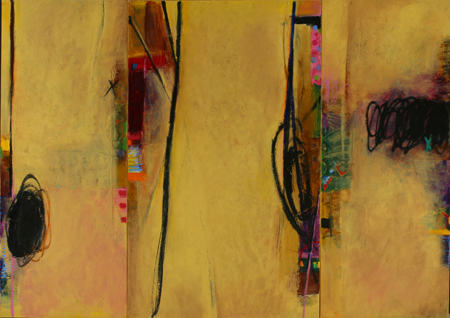
I seem to get two questions about my work lately: what is the inspiration and what do the titles mean. My usual, short-form answer is that the painting is the inspiration and the titles are the hardest part of painting and necessary just as people need names. So from my point of view, you really don't have to know a lot about painting to appreciate it. Just be there with it.
At the opening I was asked why I titled that yellow painting “Some Like It Blue.” (See January 2 entry for full explanation.) It was because I thought of it as a turning point painting, a hot painting, passionate, one that means a lot to me, one that I am still learning from. So I thought of the song “Some Like it Hot,” and just substituted Blue because this is about color and this painting is not blue. That makes sense, eh!
And by the way, here are the red and blue permutations that apparently do not go with the San Francisco light, but I am sure they will find a home soon:
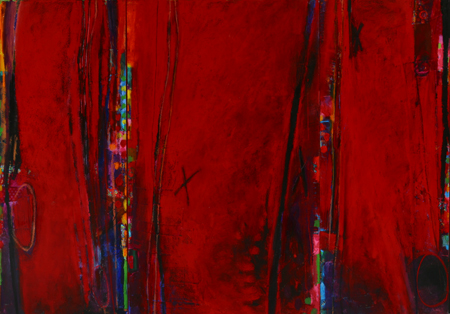
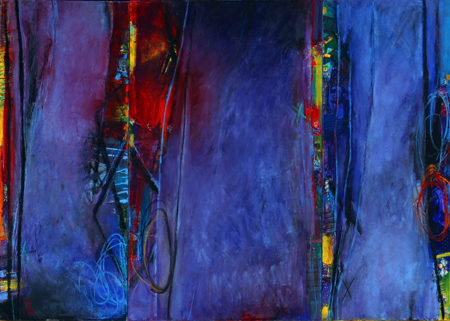
Now for a few words about the opening reception for my exhibit at the Linda Fairchild Gallery: it was good! A few more words: the work looked exceptionally good in a beautiful clean space, with high ceilings, that soft San Francisco light, white walls, so different from the clutter of my studio. I always enjoy seeing the work in another environment than my own, especially out of my work space. And the response was very positive. Two paintings had sold before the opening (those delicious red dots!) and other people expressed interest. I met some very wonderful, friendly people. Interesting conversations.
Linda is having lots of small gatherings in this space to promote my work (and herself). It will be mainly a living space. Very beautiful, fancy, elegant, etc. A large loft space, perfect for exhibiting artwork. So her future exhibits will be at the other space and this one will be for entertaining. A more private space. I'm not unhappy about any of it. Just want more sales (so I can buy more paint)!
On the plane to SF the woman sitting next to me talked with great, tender love about the city, again about the soft, pastel light. Linda had talked to me before about it being a muted color city and encouraged me to “think light.” Seeing SF helped me understand Richard Diebenkorn’s later paintings. Those colors are not my usual palette: I‘ve always been more attracted to intense reds, blues, yellows, purples, intense color of any kind. So when one woman said she was more attracted to intense color and she could feel that intensity in my work, I was relieved that not all of SF was sold on soft color, and we had a long conversation about color and environment.
When I was studying painting at Yale, under Josef Albers, he said repeatedly that color is relative. You can have perfect pitch, hear a note and know what it is, but if someone says to describe fire engine red, ten people would give ten answers. So what seems to be happening in SF is the city defining the art.
In Nova Scotia people in the country paint their houses with colors left over from painting their boats: bright greens, reds, blues. Bursts of joy in the often grey fog encrusted landscape. The art in Nova Scotia is……..well, anything goes. And so goes it.
My exhibition in San Francisco is titled Subject to Change. And change it has, many times. First I was to exhibit with another person. Then she dropped out because she didn’t have enough inventory. (Nice for me!) Then the location changed. From Linda Fairchild’s usual gallery space (921 Front Street) to a new space (One Buxome Place), then back to the old space, then finally to the new space, which is where it is now. Because of the new space needing attention, the date was changed from September 9 to September 23 which is what happened. And here I am now in Los Angeles with Tamar, Dan, Damian and cats Dante and Cocoa.
And one further big change: Tamar, Damian and Dan were to come to San Francisco but at the last minute, due to Damian starting kindergarten and all the changes in his life due to that, they were not able to meet me there after all. So now I am at their house in Los Angeles, soaking up the warm sunshine of Los Angeles, storing it up to carry me through the cold Nova Scotia winter approaching, and enjoying being with them, if only for a short week.
More later. Now off to buy persimmons and Asian pears at the Farmer's Market, an LA Sunday ritual that is special for Tamar and me.
I was asked (recently) if say, someone wanted a green painting, would I do a green one to please that person. Well, yes and no. That is a complicated question. I wouldn’t “do” and sell a painting that was just “done” to please someone else. I have to feel it works for myself as well. I do multiple panel paintings and each panel is intended to work alone and also within the context of the other panels. But I will sell them separately, sometimes. I have a (painting) habit to feed. Separating parts of some paintings works but there are some paintings that I refuse to sell as separate parts.
I sincerely believe that integrity is the main quality that is important for a good piece of art, be it visual, auditory or verbal. I also sincerely believe that it is ultimately possible to see or hear or read this quality. And today I came face to face with my need for integrity in my work. When Linda Fairchild was here this summer (June 30 entry) she suggested I stop using “x’s” in my paintings. I mulled it over and tried it out and found it very provocative, exciting, rewarding, etc. And difficult. I had to find something else to make the paintings work.
But………..today I found myself putting some “x’s” back into some of the paintings and especially a very large painting that has been hanging in my living room (over my piano). This painting absolutely needed that big bold “X”. It screamed, it cried for it. And even though Linda thinks she has a buyer for it without the X, I put the mark back in today and feel much better. If no one else wants it, I can live with it, with keeping the painting, as long as it has the X in it.
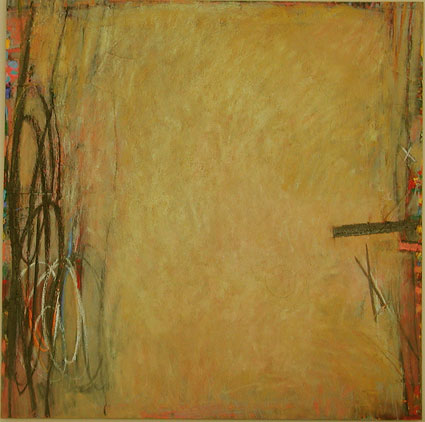
(You know, the color comes out different on every screen, so I hope this doesn't look too dark on yours. It's not a dark painting at all. Sometimes I am surprised how a photo can change depending on whose computer is showing it.)
When people ask me how I am these days (and these days it seems to be often), I find my self replying “busy.” Then, of course, they ask “busy with what. “ So then I have to think about why I feel so busy.
Well, for example: Wednesday the shipping company I use came to pick up five boxes of paintings I had, with the help of my friend Brian, packed up on Monday. Two boxes are now on their way to the Linda Fairchild Gallery in San Francisco and the other three are flying across the pond to the Halde Galerie in Switzerland. In the evening Yoko came over and we played duets and I was responsible for dinner.
Thursday I went to visit my friend Rowena who very generously showed me a lot of techniques and ideas she has learned studying watercolor and other water media. I’m going to be teaching a course entitled “Aqueous Media” this fall and need to learn everything I can before school starts next week. (Most of my technical skills are self-taught, I must admit, so this was a joy to have her show me new approaches.) Then, to top off the enjoyable morning, Rowena made a delicious lunch for us.
After lunch I went to visit another artist, a photographer, who had asked me to come over to see her work. She is new to the provence and interested in finding avenues for her (very good) artwork.
Friday morning some people came to look at my work. They were visiting from Toronto and had seen my work in the Studio Rally Map. (They bought two serigraph prints, a red and a blue.) Then, fortuitously overlapping the people who bought the prints, Susan Wakefield, who actually was the printer who helped me with the prints (she did the dirty work, inking and pulling the prints, and I had the fun, painting the artwork on the screens) came for lunch and to talk about Aqueous Media. She will teach the two classes I will miss when I go to San Francisco in a couple of weeks for the opening of my exhibit there.
In between, I am painting, doing Pilates, eating, reading, sleeping, swimming when possible (considering the weather, as usual), taking care of the photography, slides, emailing images, etc. And this is just a typical week. So I guess I have been busy. But I suppose it would be smarter just to answer “fine” and leave it at that. Easier all around, for everyone, and then I might not feel so busy. Maybe.
So the summer Olympics are over. My life will change again. I am a CBC radio addict and really really really enjoyed the sports announcers, every hour all day every day for ten minutes before the hour. I often wondered what they were high on. They had so much fun, joking amongst themselves, making jokes at the expense of the athletes, conversing with players and local people. I loved their energy and enthusiasm.
One announcer (and I am so bad about remembering names, please forgive me; I tried to look it up but….) talked seriously about what sport is: playing a game for pleasure, the activity being more important than winning medals. There is so much talk in Canada now about how we can improve our performance at the Olympics. Do we really want our children taken away from normal lives, from families and friends, to train so we in Canada can have more medals? Are medals the meaning of sport?
Oh, how I wish he could come to my school and talk to the students about their career as artists. It’s not about the product; it’s all process. That’s the mind that creates a good product.
Well, I had a conversation (on the phone) with the man who had been copying my paintings (see August 13 entry). I have known him for several years and actually the conversation was good. When I saw his recent work, I was not as upset as before. Even though it bears a striking resemblance to mine (quite shockingly so), it is better than it had been and so I didn’t feel so insulted. There is nothing worse, to me, than having someone imitate my work and do it poorly! So not being angry when I talked to him really helped. I was able to present my feelings calmly and we had a decent conversation. I was not attacking nor he defensive. Although he had known for a while that I was not pleased with what he was doing, he was afraid to call me. He was glad I called so we could talk about it.
But I have a tendency to cough (and I really mean have a coughing fit) when I am nervous, which I definitely was at first. So I told him my cough was from having just been in my studio and we talked about fumes, occupational hazards and such.
Then I mentioned that I had seen his exhibit at the gallery. And also that in the past month, at least a half dozen people told me they saw his work and had mistaken it for mine. And that I found this upsetting. As I thought, he is not aware that this is not right, thinks it is his own work, etc. He asked me for advice on his work, which was a reasonable request under the circumstances in that he had been a student of mine years ago. I told him I felt he needed to leave out the collage (a signature part of my work), that the collage might have been a good starting point for him but it no longer felt necessary--and necessity is the most important element to consider in making art. I also told him to focus on imagery that is meaningful to him, has integrity in relation to his development.
I think he understood. We will see. I definitely feel better about the situation.
I’ve been doing a lot of cleaning up lately. I bought a new bed for my guest/sewing room (it’s bigger and better than what I had) and had to rearrange all the furniture. As my sewing (and reading) habits are similar to my painting habits (very obsessive and absorbing), there were patterns and pieces of fabric hiding out in every corner and under magazines and books that never got put away because it always feels as if either I will use it soon or there is just not enough storage space or, more simply, I’d rather do something else usually than clean up.
So (this is a long preamble to say) I found some quotes I had typed out a few years ago when I was asked to give a talk at the Shambhala Centre in Halifax. My first response to the request was that I would be too afraid to do it. So she suggested then that I talk about fear. These quotes are about different artists’ reactions to the question of how they face a blank canvas, that gap in activity where anything can happen.
The sculptor Richard Tuttle said
If you force yourself, you’re just in the world of ideas, and there’s a distinction between ideas and inspiration. Agnes Martin (painter) reminds me that you can’t have inspiration every day. You have to learn how to handle yourself. Nervous energy is not acceptable and must be avoided. When a day begins with that kind of force, I take long walks to get rid of it.
I’m not too sure about the “nervous energy’ being a problem. The important point is not to get in your own way. Not to have formulas or be afraid of the openness of a blank canvas (or page). Creation as an act of bravery. I like that thought.
On the other end of the spectrum, the painter Susan Rothenberg said that she found it hard to get back to work after moving from NYC to New Mexico. “Then, one day, I suddenly got angry—enough time had passed—and I marched into the studio and set to work.” I personally find anger a good mechanism for breaking through blocks. Especially when a painting begins to look boring, feel clichéd, just doesn’t “do it.”
Then there is the trust that you need to have to make the marks. Joel Shapiro (sculptor) said “Your anxiety builds up to the point where you have no choice. Now, what am I afraid of revealing?” That’s a big factor in making changes, not standing still, not resting in that comfort zone of knowing what works. And not working for a period creates anxiety. Things can percolate from non-activity and that can be good. Yet there is always an inner compulsion, a necessity behind good work.
The painter Robert Mangold is quoted as saying “sometimes, in the studio, you can become too self-absorbed. When I go out and look at other work, I realize the world hasn’t stopped—and I’m motivated.” That is an interesting point, since so much of current art criticism focuses on what it “new.” In fact, we don’t work in a vacuum. Someone on the other side of the road can be doing the same thing without ever communicating with you. Can that be so very bad when it is all about communication anyway. And anyway, “Who’s on first?” or is it “Whose on first.” And that could be a whole other topic so...........
There’s someone in Halifax who is copying my paintings and selling them in galleries here and in other places. They are watered down, thin, not very good copies and it makes me very angry. I suppose I should feel flattered but I don’t. It feels insulting. It’s taken me years and years of studying and practice to come to the place where I am now. He hasn’t done the homework and it shows. I know because he took some classes with me and was very hard to teach. In fact, refused to try to learn anything except my techniques. None of the substance that led me to the decisions I make.
It’s not easy to create a good piece of art, one of enduring value, or even to know always when the work is worthwhile. I had some work returned recently from a gallery in Kentucky and was shocked to see what I had sent down. It was really bad. And I had thought, at the time, it was good. Some of my old pieces I still think are excellent, but my judgment was off on these.
But having someone “copy” my way of working and producing inferior paintings……….well that really makes me mad.
Just when I thought the pressure would calm down for a few weeks, everything was turned upside down (again) by a phone call from Linda Fairchild telling me that she would like to change the opening day for my exhibit in San Francisco (from September 9 to September 23) The reason is good, the effect will be good. I cannot complain. She is opening a second space and would like it to be with my work and a big celebration. But………….it means changing what was going to be an extended holiday visiting my children (and missing the first week of school in September) to a shorter, more efficient trip (with no visit in Montreal to see Aaron & Jessica and still missing a few classes) and the possibility that Tamar, Dan & Damian will not be able to go to San Francisco. But I will visit them in Los Angeles. There is no point in being in California without seeing them! But a stop in Montreal will have to wait. Darn!
The best part (for me) is that she is adding three more paintings to what we picked out (and I have already shipped to her) in July. And I feel these three paintings will definitely make the exhibit stronger. They are necessary additions.
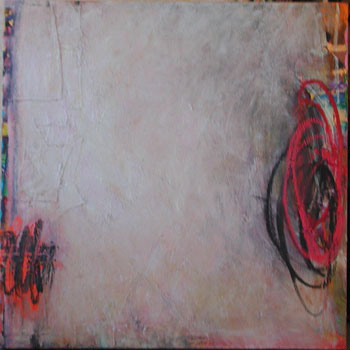
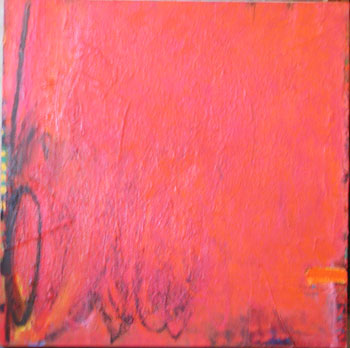
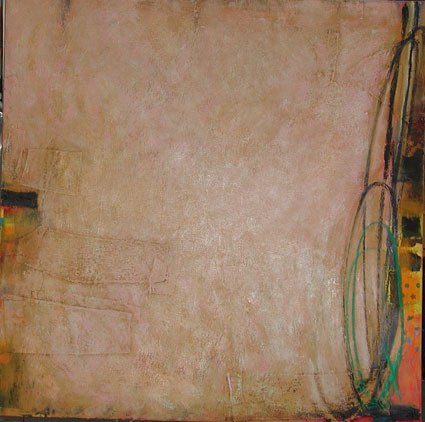
I’ve been listening to American Mavericks on Sunday mornings (CBC radio), an award winning program hosted by Suzanne Vega, the singer/writer with interviews with composers by Michael Tilson Thomas, the artistic director and conductor of the San Francisco Orchestra.
This morning the focus was on the relationships between art and music. The show was called If Jackson Pollack Wrote Music, and was subtitled Music’s Abstract Expressionists. The website describes the topic:
Contact with the abstract expressionist painters after World War II inspired many American Composers to look for a new American language in chaos, complexity and freedom.
Music from composers such as Cage, Brown, Feldman, Wolff were played (and can be heard on their website). The emphasis was on “freedom, chance, improvisation” for some, and “structure and scientific models” for others. Jackson Pollack’s paintings are referred to as a model for the music.
Considering that people will line up and wait for hours in line to see an exhibit of Robert Rauchenburg’s latest work but it is hard to fill an audience for a “new music” concert, the conclusion was drawn that music is more personal. I’m not sure about this. In fact, Rauchenburg is now a main stream contemporary artist and John Cage is a household name (well, in most households where the arts are of importance) equal in stature to Rauchenburg and Merce Cunningham, I think perhaps this is an over-generalization. We hear often of great painters “discovered” after they die poor and unappreciated. Painting too is very personal. When something is new, be it music or art, people too often think they have to “understand” something to enjoy it. It is true that the eyes are a major vehicle of communication and we “see” art more often and often more readily, whereas contemporary music does take a different kind of “understanding” and is not as “available” either in the everyday listening or in concert. It needs to be sought out.
When it comes to making art or music, the process is stated well by Jerome Kitze, a composer for 32 years, quoted on the website as saying:
I think you find your audience by not thinking about that very much. You’re doing your job and doing your work and not worrying about, let’s say, being rejected or accepted.
After my weekend in Annapolis Royal, I went to a poetry reading by someone whom I admire. Liking the person, I so much wanted to like the poetry. But I didn’t. And I didn’t know what to say to him. Other than the usual congratulations, what to offer. So I said very little.
But at the opening reception of my exhibit there was a man (who I didn’t know) who came in with very obvious sarcastic comments about my work. Clever comments, such as: “I REALLY like this one (of the nine panel painting, the one with the most yellow, the most activity). Can I buy JUST ONE of them?”....with a smirk on his face. It was funny, light-hearted, not insulting, really.
Not everyone has to like my work. Enough people do. I do. Toni does. That helps. And I do like to know what people really think. So maybe someday I will say something to the poet. Maybe. When the time is right.
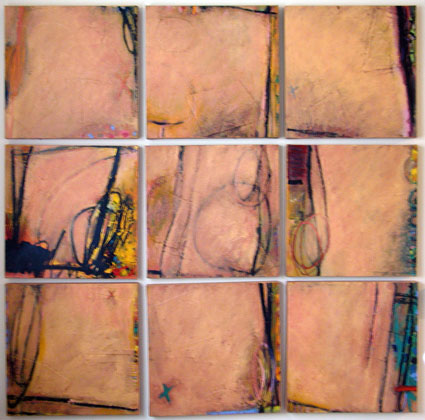
(The one my critic liked, or said he liked, was the second one down on the left. the piece is made of nine 20" squares, so it is 5' x 5')
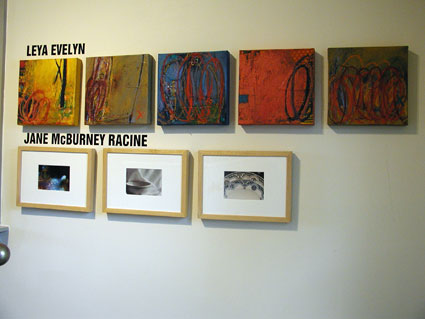
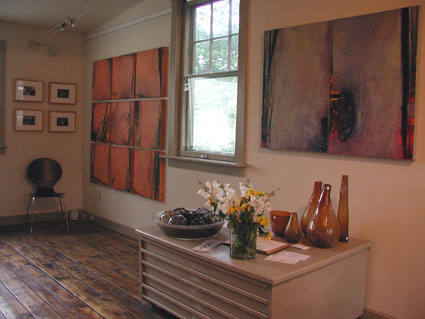
Just a couple of pix from the exhibit at Atelier 585. The opening reception was really good. Lots of good people, good friendly talk, good food and good drink. And the work looked especially good. Jo Stern, gallery owner, did a beautiful job hanging the work. More about this later, when I have caught up on my sleep! I’ll just have to let the pictures speak for now.
Just a couple of pix from the exhibit at Atelier 585. The opening reception was really good. Lots of good people, good friendly talk, good food and good drink. And the work looked especially good. Jo Stern, gallery owner, did a beautiful job hanging the work. More about this later, when I have caught up on my sleep! I’ll just have to let the pictures speak for now.
I just finished reading Enemy Women by Paulette Stiles. Although the writing is not as high quality as the story (just needs better editing), it is an interesting book historically and an interesting tale. About the Southern women during the Civil War in the States, their strengths, their struggles, how they were persecuted and abused.
The story is related through the experiences of Adair, an eighteen year old girl who becomes a strong forceful woman through her travels, incarceration and escape from the Union army (the story takes place in 1864). In the course of the story, she is forced, with her younger sisters, to leave her home, is captured and, having to leave her sisters, jailed, and befriended by the major in charge of the jail who then wants her to write a confession that would help her to be released. A task she ultimately did with great wit and intelligence, revealing her strong character and developing a bond with the major who did help her to escape.
Adair hated needlework and she could not imagine sitting and stitching the fine crow’s-foot seams……….Writing was the same, the pinching of thoughts into marks on paper and trying to keep your cursive legible, trying to think of the next thing to say and then behind you on several sheets of paper you find you have left permanent tracks, a trail, upon which anybody could follow you. Stalking you through your deep woods of private thought.
This struck home with me, the deep woods of private thought. It describes so well the creative process. Those private recesses of the jungle of the mind from which comes a reality that transcends, climbs to the highest tree and transcends even that in order to fly.
When I first started painting I was convinced that every piece of art I produced had to be completely spontaneous. An exhausting process coming from a dense jungle. At times I found various methods to organize this “spontaneity.” But when the “method” became a ritual stronger than the product, it had to be abandoned. Over the past ten years or so I have used literal visual cues as starting point, silk-screened photos of people important in my life, people to give me a charge, excite (for pleasure and pain). But these “permanent tracks” are deeply buried in the work. They are not there to be followed but to inspire, to jar, to open up, clear the jungle. To me all great art transcends “your deep woods of private thought” to reach a deeper private area, publicly.
”Of course,” Cesar went on, “talent isn’t enough in itself to make one’s way in the world. You do understand that, don’t you, young man? (Sergio) All the great art forms require a certain knowledge of the world, a deep experience of human relations. It’s quite another matter with abstract activities, in which talent is of the essence and experience merely a complement. By that I mean music, mathematics . . . chess.”
Being an abstract artist, I’m not sure exactly what he means. Maybe painting is not an abstract activity because it involves materials—paint, canvas—but the real activity of painting is time, space, not thought, but most probably, yes, the experience the artists’ life brings to that time and space—to make it a profound revelation over time and into space.
When I was in art school, there was a constant emphasis on not exhibiting too young, on garnering experience, learning, studying, maturing. That art is process not product. Things have changed. Youth is revered, blessed. And I often wonder what would have happened if I had not been so shy, not had so much fear on the personality level and been able to exhibit my work at a much younger stage. I’ll never know……………….
Speaking of exhibiting: I will be having an exhibit at a new gallery in Annapolis Royal. The opening reception is tomorrow night, Friday, July 16, from 5 to 7 pm at Atelier 585 (the reception will be followed by "Havanafax" Jazz Concert with Jeff Goodspeed and Lisa Lindo, at Hillsdale House, 8:00pm). Hope to see you there (both places)!
The exhibit runs until August 1 at 585 St. George St., Annapolis Royal, N.S., B0S1C0
Tel (902) 532-0284
Annapolis.Atelier@ns.sympatico.ca
Hours: Wed.-Sun., 11:00am-6:00pm
It really was a strike! Tomo, Yoko and I went bowling last night. My score was not too bad, considering. Tomo and Yoko were better, for sure. But partway into the game, I realized that if I concentrated more on what I was doing, not just throw the ball and hope for the best, but really concentrate, as in telling myself to keep my wrist straight, to think “strike” (i.e., get the ball to go down the center of the lane, not into the gutter!) it really helped. Not very different from playing the piano, where so often I find my mind drifting and then the notes wander away from the music and go into the gutter as well. I think it is different in painting, where my mind is tuned in whether I realize it or not, my reactions sometimes feel outside of my body/mind. Maybe because I have been doing it for so long and it is so much a part of my body language. But then there are times when my concentration is essential to make the right choices. And that’s where it counts on the scorecard.
I also realized after a while Yoko was doing so well because she used the shiny balls. That helped my game too!
Here they look like chocolate balls—good enough to eat.
When Linda Fairchild came out on Friday and suggested that I get rid of the x that I had been in almost every painting, it made sense. I worked on them over the weekend and everything looks so very good. Like a door opened up. In many places what needed to happen in the painting was a surprise to me. Without the x, the paintings are much stronger, more definite than with the x, the opposite of what I had expected.
Today she came to make the selection for the exhibit in September. She also had been thinking a lot about the x’s and had a very thoughtful comment. She said sometimes when something from the past has had its day, when you know it is time to let go, it becomes even more entrenched because it is hard to see that it has to go--and so hard to let go. Very interesting.
I have had a couple of very interesting days. Yesterday, Friday, my gallery owner from San Francisco, Linda of Linda Fairchild Contemporary Art, came for a studio visit. We are planning an exhibit September 9. (How I met her is an interesting story. Aaron was walking down Argyle Street in Halifax last summer and saw a friend out on a restaurant patio having drinks. He joined the group of people his friend was with and met the sister of his friend’s friend, who said she was looking for Nova Scotia artists to represent in her gallery in San Francisco. So Aaron said: “My mother’s an artist.” I can imagine what she thought: “Everyone’s mother is an artist.” I emailed her, she called me, I sent some work, I've been sending work, she's been marketing it, and the story continues.)
Linda was very enthusiastic about my new work when she saw it yesterday. But she also challenged me to lose the “x’s” that I have been putting in almost every piece. Now, I’m not attached to the “x’s”, I just get tired of circles and lines and need a mark, a color in a specific spot. And being obsessive (not compulsive), I sometimes get carried away with a mark. So this morning I worked into my new paintings, finding ways to either eliminate or sublimate the “x’s.” And I do see what she means. The “x” is a universal symbol that has deeper meaning than the painting needs. It stops rather than illuminates. The other symbols I use have mutated so that they don’t read only as themselves and I can see the “x” is finally doing the same because of the prod from Linda. Interesting.
You have to be brave to make art. Not think about the consequences. The times when you feel like you are working in a vacuum. No one to say you are okay, doing the right thing. Just believe all alone, trust, that you are. It takes bravery. Or stupidity. You be the judge.
One of the people who came yesterday for Studio Rally asked about those times, those places in a painting, when things are good but not quite right. Do I leave it or take a chance that I might ruin it by working into it more. My answer: I never let anything go that isn’t quite right. That’s the fun of it, taking risks. Making choices. I have more to lose by not working into it to get it to be what I feel is right. The ultimate goal is to make it feel so right that it is not possible to understand, see how it happened. And that often takes simple blind trust, bravery.
Terry Drahos is having an exhibit at the Grand Pre Winery Gallery. I saw it last Thursday. It was another cold rainy day. The work is very good, well worth the trip to Wolfville in any weather.
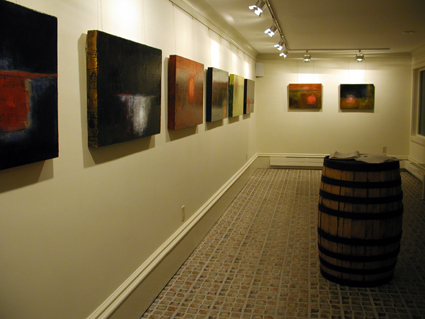
It will be up until June 11. All of the paintings are the same size which gives the long narrow gallery space a cohesiveness that it needs and showcases the work well (although I could have done without the wine barrel).
The gallery overlooks (through wired glass) the wine making barrels. I had some fun taking pictures through the (looking) glass:
Terry is pointing out the wine barrels behind the glass with her paintings reflected in the glass:
Tomorrow, Saturday, and Sunday are Studio Rally Weekend. I’ve been cleaning my studio all day. It hasn’t looked this clear of boxes and canvases and plastic and sundries since before I moved in seven years ago. If you are in the area, please do stop by!
I’ve been telling everyone (and I mean any one who comes within six feet of me!) that I bought $1000 worth of rubber matting for my studio floor! Very exciting news! It sounds much more dramatic than saying I bought 20 feet of rubber matting because standing on the concrete floor for several hours at a time was beginning to be unbearable on my back (and legs, and knees). So I am very excited that it is now down on the floor, covering the areas where I stand. But it smells oh so bad and I have all the windows open, two air purifiers going and the ventilation system circulating fresh air in constantly when I am in there. And the heat on because it is still very cold outside. (Yes I know it is Spring, but someone forgot to tell the weatherman.) The heat will also help with the out-gassing, accelerate it.
Usually when I paint I change my clothes completely, including shoes, wear a full face mask and rubber gloves. I look like Darth Veder on an undercover (under paint) job.
I love my mask, really. Making art is a dangerous profession, hazardous fumes, toxic materials. With my mask, the air smells pure.
I received the most interesting (interpret: “strange”) phone call yesterday afternoon. It was from a woman who had been given my card from someone who was at the RBC reception last Thursday (where I had some paintings displayed, along with other Studio Rally participants). She was recruiting new people for her office, had been given my card as someone who was “upbeat” and competent and she asked me if I would be interested in a job with her financial company, advising and helping people get out of debt. Now that is very strange, considering that staying out of debt is a major part of being an artist. And that I am not usually considered “upbeat” nor always out of debt. She asked me if I was happy with my work, if I was making enough money. Yes, I love my work, I am ecstatic, in love with my work and no, I don’t make enough money (to expand my studio and buy a new car) but I wouldn’t trade the financial insecurity for an office job, not on your life! Not after struggling so long to be able to see a (possible) end to my debt-load.
My life has been a financial roller-coaster, sometimes up and just as (or more) quickly, down. After 9/11 things were very (extremely) bad for a year and a half. But I am stubborn and I kept going, believing that, even though I had many sleepless nights, things would get better. That someone, somewhere would want my work. That it would start selling again. Be appreciated. And I have been very very very careful once I realized that the roller-coaster ride can continue unpredictably, even the track is not stable.
So when I hung up the phone, I went back to my painting, finding the conversation very amusing. And glad that I don’t need the job right now, nor the services.
Last night was the kick-off event for the (Nova Scotia) Studio Rally map for 2004. The Royal Bank, which has been a strong sponsor of the Studio Rally, invited their top 100 investors to a reception before taking them to a production of Cats at the Neptune Theatre in Halifax. And so our fearless Studio Rally coordinator, Adrianne Abbott invited a few artists, myself included, to display some work at the reception and (hopefully) talk to the guests. (Most of the guests seemed to know each other and were talking mainly to their friends and colleagues.)
Of course the main question I received was framed in the context of “I don’t know anything about abstract art. What does it mean?” So I gave the short form answer: just relax and experience it, don’t think about what it is “supposed” to mean. One young man said his wife thinks he is too one dimensional (thinks about numbers literally) and therefore doesn’t understand anything with depth. (Uh, oh. Sounds like marital trouble there.)
At the end, Adrianne came over and told us a man had said he “just loves artists, they are so fanciful.” He had asked a painter how much a certain piece would sell for (he wanted to buy it on the spot) and she replied she didn’t know, she would have to go home and think about it.
In case you are in the area, the Studio Rally Weekend is May 29 and 30, from 10 am to 5 pm. The (more than 90) artists and artisans on the map will be in their studios and you are welcome to come visit. Please do come visit! (And it’s a great opportunity for me to clean up my studio!)
A few photos of my exhibition at the Art Gallery of Lunenburg:
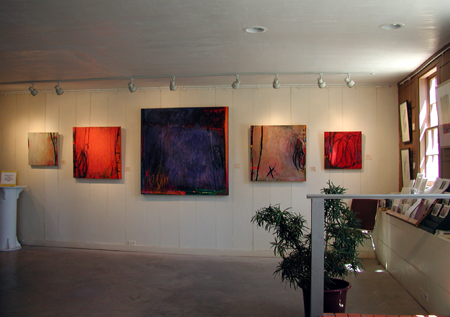
From another angle:
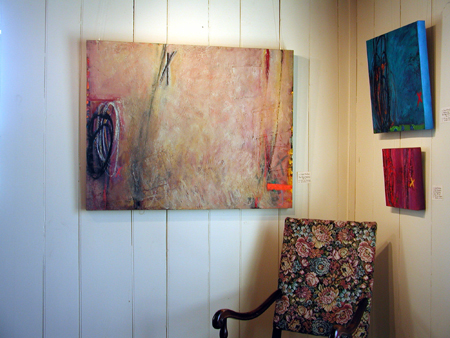
And another view:
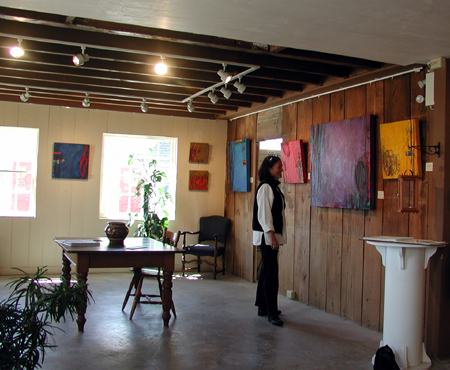
A closer view of some paintings. The next two (20" x 20") are from a series titled Measuring the Importance):
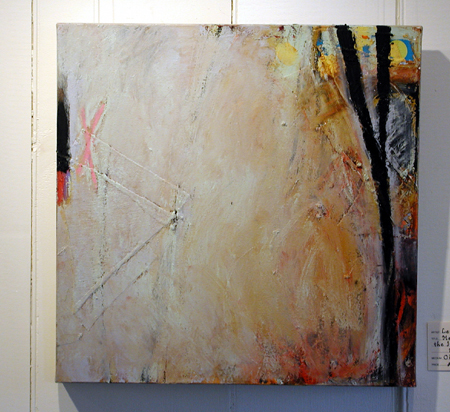
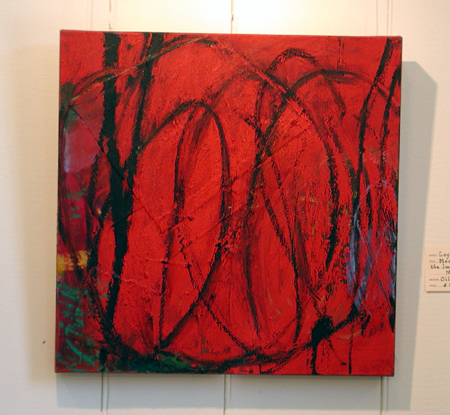
And another. (This painting is only 12" by 12" and is titled The Science of Everyday Life):
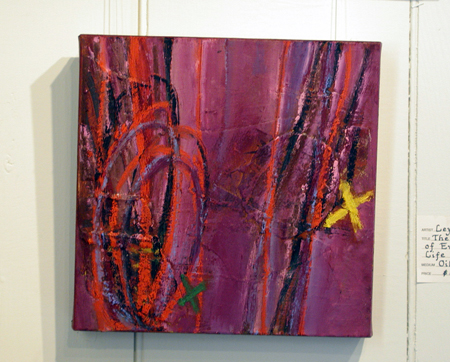
I also put four drawings of flowers in the exhibit. Here are two of them:
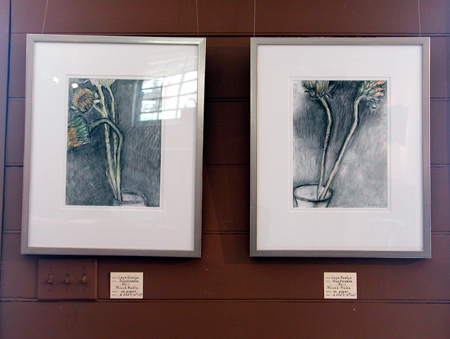
The opening reception for my exhibit at the Lunenburg Art Gallery was last night. I was extremely pleased with the way the work looked in the gallery. It was very satisfying. (I forgot my camera but will go back again soon to take photos for you to see.) A few of my students came, also friends from the area were there, a few from farther away and lots of other people, some I knew and did not know before. A nice party. It was late at night by the time we left Lunenburg.
On the way home Aaron and Jessica, who went with me, noticed some deer by the road. Then again more deer. Then a large herd crossed the road, probably eight to ten deer walked slowly in front of my (stopped) car. And it was a very full moon.
My paintings are now settling in to their new home for the next month in Lunenburg. It is a relief to have that part done. I kept changing what I was going to put into the exhibit right up to the last minute (depending mostly on what was dry and on the size restrictions of the gallery). It definitely has made sense to call this show Subject to Change although when I chose the title I was thinking more of my painting process: constantly changing, evolving, never sure where it will end, what the painting will become.
On the drive home (I took the long way, by the ocean), there was a concert of Dvorak’s music on the radio. They played the duet that Yoko and I have learned, one of the Slavonic Dances. And then they played one of my favorite pieces of music, the “Dumky” piano trio. (I had bought the record back when I was in school.) I remember when radios were new in cars. I am certainly glad they have them now. Once, a few years ago, I drove home from a retreat in Cape Breton with no radio in my (then new) truck. It was very spooky; the vibrations of the vehicle were accentuated by my month of silence. And now CD players are common, and even video screens, although I wouldn’t need that. The scenery is enough entertainment around here.
My truck is loaded with 23 pieces of art. I’m about to take off for Lunenburg, an hour's drive from here, to deliver the paintings. My studio looks only slightly less crowded, the sky has clouded over but my head feels clear.
Sunday I take 23 pieces of art to the Lunenburg Art Gallery for an exhibition that opens Tuesday evening, May 4 at 8 pm. If you are in the area, please do stop by. The address is 79 Pelham Street. The exhibit will be up until the end of May. You will have to call for gallery hours (902-640-4044).
This has been a hard show to put together because the paint wasn’t drying as fast as I needed it to. I had to keep changing what I was going to put in the exhibit. But now I have picked the work and have already started a (large) new body of paintings. So my studio is full and I will be happy to deliver the paintings to Lunenburg tomorrow. Hope to see you there!
My studio is a big mess! Paintings everywhere. Every time I tell someone I need a bigger studio, they say all artists want a bigger studio. But I REALLY DO need a bigger studio!
Yesterday when I was painting, a canvas fell down and of course punched a hole in another painting. And I keep bumping into paintings when I back away while I am working. Isn’t that proof enough that I need a bigger studio!
(I can fix the painting. It wasn’t finished yet but it is still unpleasant, to be sure.)
Such a mess:
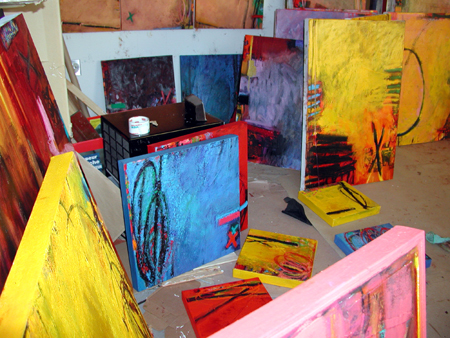
and more mess:
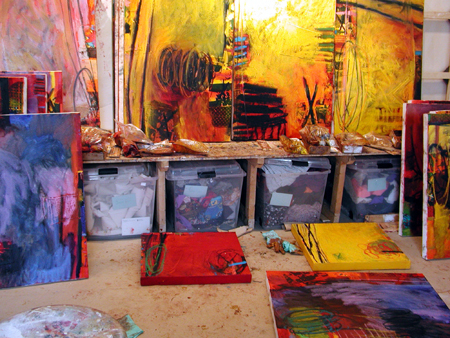
The paintings are on the floor because that is where the heat is. Still, they are taking a long time to dry.
My sister has been taking a photography class. Her photos are very good. She is just starting to put together a portfolio, just beginning. Another student asked her what she wanted to focus on in her work, what was her subject. It made her think about what she was doing in a different way, about what a portfolio, a body of work is.
It made me think about my photos, the snapshots I take around my life. I like to get up close. Very close. The same is true in my painting. Before, during and after.
There seem to be two approaches to making art. One is taking something universal, an idea, a concept, and making it personal. The other is to take something personal and make it universal. The latter is my approach. I’ve taken very personal photographs and worked them into my paintings. When the painting is finished, the photographs are barely seen, not recognizable, yet they infuse the painting process from the very beginning. Sometimes it is hard to look, day after day, at the photos I have chosen. They are there to give me a charge. They do inform the painting.
I used to think that a painting had to be pure, have no personal, recognizable emotional content, ever. Not at the beginning, not in the middle, and definitely not at the end. But this seems to be working. And at the end, no one knows the story, it does transcend my personal storyline.
Sunday was Graduation Day. 210 eager students with shiny faces and clean clothes (one wearing a beaver costume, another a striped jail suit) crossed the stage to receive degrees in various aspects of artistic discipline. And that is exactly what you need to succeed in art: discipline. And obsession. A disciplined obsession. A personal obsession that becomes bigger than oneself.
The first speaker, the Chair fo the Board of Govenors, addressed the basic insecurity of the profession, saying that artists are the historians of their times, chronicling the cultural nature of society. In the cultural tenor of the times, a comment like that is always appreciated.
Richard Serra, the world renowned sculptor, received an honorary doctorate degree. His work is in major collections internationally. (To loosely paraphrase his brilliant talk) he said that there are infinite ways to make art. There is no map of how to do it. Start with yourself, your own experience. Rely on your own needs, your own hungers, your own instincts. You have to do it yourself. We all have a subject. He ended by saying: “We are all more than we think we are. And today as you graduate, that is the most optimistic thing I can tell you.”
At the end of the validictorian’s speech, he turned to (now Dr.) Serra and congratulated him on his degree, saying he hoped it would open doors for him in the future!
When I was in art school, we would have long discussions about whether an artist, because he/she was looking for truth and beauty, was necessarily a moral/good person. I recently heard Wagner’s grandson on the radio trying to bring reconciliation to his grandfather’s anti-semetic rhetoric. The moderator was commenting on how most composers, other than Bach, are not known for their upstanding, moral character.
I think it was this program where Wagner’s grandson (or someone, I don’t remember who exactly) was saying that “the arts are a reason to be alive. Not a life support.” They show the potential of human kind. The product is not the artist.
Too bad. Wouldn’t it be nice if all the wonderful art creations around meant that there were that many wonderful, good, moral people as well.
One of my students asked me if I enjoyed teaching that class. I was a bit shocked by his forthrightness. Previously he had asked me who I thought was the best student in the class. This time I laughed and told him he asked the most interesting questions. And he asks them with such candor that I appreciate his questions.
No I hadn’t enjoyed that particular class. It was difficult. An odd assortment of students, not ones who could communicate well with each other. Too many different artistic goals, many disparate aesthetics. The students were difficult to teach. They had specific ideas about what they were willing to try and what they wanted and did not want to do. Next time I teach this particular class I will take a very different approach. I would start out more experimental, give them more of a sense of play from the beginning. My expectations were not related to theirs. My only concern would be that they learn to broaden their expectations.
The class was a collage workshop. It is something that I know a lot about, something I use in my work every day. But my approach comes out of years of working with color, originally in the form of collage, and an education that was based on process, not product.
I am really happy to have three weeks before the summer session starts!
It is the last week of this semester. We are having final crits at school. That means for me, talking to each student individually about their work. It is exhausting but fascinating as well. I’ve had some interesting conversations in the process.
I was talking to a student Tuesday about the difference between sweet/pretty and beautiful, the difference between sentimental and romantic. She comes to art school from a science background. She's been in two classes with me and I have watched her work (and her) grow from being very precise, almost delicate, always sensitive to a much stronger, experimental approach. There are times when the sensitive is too pretty and can be off-putting, when it is sentimental, doesn’t reach beyond itself.
She commented that over the semester when I had pointed out that certain parts of her work could be eliminated, strengthened, the ones where the work was from the past, was too careful, too much sentiment, she felt I was wrong. Until a few weeks after my comments when she would look at the piece again and see what I was talking about.
Sentiment can be sticky, cloying; romance is broadening. I love watching these kids grow in their work and in their being. It is romance for me.
What was it like in Art School for me? Being at Yale when Josef Albers was in charge? Intense. It was intense. I came to art school with minimal background in the basics of design and theory. I left with a profound experience in the process of making art. The focus was on process, not product. Every class was about understanding how and developing the skills to make things happen, the making of the experience. There were a lot of repetitive exercises, enough to wear out any desire for achievement and promote focus on the process of discovery.
At first, for about the first two months, I thought I wouldn’t be able to do it. In painting we learned the difference between drawing and painting. How to use color to make form. We used the same subject matter for six week periods—a dozen oranges, clay flower pots, drapery. It was difficult, a struggle, until one day, when the subject was two Indian rubber plants, I began painting the spaces between the leaves and suddenly I saw what it meant to use paint, not draw.
I had a class that met twice a week just on color. One of the classes was about color relationships with an assigned exercise (the ones in Albers book Interaction of Color). The second class was to bring in a free-form color study. These exercises were done with sheets of pure color, color-aid paper, infinite variations of color to work with. I found this very hard at first. I spent one full Thanksgiving weekend with a friend tutoring me about the relativity of color, how just a small fragment of color can change the whole piece, how to manipulate and enjoy color. Everything changed after that weekend.
It was an invaluable experience, art school. It gave form to my love of color and need to paint.
While I am on the subject of students’ homework (yesterday’s entry), I should tell you about the self-portrait another student brought in. She said it was awful and she would never do another one. (It wasn't that bad, just not up to her usual exceptional accomplishments.) So I told them about my Last Self Portrait.
When I was in my junior year at Brown University, studying Literature, a friend suggested that we go down into the basement and paint. I said sure enough, so three of us took some supplies and headed into the inner workings of the dormitory. I took a very large sheet of cardboard and some oil paint (maybe it was someone else's because I don't remember painting in oils before that) and I must have had a mirror as well. I used my favorite colors: purples, yellows, pinks, oranges, you know, the colors you find in skin (if you look closely). This was actually a seminal piece for me. It was what gave me the desire to paint, to be an artist, to dedicate my life to serving art. To go to art school after graduation. To keep painting. The process of painting that portrait gave me a sense of joy that I had never known before. It transcended the “me” that was so ever present, that was always walking two steps ahead of me. It leapt over that self-consciousness and broadened the world.
When I brought this wonderful (to me) painting home at the end of the year, and took it out of the trunk of the car, the father of my next door neighbor (the girl I had always longed "to be", friendly and likeable, the original girl next door), her father said: “What’s that? The booby prize?”
And the best part of this is that it didn’t effect any part of the rest of my life. I still paint.
AND my students have challenged me to do another self portrait. We will see. Maybe........
One thing I neglected to mention about my student who is contemplating quitting school is that it is his parents, both of them, who have insisted that he go to art school. Now that is a real turn around. Rarely do I hear of parents one hundred percent in favor of art school. And given the statistics about graduates, there is good reason. I have heard (and forgive me if I have the numbers a little off) that ten years after graduating, 10% (someone actually said 2%) will still be in the field, making art, and of those, only 10% will make over $10,000 a year from their artwork (it used to be $6,000 but there has been some improvement, maybe). My parents didn’t object to my going to art school. In those days the thinking was that I’m a girl and would get married, right? But they also didn’t object to my quitting. I had a B.A. in Literature and I knew how to cook and sew. But my history with school was never that I thought it a good place to be. (I even tried to walk out on pre-school at age four. It didn’t work. I was sent back.)
I had a student once who was complaining constantly about how stupid this school is, how much better his old school was, etc. etc. So I suggested he quit. The next year he was president of the Student Council. Either he was lonely and wanted to “fit in” or else he found a better way to complain.
In that one year of art school that I had, I learned invaluable skills. It was a very good year, difficult, demanding and rewarding. I had the best of teachers, the best of instruction. I can teach because I have been making art for many years. But I also learn as much from my students as they learn from me. Different things, definitely. I learn how younger people see this ever changing world, how they view the ever broadening field of visual art. But more important I learn how to communicate what I see and to see from their point of view and to find ways to help them clarify and develop their skills and ideas. I am still learning.
One of my students was goading me the other day. He’s one of my better students. Very talented, bright. Does work that shows integrity and directness. But he doesn’t always produce the work that is required, i.e. homework. And sometimes in class he seems inattentive. In fact, one day I had said to him, after he had told me he really wasn’t the slacker that he appeared to be, “You are too talented to be a slacker” and he made a face that told me he had heard that before.
But back to his goading me. He said he was going to crew on a boat this summer, one that was going to the Bahamas via New York and that maybe he wasn’t coming back. And what did I think about that. My reply was: “You are talking to the wrong person. I’m an art school dropout.”
“No way,” he said. “Can’t be!” And I just walked away. He can figure that one out on his own.
I did hear a jazz musician (on CBC radio of course) talking about education in the arts. As jazz is more improvisational than classical music (which is the way I feel about my painting process), he put forward the thought that “if a person is going to do it, they will.” No amount of education will change that. The important quality to have, besides intelligence and talent, is self-discipline. This is equally true in other artistic disciplines, writing, visual arts, disciplines where the heart/core of a person is the important quality that creates valuable work. I often wonder what my life would be like if I had stayed in school. It would probably be very different, but I’ll never know and have no regrets.
One of my students told me that some instructors draw during their classes and she suggested that I do that. My reply was: “You wouldn’t see me!” She said, “You mean you would be invisible?”
No, I mean I would become so absorbed in drawing I wouldn’t see them. But what an interesting idea—why not—become invisible. Then I could go around the room and draw on their work, make their drawings the way I would want them to be. So often it is hard for a student to hear what is incorrect about a drawing because they see it from their perspective and their history. And too, it is often hard to find words to express an artistic idea, critique. One picture is worth a thousand words. But then, I don’t usually like to draw on a student’s work, prefer having them make the discovery of correction themselves. Then the knowledge comes from within them.
On the other hand, what fun it would be for me to draw on what they have initiated, put my stamp, my conclusions on their ideas. One of the (many) difficult things about teaching is keeping my hands off their work. Not saying “do it this way, my way, the best way.” Sometimes their work is so exciting as a beginning idea to me that I would love to work into it. Maybe, if I were invisible, I could just take their hand in mine and gently guide them and they would feel the excitement of my ideas and experience. But for now, I will have to rely on words to show them, open doors for students. To draw pictures with words.
I was finally able to get back in my studio this morning. After so many interruptions--travel, school, snowstorms--it felt good that the paintings didn’t look strange or unforgiving for my absence. As if there is a thread that ties my life together no matter what kind of fabric I am using at the moment.
I’ve had a few days in Montreal, looking at lots of art, in museums and galleries. This trip I saw some very exciting exhibitions in the museums—from ancient clay sculptures to 20th century paintings and recent installation pieces. The one thing about Canada that causes concern for me for young students of art is that there is not much exposure to the old masters here or even to much of good contemporary art. Most of what is available to students is from slides and books. I was fortunate in living near the National Gallery of Art in Washington, D.C. when I was young and to have a family that fostered visits to museums. As a teenager I spent hours looking at Vermeers and Rembrandts. I would go to the Gallery just to see Rembrandt's Girl with a Broom. When I was an undergraduate in Rhode Island, I saw a painting by Richard Diebenkorn, a painting of a young girl with a teacup, that changed the direction of my life, gave my desire to paint more conviction, more urgency. This painting moved me so deeply, by the way the light moved down her raised arm, the one holding the teacup, that I knew then the joy I felt from painting could be received as strongly by the viewer. I was thrilled to see that painting again a few years ago in San Francisco at a Diebenkorn retrospective exhibit. Some paintings just stay in my mind like old friends.
I'm off again on Wednesday, this time to Montreal for an exhibition. A group show. If you are in the area, please do stop by. The address of the gallery is Galerie d'Avignon, 102 Laurier Oest. The reception is 5 to 8 pm on March 10 and the exhibit is up until the 28th. I will show three paintings, one red, one yellow, one blue. Hope to see you there..........
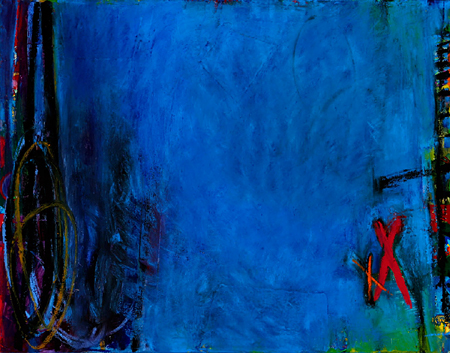
Sum of Its Parts, No.4
Sometimes I think I have painted my last good painting. That a painting is so good I cannot possibly do anything as good or better. Even though I work on the same idea, use the same marks, images over and over, look at the same thing from many points of view, standing still, repeating myself, does not appeal. I want to see progress of some kind. I hear in my head: “There’s nothing new under the sun” yet ………..So what am I trying to do, something new for the sake of new, something better for the feeling that life continues? Mostly it is the ability, chance to challenge myself.
When I went down in my studio this morning I felt like I might never be able to fulfill my commitments, that everything I had started would never come together. It felt very discouraging. Things weren’t drying as fast as I had expected. Images were not coming out. Everything was at a starting point but the bell hadn’t rung. So instead of racing to the finish point, I just kept plodding along. By the end of a few hours I could actually see progress, something happening. Maybe even another good painting. I am stubborn, persistent, and there is tomorrow. And I never lose sight that today it is a privilege to be doing this.
I do not think of art as therapy, at least not the way I work: painting, exhibiting, selling. I think of it as my job, what I do. It’s not self-expression. It’s my work. On the other hand, there are times when I think I may have to admit that what I paint does effect and reflect my inner life.
I had some upsetting experiences this week with some people close to me and then went into my studio and took an entirely new approach to a painting that had been subdued, a painting that never looked quite right, sat patiently waiting for something to change in me. I slashed it with aggressive strokes of paint and color and gave it a new life. If this is therapy, then anything in life could be therapy. But the painting is not me. It has its own life. It needed me to change. To be willing to take a chance with it, to do something different, more bold, wake it up.
A scientist friend of mine once said that he thought there was no difference between art and science. They both ask the question “what if?” In painting, there is rarely a chance to go back to what was there before a change is made, so the hesitation is more or less an obstacle, depending on the state of mind I might be in when working. At this point, I take more chances, ask more questions. There is not enough time to hesitate.
With all the snow abounding here (and more coming today) I have been struck by how beautiful it is. No matter how hard to navigate and how long winter is here in the North, the scenery is unbelievably beautiful. I cannot stop taking pictures, trying to keep the beauty forever.
When I was studying philosophy as an undergraduate, I was fascinated by Plato’s idea of absolute beauty. I held it to mean that there could be some standard to which we strive to attain, some beauty that was truth. The perfect painting waiting to be painted. Something everyone would know when they saw it, that it was beautiful, perfect. I once asked my Buddhist teacher, Chogyam Trungpa Rinpoche about this. He had been talking about absolute and relative truth. His reply stopped my mind: that absolute beauty was not a concept. I think he meant that we see beauty in relative terms. Every culture has its ideas about beauty and this too changes.
I have a friend whose cat is named beauty. Every time she mentions her cat by name, I am struck by the affection that conveys. True beauty must have a quality of connection in it. Are we connecting to what we know or to what we feel, like loving a cat?
I prefer my paintings to sit on the cusp between crude and beautiful, that they have a rawness that gives them life; not perfect. When they do, I feel the mystery of their creation. I read once that there is no point in striving for perfection because perfection is boring. The excitement is in the places where things rub against each other, make sparks, possibly make fire.
I love pink. It’s a naughty color. It’s intense. It demands response. One of the first assignments I gave my Collage class this semester was to do a piece using colors they usually do not like to work with. A majority of the class chose colors that I use often: reds, blues, purples. Pink also was not a popular color. It is too sweet you might think. When really it depends on how you use it.
Sweet can be hard to take, sweet in color, sweet in tone. But if you spice it with a slash of orange or a dot of red or bright green, it is pink of a whole other color. So my next large painting is going to be pink with all the trimmings--sour, bitter and sweet.
After spending half the day today stretching canvases and only fantasizing about painting tomorrow and actually thinking what in the world am I going to put on these canvases anyway (a new size for me, 30" x 30", small, I like to work big) and they have to be done by April for an exhibit I have commited myself to in May, I began thinking how I once could not have been so calm or so focused, knowing it will all come together in time, it does seem to, (years ago, when I first started painting, an invited critique from a friend would put me under the covers for a couple of weeks) and I thought about a friend who was telling me recently that, in her words, she is “coming to recognize the importance of a certain (measured) amount of vulnerability/sensitivity.” How exciting it is for her to meet or read about people who are “tuned into (sensitive to) what their surroundings are” and how this gives their work impact, power to effect other people. Yet there is still the need to balance the secretarial/custodial/housework with the creative work.
Being very sensitive is a blessing and a curse. It is not usually easy to make it an advantage, to find that balance of sensitivity and forward movement that is necessary to move, associate with life, even, sometimes, with the people who are important to reach. Too often it feels like a barrier in itself to communication even though the communication could be more insightful because of the sensitivity.
I was reading a book of poetry recently, On the Road Again by David McFadden and came across some lines that expressed this sensitively. In the last poem in the book he says:
give me the power to be sensitive
to the small flowers you cause to grow
in my head
and to the children and newborn lambs
that surround me
and
Sensitivity is a luxury the lucky
escape without abandoning
I took some paintings in to be photographed last week. The slides came out looking great, better than the paintings. The color was vibrant in the paintings, and more so in the slides. But after having the work out of my studio for a week, I saw that the image in the paintings felt unresolved. I took the paintings home and tweaked them, worked on them again for a couple of days. They are basically the same, just different. They look as good as the photographs now.
But I needed the slides to send to the Galerie d’Avignon in Montreal for her to choose pieces for a group exhibit in March. I sent off the slides. When I spoke to the gallery owner, I told her the story, that the paintings had changed a bit since they were photographed. She chuckled and said everyone does that. What a relief! I’m not the only one.
I’m titling my exhibit at the Lunenburg Art Gallery, Lunenburg, Nova Scotia in May Subject to Change because that is a good description of my painting process. When I told the Lunenburg Art Gallery that was the title, they thought it was just a working title and would change. But it is the paintings that change. Over and over and again.
Maybe I am making the creative process sound too romantic. It is, but………
I spent most of yesterday packing up some paintings to ship to the Susan de Witt Gallery in Naples, Florida (if you’re in the area, she has a beautiful space), making arrangements with the shipper, making sure I have the right export forms, filling out grant application forms, planning an exhibit in May, ordering the necessary canvas stretchers. Today I have to pick up some slides (that were duplicated) from the photo store, pick up some paintings that were photographed, submit the grant application (with fingers crossed!), and tomorrow the paintings (in cartons) will be picked up to go to Florida. Meanwhile, I have to sort more slides for various applications, galleries, duplication, etc. My dinning room table has seen more slides than food on it. Sounds like fun? I am happy to be in a situation where this is what I can and need to do, that my work will be seen. But it is not painting. Maybe tomorrow.
It's true, a person has to be a maniac to make art. To be so driven not even to think about the consequences. The possibilities of no one looking at it, any one or every one not liking it.
To be so driven that your need to put your particular twist on what has been done again and again overwhelms the rationality of doing it.
Forget about paying the bills and cleaning the house (well, perhaps figuratively, not literally, but definitely, when working). The pleasure, thrill of creating a work of art is all that is important.
I have been pondering Jasmin's comment/question to me (in my January 2 entry) about the motivation behind abstract art, what's in the mind of someone who paints with no recognizable image.
When I was in art school, a group of us drove down from New Haven, Connecticut to New York City to see the exhibit of Sixteen American Painters (I think that was the title then), paintings by the Abstract Expressionist group, Kline, deKooning, Rothko, Motherwell, and others at the Museum of Modern Art. We were all so energized by the adventure that we were issued a speeding ticket. Seeing so much strong abstract art in one space was confirmation for me that this was the direction I needed to go, what I needed to do.
What goes through my mind is similar to what brought on that speeding ticket: the excitement of seeing what paint can do, how manipulating the paint creates something that has no immediate story to tell other than itself. How color, marks, texture can have a life that transcends the process of choosing and creating them.
I do have certain qualities that I want a painting to possess, qualities such as weight, mass, color. The particular form that takes is dictated more from what happens as I work than what I think I am going to make happen. One painting informs another, breeds the next one. They don’t exist in isolation. And it all works best when I feel I have stepped out of the way in the process. Wherever the road takes me.
I was listening to an interview with the English writer, Martin Amis, on the radio this afternoon (CBC, of course). He was talking about how he listens to his body as his critique when he is writing. He honors his feet as they take him away from his desk when he is struggling with his work and as they bring him back after he has rested his body in a chair and thereby refreshed his mind.
For me, it is also the body that talks when I am working and it also has the final say. When I look at a piece to decide what to do next, to understand what is happening, I feel it, literally, in my gut. A visceral reaction.
A painting needs to have tension and excitement. It is easy to get stuck in some area that excites, pleases but nevertheless does not work with the rest of the piece. So there is often a feeling of sacrificing something in order to have the different elements work together. The areas that do not work well with the whole usually talk louder, have a voice that is discordant. Like when I was in eighth grade and wanted so much to sing in the choir. But the teacher always knew when I was singing, would say someone is off key in that section. So I would mouth the words, just to be there. But that didn’t work for long.
Sometimes I will think a painting is finished, photograph it, show it, but then later that uncomfortable feeling creeps into my experience of it and so I will continue on with it, sometimes with just a few minimal changes, sometimes for a couple of years. When a painting is finished, there is no anguish in the gut, no desire to change anything. And then the desire to look at it is constant. It is a feast.
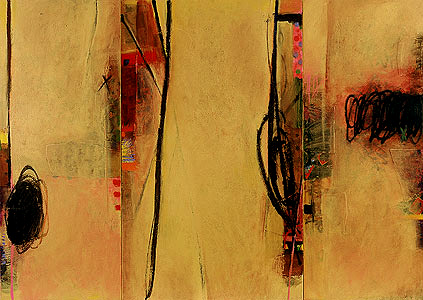
What’s in a name? I often find titling a painting the hardest part of the process. Years ago, I had a printmaking teacher tell me that I must name my work, even if I call a piece Fred, that titles are very important. Just like people need a name, so does artwork. A way of claiming it, giving it stature. So I began calling my paintings by different pet names, the name of my dog, Miranda, my daughter’s cat, Mithril, my neighbors cat, Nexus, and such like that. Then I began to get into more obtuse, obscure names, like Contingencies, or Landings. When I outgrew that, I began to use more poetic, fanciful names, invented while playing with refrigerator magnet words or words that arise on their own. Naming is still a mystery to me. Sometimes the title has a life of its own and is effortless, like the painting; sometimes it is a struggle, also like a painting. So this painting is, at present, titled Some Like It Blue. It is derived from Some Like It Hot, as this painting, and the series it has fostered, are, to me, hot. This is the painting that now dresses my livingroom.
I changed the painting in my living room yesterday. For the New Year. It may sound like a small change, but it was and is a big adventure. A friend came over and, after looking at my new work, suggested that a particular yellow painting should be hanging in my living room. I agreed. It is one of those IMPORTANT paintings (to me). So we took down the red painting (4’ x 5’) that has been hanging behind my piano for at least two years and brought the yellow painting (5’ x 7’) up. This also meant putting in new nails and changing the plant that would obstruct the new, much larger painting.
The result is shocking. The room is a different place, larger, more spacious, more welcoming. The painting itself is one that I feel holds within it a major, exciting shift in my work, a seminal painting, one from which I can keep learning. As silly as this might seem, it is as exciting as when I installed my new Miele dishwasher and would get up in the middle of the night to go down and look at it. An astonishing change, in that case, to something very sleek and understated. In this case, to something that tells a long rich story.
I was listening to Twyla Tharp, the dancer, choreographer, on CBC radio today talking about her new book, The Creative Habit. She says anyone can be creative. All you need is discipline, discipline to overcome laziness and fear. And to be really creative, challenge yourself, expand your repertoire. What used to lead me to make dramatic changes in my work every three or four years, now becomes more subtle yet important changes that keep me excited about what is happening and what will happen next.
This is a painting that comes out of a decision to take the borders off my work. A big decision that was brewing for two years. I needed the borders to contain what I was doing inside the painting itself. But then I seem to have outgrown them. Nevertheless, when I finally gave up the frame and borders that had originally been there to allow more freedom, I felt intense anxiety for a couple of weeks, until I grew into the greater freedom that not having them there created. Now that big change is part of my everyday painting experience.