
Tuesday evening. Two and a half days until Moving Day.
The "last time" moments are piling on top of each other now. Today Gloria, who has been coming to clean our house every other Tuesday for the past seven years, came for the last time. We've grown to like each other tremendously. Goodbye meant a lot of hugs and an exchange of presents.
Gloria gave Damian a Harry Potter Lego set. When we got home from dropping her off and running errands, Damian wanted to put it together. Well, actually, he wanted me to come and put it together for him. All those little pieces were too intimidating. I don't blame him. But I can't, not right now. Can't do it for him, can't do it with him. Can't do it. I told him if he was willing to wait till Saturday night in the first hotel room, I could. But not right now. He pouted. I went off to pack.
About half an hour later I came back into his room to pack his drum stands. He'd assembled the first little stand-alone vehicle and was sorting through the necessary pieces for the second.
I was impressed. The box says ages 7 to 13. Kid has some visual motor issues. This kind of tiny manipulative work isn't always easy for him. And yet here he was, age 7, doing a damned good job of it.
I'm not sure what the moral is here. Neglect your child doesn't seem exactly right, y'know? But if I'd cajoled and pushed, he never would have done it. Leaving him alone did the trick. And having a strong reason for saying no. He KNEW I couldn't take the time. So he did it himself.
I was amused to find out today from a friend that Dan and I are quoted in a currently popular baby parenting book. Turns out it's written by our first pediatrician. Turns out I actually jotted something down back then, when he told us he was writing a book and asked for quotable material. I had no memory of it until Dan reminded me tonight. Then again, I'm amazed I remember anything of that sleep-deprived zombie time.
Hearing that our names are in this book amuses me because we switched pediatricians between the six month and nine month checkups. Not because the first one was bad – and I suspect his book is quite good – but because when we first interviewed him, he promised not to pressure us into vaccinations. But once Damian was born, what did the guy do? Pressure us into vaccinations. We agreed to the first one after he scared the bejebus out of us about pertussis and little ones. But we figured that was it.
It wasn't.
It became apparent he was gonna scare the bejebus out of us about every single serious disease you can be inoculated against. Listen, if that's what you the doctor believe, you the doctor have that obligation. But then you the doctor should not represent yourself one way to anxious prospective parents and then turn around and scare them into doing something against their instincts.
If we hadn't inoculated Damian, would he have been autistic? I suspect the answer is that he would still have some issues, yes. I think he was born that way. But did the thimerosal in the three vaccinations he got make it worse? And would his impairment have been more severe with more of it in his veins? That we'll never know.
I'm not wildly angry at that pediatrician, even in retrospect, probably because I never saw a clear connection between vaccination and regression in my child. He never regressed, he just developed differently. But I do think we made the right decision switching to a doctor who truly respects and understands our choice, our concerns. It's just odd now to be quoted by that first doc, an implicit approval of his entire practice as a physician. On the other hand, he did give us excellent advice about soothing a cranky baby, and I gather that’s what much of the book is about. So it's right and fair that we be quoted. It's just… odd.
I've been dreading this day.
This morning:
"Mommy, where are the boxes that the jewel cases come in?"
"Um, what boxes?"
"The boxes. That the jewel cases. Come in."
It took a while, but he finally explained. He wanted the boxes to his computer games. He likes to look at the illustrations.
"I packed them this weekend, along with the computer games you didn't want to take with us."
Thus ensued much gnashing of teeth and cries of "You MUST unpack them! I NEED them!" and no patient reiteration of "have you seen the mountain of boxes in the guest room? I can't unpack anything anymore. You know that. We've talked about it," none of that made much of a dent. The rage machine had to run down on its own, interspersed with many "Don't EVER do that again!"s.
Late this afternoon:
"Mommy, have you seen my Simon Sticks?"
"I packed them."
See above.
Two weeks ago, when I first tackled Damian's room, I asked him which toys he wanted to donate, which pack and which keep for now. While explaining that nearly everything he earmarked to keep would only be around and available for two weeks (ie: until now), with the exception of the few toys we'd take in the car. He understood. He accepted.
Theory is different from practice.
I understand. I do. It's hard to part with your stuff even though you know you'll see it on the other side. In a way, it's hard to conceive of the other side even though it's coming soon, sooner, soonest with the inevitable inexorable and yes, exhilarating march of minutes. Damian is committed to this move. He admits it all feels weird but also acts and seems and says he's excited about it all. But this in-between, when our stuff is inaccessible, sealed up inside a hundred boxes, here but not, this is the hard part.
Edited to add:
Tonight, as Dan was kissing Damian goodnight after telling him a bedtime story, Damian commented, "I know one thing that won't get packed."
"What's that?"
"Your stories."
Damian turns seven tomorrow. He told me today was about saying goodbye to six and tomorrow will be about saying hello to seven. When Dan came in with a shopping bag full of presents, Damian hid his eyes. Even when he came into the bedroom later, he walked in with his eyes closed. "I don't want to accidentally see any of the presents." And so he didn't.
I wish we could make more of his birthday this year; we just got back from our life-altering trip east and first Dan, then Damian got stomach-wrenchingly ill. Still, we'll give presents and hugs tomorrow and make much of him, and Sunday we'll invite a few of his friends over to communally demarcate the division between six and seven, and we'll take him to Legoland and Sea World next week and call it a late birthday present. And I hope it will all feel like a true birthday, like a celebration, like love.
Seven years ago this minute, as I write this at ten p.m. on May 4th, seven years ago I was deep in labor. Transition, in fact, where it gets so painful and so sustained you think you're going to split wide open, cra-aa-ck, like an eggshell. Seven years ago an hour from now, I started to push. Not the end of the journey, it turned out, but a deeper descent into a nightmare night. But the story ends happily, with a healthy baby and a scar across my lower abdomen.
It took a long time to heal both physically and emotionally from that night, but now, seven years later, it finally feels distant enough, separate from me, simply the story of my baby's emergence into the world. At 4 a.m., my child was born. At 4 a.m. tomorrow morning, he will turn seven. The top of his head reaches my armpit now, his dark hair is thick and straight, and his laugh contagious. He has so much to say, and such bright eyes when he says it. So now, finally, yes. I can celebrate the anniversary of the day he was born, not just because it was the necessary prelude to parenthood but because it is simply what was, part of the pattern, the weave, of my -- and his -- life. And what is now comes from that, past is prologue and present is a child's kiss on my cheek and a sweet goodnight.
This past month has not been good to Damian. First came the flu. A week and a half of fevered misery, curled up on the couch on a parent's lap. Then he had a respite, a few days to go see Robots and eat out with Mommy and frolic in a toy store. Then, boom, the stomach bug hit with cramps and all the other not-pretty aspects thereof. Then, finally, better?
You'd think.
He went back to school last Friday. Had a great day but, um, itched. We gave him a bath Friday night (it had been a while, due to illness), figured that would fix the problem. Saw some scratching over the weekend, not a lot, but just in case, I gave him an oatmeal bath Sunday night, bought special gentle non-irritating, non-drying liquid soap with aloe and other good stuff, used that too. Used A&D ointment. Monday, I saw lots of scratching. Red spots that came and went all over his body (and face). Welts that came and went too. Gave him another oatmeal bath. Seemed to help. Skipped Tuesday but yesterday (Wednesday) seemed particularly itchy, so in he went for another oatmeal bath.
After last night's bath, I slathered him with vitamin E cream and aquafor and then watched him particularly closely. Not a single scratch. All evening, all night, all morning too. All the way through to his midmorning school dropoff. Problem solved?
When I went to pick him up from school, I could see him through the fence. Scratching. When he got close to me, I saw. Red blotches on his face and belly again.
I finally did what I guess I should have done days ago. I called the pediatrician's office. The nurse confirmed what I was beginning to suspect. Looks like an allergy. To what? Who knows? But right now it sure looks like it's something at school.
Fuck.
This is going to be hard to track down. If they're even willing. I have no idea where the law lies in this regard, though I certainly know where common decency lies. If a kid is in extreme discomfort throughout the school day, you have to do something, don’t you? If you can figure it out, that is. But what if it's something in the air, the result of some work done over break? Or what if it's a cleaning solvent residue, maybe they changed their brand but the new one is a district-wide purchase? If the culprit is at school and they can't fix it, then what?
This could get complicated. My poor kid.
Still sick but I have a lot of thoughts floating around in my fevered brain and I'd like to write down at least a few before I lose them all. Currently uppermost:
I read two articles back to back yesterday that seemed to fit together hand in glove. First, today's New York Times has an article about Columbia High School in Maplewood, New Jersey. It caught my eye because we'd considered Maplewood as one of the landing spots for our theoretical, hypothetical and completely uncertain move east. Anyway. Schools there have a great reputation. The high school gets good test scores, sends over 90% of its graduates to college, and so on and so forth. And this is a liberal town, known especially for its racial diversity. And the high school is in fact diverse: 58% of the kids are black, 35% are white, with droplets of Hispanics and Asians filling out the rest. (An aside: why is it that Hispanics and Asians have so little presence in Jersey suburbs?) But apparently that diversity doesn't show up in the classroom:
Though the school is majority black, white students make up the bulk of the advanced classes, while black students far outnumber whites in lower-level classes, statistics show."It's kind of sad," said Ugochi Opara, a senior who is president of the student council. "You can tell right away, just by looking into a classroom, what level it is."
Kind of sad? Yeah, you could say that. Apparently this so-liberal so-racially integrated town has a few blind spots. They divide kids into four levels, theoretically by ability, but it sounds like parent bullying and pleading have some effect:
The superintendent of the district, Peter P. Horoschak, acknowledged that there were, in a sense, two Columbias. The de facto segregation is most visible at the extremes. Statistics for this year show that while a Level 5 math class, the highest, had 79 percent white students, a Level 2 math class, the lowest, had 88 percent black students. Levels 3 and 4 tend to be more mixed, though a school board member, Mila M. Jasey, said, "Some white parents tell me that they know their kid belongs in a Level 3 class but they don't want them to be the only white kid in the class."Though parents and students are granted some input, students are supposed to be placed in levels primarily based on grades and test scores. Many black students complain that they are unfairly relegated to the lower levels and unable to move up.
Kind of sad, yeah, you could say that.
Even though Jeffrey Gettleman, the Times reporter, is writing about the high school, it sounds like the divide runs deeper in this particular town. I read a long discussion in the Maplewood-South Orange forum about what had sounded like a wonderful, progressive "demonstration" school they've set up, partly to address the de facto segregation in a town where property values affect the student population of any given elementary school (more expensive houses usually means more white kids in that school). This is a magnet-style school, drawing children from the local area (primarily black kids) as well as kids from other Maplewood districts because their parents like the sound of the school. Well, hell, after reading about it online, I like the sound of the school too. But. According to a few people on this thread, guess what? Nearly all the kids in the demonstration part of the school, ie, the project-based, multi-age cluster hands-on teaching part, are, can you guess? Yeah, mostly white. And the kids in the regular neighborhood school part? Mostly not. Why? Probably because if a parent is going to send her child to a particular school because of a particular philosophy, she's going to do her damnedest to make sure he gets into the progressive classroom. And you can't blame the parents, or the school for accommodating them. But you can blame the school, I think, for not then saying, "gee, this is a popular program. Let's enlarge it to make sure we can offer it to the disadvantaged neighborhood kids." Seems to me that classroom segregation within a larger racially mixed school environment is actually worse than a school with a single racial makeup. Because this teaches that kids with different color skin have and deserve different levels of education from each other, that some are therefore inherently better or smarter or some other crap. And it exposes children to each other in such a glancing, sideways way, they'll only learn to think of each other as Other, never making friends across that divide.
(A note to cover my ass here: this is all purely from reading the forum -- I have never personally visited the school.)
Back to the high school: What if you could remove the parental persuasion factor from the decision on which child gets a higher level of educational challenge? You'd be left with grades and test scores, right? Which are objective, right?
Which leads me to the other article, F for Assessment, in Edutopia Magazine (found via this Kos post). W. James Popham cogently attacks those very test scores that the school is theoretically supposed to use to differentiate children.
For the last four decades, students' scores on standardized tests have increasingly been regarded as the most meaningful evidence for evaluating U.S. schools. Most Americans, indeed, believe students' standardized test performances are the only legitimate indicator of a school's instructional effectiveness. Yet, although test-based evaluations of schools seem to occur almost as often as fire drills, in most instances these evaluations are inaccurate. That's because the standardized tests employed are flat-out wrong.
What does he mean? Well, among other things:
Because of the need for nationally standardized achievement tests to provide fine-grained, percentile-by-percentile comparisons, it is imperative that these tests produce a considerable degree of score-spread -- in other words, plenty of differences among test takers' scores. So producing score-spread often preoccupies those who construct standardized achievement tests.Statistically, a question that creates the most score-spread on standardized achievement tests is one that only about half the students answer correctly. Over the years, developers of standardized achievement tests have learned that if they can link students' success on a question to students' socioeconomic status (SES), then that item is usually answered correctly by about half of the test takers. If an item is answered correctly more often by students at the upper end of the socioeconomic scale than by lower-SES kids, that question will provide plenty of score-spread. After all, SES is a delightfully spread-out variable and one that isn't quickly altered. As a result, in today's nationally standardized achievement tests, there are many SES-linked items.
Unfortunately, this kind of test tends to measure not what students have been taught in school but what they bring to school. That's the reason there's such a strong relationship between a school's standardized-test scores and the economic and social makeup of that school's student body. As a consequence, most nationally standardized achievement tests end up being instructionally insensitive. That is, they're unable to detect improved instruction in a school even when it has definitely taken place. Because of this insensitivity, when students' scores on such tests are used to evaluate a school's instructional performance, that evaluation usually misses the mark.
Socioeconomic status. Right. That'll really help the kids from disadvantaged backgrounds, won't it? And if you start to use those very tests to choose the kids who then get more high level teaching? You're going to continue segregation, sure as a winter night is long, dark and depressing.
I'll grant you that it's a difficult conundrum. I know for myself as a parent, I've become very concerned with the fact that there is absolutely NO differentiation in Damian's current school, so that he may be a grade or two above his classmates in reading or science aptitude but won't be given a chance to stretch his brain even a teeny bit. But can it really be that hard in a liberal town to figure out a way to ease the ratio, to pick out smart kids from lower socioeconomic brackets who might not test well but sure want to learn and sure seem to soak up knowledge, and yes, you as teachers can in fact pick those kids out if you use your eyes and brains. What if you give those smart black kids (and in this situation most of them are black) a chance for that Level 5 class? Y'know, just to see if they can keep up? And maybe, y'know, to help them with some extra tutoring to, y'know, potentially give them a leg up FOR THE REST OF THEIR LIVES?
And this is a liberal town. I have to assume it's a question of, well, yeah, I'm liberal, but this is my KID. And like I said, I can understand that. To some extent. I too want the best education for my child. I may differ on what that means (hint: has less to do with test scores than with interactive, engaging teaching methods) but I want that too. But so does every parent. And for this ugliness to crop up in a town that prides itself on its diversity, well. Wow.
Um. Anyway. That's what I've been thinking about.
First Damian got sick. For a week. Sitting on the couch wrapped in blankets, insisting on my constant presence. Then, just as he started feeling better, spring vacation hit. His, that is. Not mine. Nor Dan's. Dan, in fact, stayed at work until 1:30 a.m. one night. Dan is on deadline. So. Week One. Damian sick. Week Two. Spring Break. Week Three, get that kid back to school and get some work done?
Nope. Sunday morning Damian walked into our room and threw up all over the floor. Poor kid. Poor us. He's been home for three days and, judging from the cramping pain he was in last night, he'll be home the rest of the week. And. Yesterday I started feeling achey-feverish. As did Dan. So now we're all sick.
I am so frustrated I want to scream. I have a rewrite I desperately want to start and, as always happens when I don't write, I feel like a worthless nonentity taking up room on this planet but doing nothing of substance. I hate that feeling. I have to write. I'm too sick to write, and besides, Damian is home and Dan is not only working hard this week (through the flu because he can't take a day off, not with this deadline), he'll be working hard this weekend. And next week.
This sucks.
That is all.
No, that's not all. I find myself thinking � found myself thinking last night as I soothed Damian at 12:30 am � that I'm actually one of the lucky ones. Assuming he goes back to school Monday, Damian will have been out of school a total of three weeks. If I had a job as intense as Dan's, what would we have done? Hell, if I had a part time job in a bookstore or an office, what would we have done? Some well-heeled folk have full time nannies, yes, but most parents don't. By this stage in a child's life, most either have nannies who come to pick the child up from school and stay a few hours till evening, or they rely on on-site childcare at school or at a YMCA. And if your child is sick? He can't attend. So you have to stay home with him. And jeopardize your job, because who has that many sick days stored up?
What do other parents do? Not everyone has this luxury to stay home with a sick child. Most don't. I may hate the idea of myself as a stay at home mom, but damn. It comes in handy sometimes.
Sit on bed, minding your own business. Child hops on bed. "Mommy, I want to do something with you."
"Sure, what do you want to do?"
"I don't know. You think of something."
"How about we take a nap? I'd really like that." (You are tired.)
"No. No naps. Think of something else."
"Um… we could read a story. Or watch TV." (Trying to think of things that require no physical exertion whatsoever.)
"Too boring."
"Well, why don't you think of something, then?" (Something low key. You are, yes, tired.)
"I don't have any ideas. You think of more things."
"We could do anything. Draw a picture, bake a cake, do a puzzle…"
Watch child's eyes light up. "You gave me an idea! We could bake brownies and then while the brownies are cooking, we could have dinner and then we could eat the brownies for dessert."
Sounds so benign, doesn't it?
You sigh inwardly at the calories you'll undoubtedly consume, while simultaneously (and visibly) smiling with pleasure that your kid did after all come up with his own idea.
Go to kitchen to investigate ingredients. Unsweetened chocolate? Yup, back behind the peanut butter chips. Man, this stuff must be old. But it looks bug-free, and chocolate doesn’t go bad, does it? Decide to use chocolate. Unsweetened cocoa? Yup, got that. Butter? Yup, that too. What the hey, why not make the brownies? After all, it's a semi-structured activity, a chance to interact while working on a project that involves exactly zero small rubber frogs.
"I want to eat some of the chocolate."
"You won't like it. It has no sugar in it."
"I want to! Can I have that one?" Pointing to half an ounce of pure unsweetened cacao.
Offer child a teeny head-of-a-pin homeopathic sliver instead.
"Ptui! Yuck!"
Explain how the chocolate he likes has other ingredients to mellow the flavor. Put chocolate and butter in saucepan. Show child the lumps of yellow and brown. Ask him simple questions like: what's going to happen to them? And: What colors will they be? Feel good about the interaction, about stimulating him to think and be part of the process that way.
Turn to the cocoa. Ah, another little lesson, this one perhaps more age-appropriate. "We need two thirds of a cup of cocoa. But we only have a one-third cup measuring cup. What should we do?"
His first thought: we should buy a two-thirds sized cup. But none exist. Confounded, he reconsiders. We should have two one third measuring cups, then. Smile, "You're very close." Explain the methodology.
Wonder why you haven't explored math in the kitchen before. Heretofore baking together has been all about stirring and pouring and whisking and running a knife across the top of the measuring cup to knock off excess flour. Actions, not concepts. Feel proud of yourself. You could even be a homeschooler, the way this is going!
Kid dumps cocoa powder into now-brown now-bubbling butter-chocolate mix. You stir, put it back in stove. Time to measure sugar. No, not to eat it. No, really, child, don't stick your fist into the sugar bag and stuff your now-crystallized hand into your mouth. Please. You're six years old, not two. Kid has a sugar addiction. Wonder where he got that from? (Give you a hint: not his daddy.)
Moving right along: You and kid pour sugar into dark, muddy chocolatey concoction on stove. Stir and go back to butcher block counter. Next step: cracking eggs. Kid is relatively interested in the whole separating-out-the-whites process but doesn't really want to hear about the properties of whites and yolks. Maybe next time. Meantime, kid wants to get into butcher block drawer.
Get irritable. Kid is not listening. This is supposed to be baking-together time, not child-drums-with-utensils-while-Mom-makes-overly-caloric-treats. Discover kid is looking for whisk, ie: thinking ahead. Have Egg Whites, Will Whisk. Feel chagrined, nay, positively guilty. Kid was more involved than you knew. Apologize, praise, continue.
Smell something burning. But what? We're baking here, not – oh. Right. Chocolate-butter-cocoa-sugar concoction, the heart of the brownie recipe. Burning while you debated whisks. Turn off stove. Check chocolate mixture. Decide it's okay except for a tiny bit at the bottom. Hope you're right.
Continue. Whites, whole egg, whisk. Flour, baking powder. Discuss tablespoons and teaspoons, halves and quarters. Back in the math groove, maybe it's not too late to rekindle the whole baking-as-learning-and-togetherness deal?
Mix dry ingredients with (clean) hands. "Why are you using your hands, Mommy?" Because… um… because they're here and clean and everything else is full of chocolate goo?
Kid is interested in everything again, watching the melding of egg and chocolate, readily answering the question: "How long do I stir the flour in? How do I know when to stop?" Calories are worth this, definitely. This is great.
Kid leans forward, wanting to peer into the pan as you pour the brownie mix. Drops his raisin box on the floor. Raisins scatter everywhere. Kid cries buckets. Remember, he just today got over a week-long debilitating bout of flu. He has low self-regulation reserves. Kid wants, not more raisins, that would be too simple. No, kid wants a toaster pastry (Nature's Way, the organic version of Pop-Tarts).
"Sorry, I can't give you one this close to dinner."
Kid cries more buckets. Wails turn inevitably to a coughing fit (a flu remnant). Coughs erupt in vomit. Copious amounts. All over the kitchen counter. In measuring cups, mixing bowls, everything. Except, miraculously, the pan with the brownie mix.
A lesson, yes. But for whom?
Brownies come out well, though. And kid is in a good mood for the rest of the evening. Go figure.
The moral of the story: Life is messy. But sweet. And sometimes chocolatey.
That brand new charter school? Damian got in. We found out Saturday. Big question: will they be able to provide special ed support (occupational therapy, speech therapy, possible aide in the classroom). A very big question indeed because last year when I was frantically searching for a tolerable kindergarten placement, the head of the progressive charter school I sort of liked told me that they might not be able to provide for his need and then avoided my phone calls as assiduously as a studio executive might avoid a fired-but-doesn't-know-it screenwriter's calls.
So tonight I went to an open house for the school, a chance to ask questions directly to the brand new principal and the founding educator (the woman who has done the most to shape the concept behind the school). I asked each of them the same question: how much ability do you have – financial and otherwise – to support kids with special needs? I liked their answers, which boiled down to: we don't know the particulars yet, but whatever another school can do, we can do. And they both said they'd know more in a few weeks and we could sit down and talk then. Works for me.
As I was entering the small building (a guesthouse-turned-intimate-theater, a wonderfully rococo relic from Old Hollywood), I gave my name to the woman at the table. The man in front of me turned around. "Tamar? I'm Paul!" (Not his real name.) He reminded me where we'd known each other. I think I can be forgiven for forgetting: when I knew him he was still in college and I'd just barely graduated myself. We worked together on my very first editing job in New York. Now we're middle aged, with kids who may be going to the same school next year. He's still in editing; episodic drama, just like Dan. (He remembered Dan from New York too.)
As I stood in the middle of the room, trying to get my bearings and chatting with Paul, a woman leaned forward to look at my nametag. "Tamar? Are you Dan's wife?" She worked with Dan seven years ago, they were both editing on a short-lived TV series and I was pregnant with Damian. Her oldest child is a year younger than Damian and also in kindergarten. It looks like she and her husband are taking the plunge, pulling their son out of private school and trying this new charter school out. Our kids might end up in the same class.
Then, as we were chatting, a man came up. Started talking editing shop with the woman. She introduced me, mentioned Dan. The guy looked at me. "I think I met you. A long time ago." Dan had just gotten bumped up to editor and was interviewing potential assistants. This man came to our apartment for an interview. He ended up getting another gig before Dan had made a decision and so backed out. Now he too is a TV drama editor. His eldest daughter is going to a local Jewish day school. Which school? Oh, the one affiliated with Damian's first preschool experience, before his diagnosis. He and his wife will probably pull her out, send her to this charter school too.
Much later, as I walked out of the building, after hugging the founding parent who is a friend of a friend (and who works on the same show Dan does, though as a writer)(and who went to the same college I did), I chatted with a woman who's deciding whether to send her son to the charter school. She's from New York. She spoke about attitude and decision making and I liked her a lot. Turns out? Her son is in a preschool nearby. Which one? The second one Damian attended, the local one that I pulled him out of after six months because I didn't think they were doing him much good. She gave me the lowdown on the place: apparently it's vastly improved since that year, which sounds like it was the nadir for that school. Good to hear. Also another interweaving of life paths. I didn't ask her if she too was in TV dramatic editing. The coincidence would have been too much for my brain to handle.
All these people were choosing, not between their local public school and this charter school, but between this one and private schools. Progressive, nurturing places, all. The kinds of places I might have chosen for Damian if I'd had that option. Besides wondering how they can all afford $15K a year, I find myself thinking that this speaks well for the place. If people who run from public schools are willing to come back for this one, it bodes well. (And I know they're doing outreach in the poorer communities too, so there will be some ethnic, cultural and economic diversity. Maybe not as much as they'd like at first, but there will be some. And this too is good.)
If we end up in New York (New Jersey) before fall, I'd be a little sad to not experience the place, but the move would have its own – plentiful – rewards, including, I suspect, an excellent school situation there.
If we stay in Los Angeles for any amount of time, one year or two or ten, Damian will attend this school. It will be very good for him and I now think it will be very good indeed for me too. A sense of community finally in this alien sprawl of a city.
I like this. I like having good options, for a change.
In general, I like Damian's school. It's a friendly place, the teachers seem compassionate and fun, he's having a good time. But more and more I find things that bother me. And more and more I realize that what I�m seeing is not a fault of the particular school but of the school system as a whole. Or, well, fault may be the wrong word. Let's just say a mindset that I don't fully embrace.
An example: I went in for parent-teacher conferences back in November, I believe. The teacher said Damian's doing well. He's right where he should be with reading comprehension, for example: he knows all his letters. Say what? He's READING. First grade level, at least. Real, albeit short, books. I mentioned this. The teacher said, "I wouldn't know." She only can test him in one way. And it doesn't really matter to her � to the school, to the system � that he can do better. Challenge him? Teach him at his level? Um, why? That would take differentiated instruction, we don't have time for that.
Okay. Well, we can continue to give him real books at home, I guess. And he likes school. I know he does. He thinks his teacher is funny. Which she is. She has a good heart, too. This is not her fault. Not the school's either, they have a curriculum they have to implement. They do a good job of it. No, this is simply the way the system is designed.
Another example: I picked Damian up from school a few weeks ago. He was holding a triangle on a stick. Tommy Triangle, apparently. Why? They're learning about � wait for it � shapes. Um, yeah. Five-and-six year olds. Do any of them really not know the difference between a circle and a square? They're spending weeks on this curriculum rather than any of the myriad more interesting, valuable and perhaps even educational subjects they could choose? Say what? What are they going to learn next? Colors? Man.
One more example: Today I stood chatting with another mom after I dropped Damian off. She knows about his diagnosis (I'm perhaps too up front about it, but her kid has play dates with Damian and, well, I wanted to be straight about it all). She was telling me about how I should volunteer to work in the classroom, that I could then see what goes on and my fears would be assuaged. She said Damian fits in well, does fine. I said, "Well, sure, I know the teacher says he answers readily when she calls on him, but he doesn't ever raise his hand and volunteer his own thoughts." She laughed, then explained. None of the kids volunteer their own thoughts. That's not what it's like in there. It's a one woman show. The teacher instructs by entertaining, she presents the curriculum in a lively and engaging way, but the kids are really just sitting there, listening and observing. Oh, she calls on them, asks questions, makes sure they're understanding the lesson. She's a good teacher. But this is not interactive learning. This is passive.
Damian has learned a few things this year. He knows the legend behind Chinese New Year, for example, and he learned a dab and a dash about Martin Luther King. His table work and homework have been a godsend because it's enabled him � no, forced him � to get used to writing, coloring, and gluing, things he'd heretofore avoided like a fifth grader avoids cooties. But I don't believe in this style of education for him. For anyone, really, but especially not for him. Passive is easy, passive doesn't stretch him. Only active, engaged, hands-on, challenging kinds of lessons will help him grow into the man I know he can become.
But we can't afford any of the wonderful progressive private schools in town (and they might not accept him with a diagnosis anyway), and I would go out of my mind if I homeschooled, as would he � he learns more readily from anyone else but Mommy (though I�m tempted even so). So what's left? Do we go the distance with this passive, impersonal learning style? Am I simply overreacting? Maybe I am and maybe he'll be fine over the next few years at his current school. After all, we may be in Toronto by third grade, and anyway, maybe this is just my idealistic parent mindset and there's nothing wrong here. Damian certainly doesn't mind not being challenged to grow. But it doesn't sit right with me.
As it happens, I know of a brand new charter school opening next year near here. It's based on a constructivist, hands-on model like the magnet school I so desperately wanted to get Damian into last year; in fact, the two schools are in touch, the established site sharing information with the new one to get them up to speed faster. This new place sounds perfect, at least on paper. I do of course realize that the first year (or more) of a new institution might be rough around the edges, might involve lots of kinks and knots and puzzles as they figure out how to run a brand new school. But I also know now that the most important elements of my child's education are the philosophy and the teacher. I don't know if they've hired teachers yet, but their philosophy is wonderful. We're going to apply on Damian's behalf, see what happens.
Sometimes, I think, parenting involves one simple decision. Whether to get angry or not. Sometimes, if you so choose, you can respond to obstinate obstreperousness with teasing, giggles, and shrugs. You can choose to join instead of tower over your child. You can play. You can be silly. You can defuse. And it can be a wonderful thing and make you feel like more of a real parent, with the tools to teach warmth and compassion and fun and connectedness.
Other times there is no decision. Someone's got to be the boss and you're it. He can run but he can't hide. He can yell but he can't win. He may be an irresistible (and loud) force but you're a brick wall. It's not fun, but it too is needed. It doesn’t make you feel very good about yourself as a parent, especially when he starts talking about trading you in for a mom who will let him do whatever he wants whenever he wants, but you're teaching that some things matter. Some things are non-negotiable. Some rules are too important to bend or break. Ethics, morals, boundaries.
Sometimes, I think, parenting involves knowing which approach to take. Simple but not.
People are saying the tsunami is the largest natural disaster in a lifetime. It still shocks me. I still find myself wondering how I can ingest it while knowing I can't. But today I started mulling another question: should we tell Damian about it? Do we have a moral obligation to do so? This is that kind of event, one with reverberations through the year and even decades. Should we give him some sense of what's going on now, whether in pictures or just words, so it can be part of his personal history and he has a frame of reference for it in the future? Is this part of being a responsible parent?
But I don't want to show him photographs of faces twisted in agonized mourning or walls of photographs of the dead. He's six years old, does he need to see that? And we live in earthquake country. A tsunami is just as possible here. His old preschool is just blocks from the beach. And if we talked about what happened around the other side of the world, we'd want to make it real for him, and that means talking about earthquakes under water and tidal waves devastating Santa Monica, doesn't it? And that may mean nightmares and inchoate fears and free floating anxiety as he stays away from the beach and worries about walking on the Third Street Promenade. When is real enough too real to a child with an acute imagination?
We don’t watch TV news, we don't get the physical newsprint delivered to our door every day. We read the paper online and so Damian isn't exposed to a daily image of carnage; instead, it's our choice. And because this is in fact on the other side of the world, people aren't talking much about it here; it doesn’t come up during daily chitchat in the grocery store, may not come up when his teacher greets the kids back to school in a week, may not even come up tomorrow over scones and bagels during our now-annual New Year's brunch. And there's no reason it should: it's not part of the fabric of our lives. We can mourn from afar, we can send money and imagine – or try to imagine – what it's like there, but it's not a reality here, is unlikely to personally affect anyone we know. And in that sense, we don't need to tell Damian about it. He doesn’t need that knowledge.
Or does he?
I realize I misspoke in last night's entry. It's not so much that Damian's reading everything he sees. It's that he's back in question everything mode, only this time he's not asking why the sky is blue or how food turns into poop, he's asking more relational questions. "Mommy, what are you talking about on the phone?" And if I say it's too complicated to sum up, "Mommy, tell me about that." Also lots of "Mommy, what are you doing? Why are you doing that? What are you reading? Can you read it to me?" He wants to know all about me, wants to see the world through my eyes and thereby expand his own awareness and understanding. It's a real pain, explaining myself constantly to an inquisitive child.
I love it.
Tonight as Damian was working very hard at not getting into his pajamas (ie: procrastinating like mad), he gazed curiously at my computer screen. "Mommy, those words say Bad Mother. Why does it say that?"
"Well, um," (and how do I explain blogs to a six year old?) "This woman writes about her life, just like I write about my life. I call mine Postscript. She calls hers Bad Mother even though she's not really a bad mother. She's being sarcastic."
He contemplates this. "Then she should change it so it says Good Mother."
"I'll tell her." (Ayelet? Don’t worry about what my six year old son thinks of your title. Personally, I love it. And I’m not six so I'm your more likely demographic.)
Damian's got his pajama pants on now, his arms through the top like a straightjacket and his narrow chest exposed to the not-so-harsh elements. His gaze strays again. "Mommy, what's that? It looks like a drawing of a person with a T in the middle."
"Yeah, that's just what it is."
"Why is there a T there?"
(How do I explain DES? I don’t.)
"Well, you know how babies grow in their mommies' uteruses?" (A nod.) "Well, a uterus usually looks like this." (I make a very rough approximation with my hands, probably rougher than necessary given that I suddenly can't remember the shape at ALL.) "But some women have uteruses with other shapes and then it's hard to keep a baby inside them. This woman has a uterus shaped like a T." (I know how to make a T with my hands, this I'm much more confident about.) "That's why she has that drawing there."
He accepts this. Which is good, because I’m not quite ready for the explanation of how Getupgrrl's eggs are currently growing into glorious little fetuses in another woman's body. He'd probably find it fascinating, but he still needs to finish pulling his pajamas over his head.
I got off easy tonight. Now that he can read, I have to be excruciatingly careful. We've been dancing around the A word for a while now when we're in his vicinity. The kid has ears. But now he has eyes too. I'd hate for him to find out he's on the autistic spectrum by reading it online first and coming to me with that wide-eyed simple curiosity: "Mommy, what's that word mean next to my name?"
I'm not ready for that conversation yet. That one's going to be harder than the birds and the bees speech (which we had in the aisles of a pharmacy about a month ago and woo was that interesting). I want to have a little more time before that conversation. Guess I should hide all the autism-related books, huh?
Reading is supposed to be such a great thing for kids. And it is. It's also dangerous. For their parents.
I yelled at Damian today. I'm not proud of it but there it is. Yes, it happens sometimes, parents yell at their kids, but this was a particularly egregious instance because I was theoretically trying to encourage (note the word, connoting warmth and nurturing) him to practice his drumming.
We do this every day; I sit on his bed with the book of practice rhythms all written out in musical notations. He sits at his drums wearing red headphones, the kind that block out sound rather than transmitting it, saving his eardrums for old age. I too wear earplugs, but the kind that fit in your ear canal. I am, after all, a grownup. Or at least, I'm supposed to be. Though grownups keep their tempers when trying to teach children to learn patience. So maybe I don't qualify. Maybe I too should wear red earmuffs signifying my lapse in maturity.
Here's the thing. Damian is very good at the drums. For a six year old, he's phenomenal. He has a natural sense of rhythm, he picks things up amazingly fast, he looks at a bar written out and then sort of spaces out for a moment, looking dreamy, hearing it in his head. Then he just plays it, nearly perfectly. He loves it, too. He's told me he no longer wants to be a veterinarian when he grows up. Now he wants to be a drummer. Not just any old drummer, either. The best in the whole world, with his picture on the front page of the paper. No, I don't know where this notion came from. I was amused and slightly appalled. It's great to aim high as long as you don't mind the arduous climb.
Which brings me back to where I began. Because yes, he is very good at the drums. Natural talent, great ear, good memory, all that, yes, yes and yes. But that doesn't mean he's superhuman. Doesn't mean he can just magically achieve all the complex changes in beat and notes that he needs in order to progress. He has to actually, y'know, LEARN this stuff. But if something feels a little tricky, he says, "Let's do it tomorrow," or "I want to do it one time only." He whines, he fidgets with his drumsticks, he tries to argue and negotiate and cajole me into letting him do only the easiest grooves.
Part of me says hell yes, he's only six years old, this is not work, this should be fun, give the kid a break. And I would, but this is not just about the drums. This is about Damian. He never wants to do anything if it feels hard. If he can't do it easily and well right off the bat, he won't do it at all. Or at least not without a whole lot of coaxing (or, ahem, yelling). I could blame it on the remnants of autism, I know that a lot of skills have been harder for him to acquire than most children could ever comprehend. Like, say, talking. And going down slides. And walking across a jungle gym without panicking. But his friend Corey is also borderline maybe-no-longer autistic, and Corey's the opposite of Damian. If Corey can't do something, he'll keep trying and trying and lo, he's got it mastered. Damian, not so much. Some of this may just be his nature, this unwillingness to stick his neck out, to fail, to be less than perfect. But it's a deadly trait. Because you can't achieve anything much in your life if you're not willing to fall flat on your face a dozen times, to brush off the dirt, put band-aids on the cuts, and do it again. And again.
So I see this drum practice as a challenge. Not just for him but for me. I have to learn to teach him. I have to show him that it's not only okay to make mistakes, it's important. Crucial, even. And I do tell him all of this. I even point out that he balked at trying the paradiddle at first (right-left-right-right, left-right-left-left) and now it's so easy he can do multiple iterations while carrying on a conversation and pulling up his sock in between beats. I thought he got it. I thought he understood from experience, that he could feel it in his body, how much easier a groove gets when you keep at it. And he did for a while, he'd dive into the hard stuff and smile with his eyes alight and happy when he finally nailed it. But he's been slipping lately, he's been in a recalcitrant mood. And I didn't expect it this morning. Wasn't prepared. Responded badly. I too need to remind myself it's okay if I make mistakes, I don’t always get it right every time. I too need practice.
Tomorrow. I will be calm, I will be proud of him (which I am), I will coax gently and warmly and talk about all of this with him, that drum practice is practice for life. I will be a better mom tomorrow.
It sounds so simple: hire a babysitter, have more time to work. And back when Damian was a baby, it was simple. I mean, rock baby, make silly faces at baby, sing to baby, dangle funny toys in front of baby's face. Not that complex a job. It got harder as he got older and we didn't know why (hint: huge looming developmental disorder on the horizon). His part time nanny back then was – well, any words I write will sound trite and over the top, but she was and is a tremendously kind, warm, intelligent, loving person (told you, sappy -- but all true). And we were lucky. Damian was lucky, though he didn't know it then. He needed someone like her in his life. Desperately.
She left four years ago. Damian's been in preschool, in therapies, on the road. No regular babysitter needed, no room for one in his life. I missed the ability to go out to dinner occasionally without child in tow. Missed the chance to run out while someone was here or tell her he needs park time and not have to face said park myself. But I also liked having the house to myself while he was at school. Liked that nobody else riffled through our fridge, knew our daily schedule and habits. Floor time therapists may come over for two hour chunks and yes, we let them into our lives to some small extent, but it's not the same as an ongoing relationship with someone you yourself hire to companion your child.
The past couple of weeks we've interviewed a couple of people and I've talked to a few more on the phone and I'm reminded once again of how strange a relationship it is. You're in essence asking this person to be a surrogate you, but you the way you wish you were all the time: loving, supportive, never flying off the handle, always attentive and interested in play time. A clone of the best parts of yourself. And it’s not an unreasonable expectation if you're only hiring this person for ten hours a week (or in this case, less). If you pay me to be nice to a child, trust me, I'll be nice to that child.
But that's it, isn't it? Because I know you can trust me. But how do I know I can trust some strange woman who rings my doorbell, who I spoke with for a few minutes on the phone, who Dan and I have to judge based on a half hour of slightly stilted conversation? We can't hire them all for an afternoon each, watch behind a two way mirror, make the call based on an in-the-field experience, babysitter plus kid, analyze the chemical interaction of that combination. We have to decide to trust. And when we do, we're inviting that person to become almost a part of our family albeit for just a few hours per week. Obviously she'll get to know Damian, but she'll get to know us too. It's an intimate relationship in its way. And yet we'll hand over a check every week. Paying for companionship for my child and freedom for me. Odd. But I need this. And so we meet people. We talk to others on the phone. We decide to invite someone to become part of the fabric of our lives.
Today when I picked Damian up from school, he greeted me eagerly with: "We did a BIG art project today!" as he unfurled said art project, a double-sized piece of construction paper with three paper images of sailing ships glued to the top and the words (in Damian's handwriting!) "Christopher Columbus October 12 1492" across the bottom. "I wrote that because that's the day Christopher Columbus discovered America," Damian informed me proudly.
I feel mixed. Oh so mixed.
Pleased. He's learning history now, not just the three Rs. This is cool.
Delighted. He wrote all that? Complete with lower case?
Tickled. He's so enthusiastic about learning, it warms my heart.
But also disconcerted and even a trifle disturbed. Because of course Christopher Columbus did NOT discover America. Eric the Red was probably the first European to set foot on this soil. Those we used to call American Indians, then Native Americans, and now call whatever the hell they want us to call them, they actually discovered this country before anyone else when they came trudging across the Bering Strait when it was still a peninsula that connected Russia with North America. To say Columbus discovered this land is to negate those who came before. It's a disturbing foreshadowing of Manifest Destiny, the rape and pillage of this continent's natural resources, boxing the Indians into tiny reservations on arid soil because they saw their relationship with nature in different, less possessive terms. It presages all that's wrong with the world, in a way. The assumption that MY needs matter and yours, well, you're not like me, are you? Your skin is a different color, your rituals are different, your language and religion are weird and uncouth and don’t count either. Not good to be teaching five and six year olds. Also, isn't it outdated? Don't we know better? My History & Literature major soul is disturbed by this simplistic distortion of the truth. Yes, I learned it this way but why does he?
I know, I know. It's Columbus Day today. This is the easy form, history in child sized doses. But does it have to be?
I didn't tell Damian today that his teacher was wrong – or, at least, only half right – because I didn't want to demolish his pleasure and his pride. But maybe next year or the year after, when he seems ready, I want to leaven the official elementary school story with something more complex and a great deal darker. I think it's important to understand that there's more than one way to see any historical event and that the way you learn it in school (at least at this level) is merely surface gloss. It's important to shaping a thinker, not just someone who trusts rote learning for all the answers. Answers are much harder to come by than that.
I picked Damian up from school yesterday as always, but this time I was running late so I didn't bother to grab a juice box on my way out. Besides, he usually doesn't ask for it these days. So of course he asked for said juice on the ten minute ride home and got mad at me when I said sorry, none in the car today. He claimed he was parched. He claimed he needed sustenance now, not in six blocks, else he'd wither to a desiccated husk of a boy. He claimed this was a horrific turn of events. I shrugged and told him (super calm) that we'd be home very soon and we had plenty of juice there. I could hear him scrabble around in the back seat. I knew what he was thinking. So I headed it off at the pass:
"Damian, if you throw something at me, you know what will happen, right?" (I'd take his beloved rubber frog away for five minutes. This is the consequence any time he hurts someone physically. Simple and effective albeit not entirely logically derived from the action.)
"Ohhhhhh." Pout. Pause. "But what can I do that will make you unhappy?"
How perfect an encapsulation is that of a child's desire to push a parent's buttons?
For the record, I said he couldn't make me unhappy, that I was in a good mood and that wasn't about to change. Then I turned on the music and started humming along. He became quickly involved in the song and that was the end of that hissy fit.
I've been more volatile myself lately, frustrated at how little time I have to do my work, frustrated with his flash-flood temper. Dan and I talked about this Sunday night. He reminded me to keep my cool. He was right. Clearly. Parent-goading is obviously a huge part of Damian's modus operandi right now. Nice of him to tell me that outright, don't you think?
In her comment on yesterday's post, Rose says she disapproves of homework for elementary school kids unless the child wants to do it. I'm theoretically in agreement with her. A few weeks ago, I would have told you that the emphasis on academics in kindergarten is ridiculous and that children don't need to drown in homework at such young ages. I still believe this. And god knows, when Damian doesn’t want to color in the alligator on his homework, the mom in me wants to say "Okay, then let's forget it" because childhood is too short and his life is too full and why not learn through fun and not through tedious or irritating tasks? Why expect a still-young child to act older than he is? He should have time to grow up later.
But I have a child who balks at these visual motor skills because they're hard for him. I have a son who refused to write his name on a friend's birthday card a month ago even though he's known how for a year or two. I have a six year old who almost never draws of his own accord and whose handwriting used to be so shaky you'd think he had Parkinson's. This child will never want to practice his letters, never want to improve. And he needs as much practice time as he can get. He's in a half day kindergarten, not that much class time to get up to speed. And if I ask him to do more at home without the "It needs to be turned in tomorrow" external pressure, he'll never go for it. I know. I've tried.
Children with Asperger's Syndrome often get special permission to bring their laptops into school because their fine motor or visual motor skills are so poor. If it comes to it later in Damian's academic career, we too can ask for this. But isn't it better if we can give him the extra time now so he won't be that different from his peers later on? I think so. And in the past week and a half, I've already seen improvements. His lines are stronger, more sure, his letters sized more proportionately. He's getting it. And I think part of the reason is his fifteen minutes of homework every night. Copying the same shape across an entire page gives him that repeated motion, that hand-confidence he needs. And doing it at home means he's generalizing. He's no longer just writing in the classroom, he can do it in real life too.
Does he like it? Nope. Do I? Not really. Do I think it's a good idea? Yes. Surprisingly, I do. Is it right for every child? Probably not. But I do believe it's right for mine. Will I continue to think homework is worth the time this entire year, next year, the year after? Up in the air. But right here, right now it's what he needs.
Now that Damian's had a week's worth of homework (homework in kindergarten! Life is different now, that's for sure), I find myself contemplating the life of a homeschooler with something approaching awe. It's hard enough to get this kid to sit down and practice his lettering on a single sheet of homework, how could I possibly get him to learn an entire day's work? Maybe it takes a different kind of child than mine or maybe a different kind of parent-child relationship, I don't know. But he procrastinates and dawdles and whines and this is the easy stuff. Well, yes, it's boring, I'll grant you that. And... well... maybe not so easy for this child who tends to avoid any drawing or writing unless you insist and even then turns into a miniature lawyer pleading his case for the defense. So maybe yes, it's this child with his specific deficits that make for more difficulty and therefore more procrastination. But still. Man.
On the other hand, I sometimes find myself watching him work so diligently (once he starts), head bent over his work, concentrating at the dining table. It's such a picture of a young student. It makes me feel more like a parent in that specific media-portrayed way, mother to a student, helping with his homework. We've got the minivan and the mortgage and now the homework too. It creeps up on you, this image becoming reality. I find I rather like it.
I should be getting ready to go. My mother is on a plane right now, flying from Nova Scotia into San Francisco. She has a one-woman show at a good gallery and the opening is tomorrow. I wanted to be there. I planned to be there. I’m not going to be there.
Sometimes you know what’s right even though it’s wrong. Sometimes you can’t choose what you want. Last night was one of those times for me. I stayed awake worrying, going over the plan, wide awake well after midnight. Damian would be coming with me on the plane tomorrow, Dan would join us Friday night. Sounds simple, sounds easy. But with a special needs child sometimes the simple isn’t. Damian is doing well right now, yes. Weathering the huge change from special needs preschool to regular kindergarten better than expected. But that doesn’t mean he’s as flexible, as able to handle the chaos of travel, as another child might be. Not right now. Not in the midst of an emotional, bewildering time of change.
Dan and I talked it over. I got up to call my mom at two a.m. (six a.m. her time). She agreed. It makes sense. It’s the right decision.
This isn’t the first time I’ve cancelled a trip on his account. I was going to go to New York to attend a good friend’s wedding while I was pregnant. I was going to go to Montreal for the opening night of my brother’s play. I stayed home both times. The pregnancy was too fragile. Later, the baby was too fragile, then the child too sensitive, and we traveled less and for a couple of years we stopped altogether. I read Tiny Coconut describing how she left her seven year old daughter with her parents (Em's grandparents) for a week and I shake my head in wonder. I can't imagine Damian being okay with that. But we do travel with him now, and it’s usually a success. He’s mostly a good companion, likes seeing new places and learning new things. But sometimes it’s better for him if we stay home. Even if it’s not what I want, it’s what he needs. This is what it means to be a parent, at least to this child. Not quite the way I pictured it. Worth it, of course. But there it is.
With Damian happily ensconced in kindergarten, I find myself bemused. Aware of a prejudice I'd never before realized was a false construct. I've always assumed private school was better than public in some empirical, provable way. That people may choose public school for their children out of financial necessity or some idealistic belief that they should participate in the public education system but that everyone really knew in their heart of hearts that private was better. Not every private school, of course, some are no doubt very bad indeed. But in general, if you wanted excellence, you did not look toward the heavily bureaucratized, overly traditional, hide-bound unified school district.
Well. A week into this I can already see I was very wrong. I have no idea how the next several years will go, what the upper grades will teach Damian or how we'll find a good public middle school (which I understand is far more rare here than a good grade school), but damn. This is a really good class he's in. The teacher is warm and lively, she obviously keeps Damian's attention. She's got the kids doing yoga, playing telephone, drawing self portraits, decorating paper bags for their very first homework assignment (to find objects/pictures that illustrate five of your favorite things). She says she has them do a lot of singing, and she's folded phonics and math into the mix.
Tell me how a private school, even a very good one, can shine brighter than this. And this isn't even one of the top public elementary schools in LA, a city not known for its educational system. People move to Beverly Hills or Santa Monica or even Culver City to switch school systems. No, LA is not known for its excellence. Nor is Damian's school one parents whisper about in envy. Some people know about it, yes, but it's not on any Best Of list. Not yet, anyway. It's just your standard elementary school. And good.
I realize there are bad schools in the system. Hell, I know too much about the bad ones. There's one three blocks from here. The school Damian was supposed to attend before we looked into alternate routes. (Hint: childcare permits are your friends. Legal and perfectly legitimate, too.) But there are clearly also some excellent ones. How is it that I didn't know this? Why did I assume that if a school follows traditional teaching methods and has to conform to a rubberstamp set of rules created from above, that this automatically makes it bad? Is it a suspicion that you can't get something for nothing? A belief that any public entity is by nature corrupt and uncaring? I don't know where I got this notion, but it's clearly wrong. Or if not completely wrong (this is, after all, just kindergarten, not exactly a huge sampling here), then at least not right either.
Don't mistake my meaning; I still believe that certain alternative teaching philosophies make more sense than the prevailing public school so-called wisdom. In an ideal world, I'd like Damian to participate in some of that before he holds that high school or college diploma in his hands. But here and now, today and tomorrow and maybe even next week, I'm well content with the regular public school education he's getting. And that's more than I expected. My bottom line is that learning should be fun, should make you want to learn more. As long as school does that, school does just fine by my boy. Public or private, makes no difference at all.
I think it's rather brilliant assignment to give a group of brand new kindergarteners on their first day: here's a piece of paper, you can do it with your mommy or daddy or grownup friend who's here with you today, it's a scavenger hunt, you can check off each item on it and then go play in the yard.
Brilliant because the kids have something concrete to do right off, something that makes them feel industrious and successful. Brilliant also because that list includes items like: bathroom, snack tables, kindergarten gate. This gets them acquainted with the layout of their new classroom without boring them in the process.
I also like that one of the teachers' examples of said scavenger hunt was, "Where's the flag?" only, oops, the teachers had forgotten to put it up. So they said, "We forgot. Do your parents ever forget to do things? Yeah, everyone forgets sometimes." A nice little lesson. And then all the kids closed their eyes, no peeking (one of the teachers too) while a teacher got the flag and set it up.
Warmth. Intelligence. Good signs.
On the other hand, when asked tonight if he liked his new class, Damian said, "Not very much." Why? "I thought it was boring." Not what you want to hear, is it?
From a preschool perspective, the kindergarten class was boring. Few toys, not much to do during free play. The difference? No free play, or at least not much. This is a structured classroom for formal learning. Fun in the sense that learning and interaction can be fun, but it's not about the toys anymore.
I think I'll ask Damian again in a week or two, see if he still thinks it's boring.
Damian starts school the day after tomorrow. Tomorrow morning we go to a one hour assembly to meet the teachers, administrators, other kindergarteners and their parents. This is real, this is here, this is now. I feel oddly calm. No, excited. Anxiety has transmuted to pride. My little guy in elementary school. A mainstream, regular elementary school classroom, and he's just one of the kids. I'm sure there'll be bumps and bobbles, but for now it's all idealized in my head; the vice principal tells me all the kindergarten teachers are great and I have the freedom to believe him. It's all fresh and new and full of promise. I'm not scared anymore.
This is so cool.
I'm jittery tonight. Not much to say. Mediation tomorrow. I've never been to a mediation. Don't know what to expect, though someone told me today that it's like buying a car in that the other party leaves the room for long stretches, hoping to wear you down. Maybe that depends on what you're asking. I may bring a good book.
This is a big week. Damian starts kindergarten Thursday. I think I'm more nervous than he is. What I keep thinking is: what if it doesn't work out? What then? In preschool, we always had the option of switching to a different school. We did that twice. Shuffling things around. But here? It's a public elementary school. Not so easy to switch. I guess there's always homeschooling, but that's not an option I embrace for this child. So we hope it works out. Hope this next step is a good one.
We've been so careful, so protective. Is there a time we have to let go? Probably so, inevitably so, but not yet. No, not yet. So yes, this needs to be a good place for my little boy. Needs to be the proper next step. No way to know. I can't even picture his teacher in my head yet. I need that. Soon. This week.
I'm a little preoccupied tonight. Maybe all week. The beginning of a new phase. Nervous-making, this.
New entry in my passworded kindergarten blog. Damian starts kindergarten Thursday (at a good school! yay!). Mediation is on Tuesday morning. We still do have some sticky problems to address at the meeting. I don't feel comfortable writing about it in a Google-searchable blog, thus the post there. If you don't remember the URL/password or if you haven't looked there and now want access, email me for the info. I'm fine with anyone reading -- as long as I know who is.
Tuesday afternoon I was completely fed up with Damian’s caterwauling and had tried everything I could think of short of bribery to get it to stop (yes, including yelling myself – I’m not proud of that but there it is) and we still had some miles to go between school and swim lesson. So I invented someone. This is so not my style, it goes against my non-cutesy mom persona, but I did it.
Meet Mr. Grouchy. When you’re irritable and snarky and just generally a pain in the butt, it’s not your fault. It’s Mr. Grouchy whispering in your ear, goading you. Mr. Grouchy is a very mean person. I described Mr. Grouchy some more, talked about how much I hope that he goes on a vacation real soon. A long vacation in a far away place. Bermuda, maybe. Or Paris. But somewhere most emphatically not here.
Damian loved it. He cheered up and joined the fantasy. He said that it doesn’t matter where you send Mr. Grouchy, he always comes back to bother you. You just can’t get rid of him.
That was two days ago and we still discuss Mr. Grouchy. And still every time I mention him, Damian instantly gets over his sulks and starts making up new attributes. He sometimes brings him up on his own, too. Mr. Grouchy is a presence, a surprisingly benign one. I don’t know how long this will last and I have to be careful not to overuse this improbable ally, but for now he’s our personal magical companion.
I believe there’s more to this than the lure of something new or Damian’s delight in using his imagination. I think it meets a need for him. He hates being scolded, hates being seen as doing something wrong. Hates feeling bad. Mr. Grouchy allows him to separate himself from that, to lay it off on this uber-irritable creature instead. This makes him very happy. It’s not his fault now, not his lack of control. It’s just Mr. Grouchy up to his evil tricks again. This takes the onus off and allows Damian to let go of an anger that must be partly fueled by his own bad feelings at getting so angry.
I think I love Mr. Grouchy.
This will be only the second time Damian has been without me overnight. In six years. (The first time was Labor Day weekend last year; I went solo to Boston for my cousin’s wedding.)
Damian is having a hard time with the idea. He’s tried to convince me that we should use my printer, take it apart and fix it, and give them those pictures. That they should find another printer in Los Angeles and I could take pictures of that one instead of the one that's far away in Irvine. And finally, that someone else should do the job.
He told me yesterday that he was “a little worried” about my going. Perhaps an understatement. Today he’s been an emotional volcano, erupting at regular intervals. I sat patiently on his toy box this afternoon while he rampaged and yelled until I finally asked, “Are you feeling anxious about my job?” He burst into tears. I coaxed him to sit in my lap so we could talk about it. Which we did, and it seemed to help.
Part of me thinks I should feel guilt. Mommy guilt. Mother abandons child, rushes off to Irvine. But y’know, this child’s been like glue for the past six years. Another limb, and not so phantom either. I’ve given a lot of myself to him. He needed it. But he can handle this now. Dan will be here, school is in session, Damian will be fine.
Growing up isn’t simply a matter of child growing away from parent, gaining independence and confidence. Sometimes it’s about the parent too. I’m not the woman I was before giving birth. Damian has changed me. And that’s a gift. Now I’m ready to leave for brief forays, see who this new person is when I’m in the working world.
Besides, there’s always the phone.
The strange part about being interviewed on TV is how, after a few minutes, it isn’t strange at all. When I realized I was going absolute right-this-minute-we’re-ready-for-you first, I mostly felt “oh shit” and not much else. Not that adrenaline surge, not that heart pounding in your throat, not that wild flush of blood to the face. Just “Crap, now I have to do it.” I’m not sure why exactly. Maybe because this wasn’t about me. Maybe because it was in someone’s house, not a sound studio. Maybe just because I’ve been around enough cameras and equipment in my life, even if I haven’t been the one looking into the lens. But for whatever reason, it seemed surprisingly like no big deal.
I spoke. The reporter listened. Asked questions that frankly were not germane to the story I was telling. I answered them. I know my answers disappointed. No, I have not had other trouble with the school district. No, really, they’ve been remarkably fair with us and with our son’s services. No, truly.
I walked away frustrated. The story I think worth telling, the one that outrages me, with its widespread and clear-cut discrimination against children with neurological diagnoses, the story where we find doors shut in our faces that are open to every other child in the system, that story isn’t the one she’s interested in telling. She wants to tell another story. Related perhaps in theme but not in specifics. A story of budget cuts and service cuts and fights with the school districts to get the therapies our children need. I understand her need to tell that story. It’s just not been mine. And so I was perhaps irrelevant, a footnote.
I suspect, in fact, that the only thing I said that will end up on camera is an aside I mentioned at the end, about how the players have changed at our IEP meetings, the administrator with a clue was shoved out the door and two women were brought in, women who not only don’t have a clue but who actively avoid any emotional connection with the children they supposedly are there to help. I believe these women were brought in with the understanding that they were to make no decisions on their own, do nothing that would cost their superiors any additional moneys. They were brought in to be button pushers and paper shufflers and they’re not even all that good at it, but at least the district is getting what they want. Did you know that the LAUSD contains approximately thirteen percent of the state’s special needs children? And seven years ago the LAUSD also had approximately thirteen percent of the state’s mediation and due process cases. What you’d expect, right? Well, these days the LAUSD generates FORTY PERCENT of the mediation/due process cases. The system is broken. What’s more, it may be broken on purpose. If they deny services to ten thousand families, how many of those families will fight them? Some will, yes. But most will roll over and accept the cuts and then they’ve saved themselves a bundle of money.
So yes. There’s a story here. But as I said, it’s not my story and not my son’s story. We’ve gotten the services he’s needed. He’s progressed wonderfully as a result. For us, the system and the people in it have been kind and understanding in all the right ways. So I spoke, she listened, she tried to elicit the answers she wanted but ultimately she failed, at least with me. I got up from the chair after the camerawoman had filmed me this way and that way and filmed the reporter asking another question just for coverage, just in case.
I guess I’m disappointed, but not really. I hope she gets her story. I hope it’s strong and powerful and shocks people. I want to write mine too, though. I want to do some research, get some quotes, and write up something that may also shock on a different front. Because there are many stories here and hers is only one.
Packing list for a two month old:
Diapers
Desitin
More diapers
Baby Bjorn
Sling
Swaddling blanket
More diapers
Breast pads
Clothes so tiny a whole pile of them takes up approximately the same room in the suitcase as a single paperback book
Gymini, which takes up approximately the rest of the huge suitcase
Packing list for a one year old:
Diapers
Sling
Baby backpack
More diapers
Board books
More board books
Trucks
Durable puzzles
More board books
Sippy cups
Small utensils with rubber handles
Pull toys
Lullaby CD – just one, he won’t listen to any other
More diapers
Clothes that take up approximately the same size as two hardcover books
More diapers, just in case
Packing list for a four year old:
Picture books
An array of stuffed animals to scatter across the bed and remind him of home
Trucks
Frogs
More picture books
Lullaby CD – same one, he still refuses all others
Computer to play it on
Computer games
Favorite videos
Fold-up portapotty for inevitable emergencies
Diapers just in case
Puzzles
Sippy cups with straws
Playsets (school house, construction site, anything else you can jam into the no longer so huge suitcase)
More picture books
Packing list for a six year old:
Agent X (stuffed red eyed tree frog, the nighttime companion of choice)
iPod and portable speaker set containing the MP3s of three favored lullaby CDs
Henry Huggins
Alice in Wonderland, the pop-up chapter book version (now on its third reread)
Bob Books early readers, set B part 2
Juice boxes and sippy cups with straws for the car
Computer games
Favorite DVDs for the long car ride
A select few rubber frogs and perhaps White Mouse too
Kid Knex because, well, why not
No other toys “Because they’ll have toys there”
Clothes that are now approximately half the volume of my own, folded neatly alongside mine. Socks practically indistinguishable from Mommy’s. Buzz Lightyear underpants. “Don’t forget my pajamas!”
Development as measured by the contents of a suitcase.
I’ve never been a big fan of time-outs. For my childless readers: this is when a kid is doing something you don’t want and you say “don’t” and still she does it and you say “don’t, I mean it” and she does it again and you say “If you do it again, you get a time-out” and she of course does it once more because that’s what boundary testing is all about, and then you put her in whatever time-out you’ve devised. Send her to her room, go sit in the corner, sit silently on the park bench. For as many minutes as the child has years, or so it’s supposed to go.
But I’ve seen time-outs in action and I frankly think they’re kind of dumb. There’s no causal relationship to the deed, it’s not like “Don’t hit the cat with that book or I’ll have to take the book away.” It must feel like a random punishment to the child. Besides, I’ve seen kids in time-out, especially young ones, age two or so. They sit there, bored and fidgeting. Not really learning much of anything except that it’s dull to sit around with nothing to do. It rarely seems to stop them from getting up and doing their dastardly deed again. If not immediately, then next time they get a chance. Mostly, it just feels like jail. And why would you want to teach a kid about that?
Are time-outs better than spanking? Unquestionably. Nevertheless it's not my favorite discipline method. It's just not terribly logical.
However. My son? Has started giving himself his own time-outs. Today he got mad at me and ended up by saying, “I need you to go away so I can calm down.” A few days ago, he ran into his room shouting, “I need some alone time!”
Ironic? Nah. There’s an enormous difference between alone time as an external stricture to contemplate the bad thing you did and alone time that you realize you need in order to pull yourself together. The former is, well, see above. The latter is an important kind of self-knowledge. I’m proud of Damian for sensing what he needs, verbalizing it, and then giving himself that time to re-organize his body and his mind. Maybe this is what time-outs were supposed to be about: teaching the child how to cool down when he gets out of control. Maybe I’ve just seen it done wrong all along.
No matter. I’m pleased as hell that Damian is doing it this way. It’ll stand him in good stead, I suspect.
Did you know that drowning is the second most common cause of child death? Did you know that nine out of ten children who drown are under adult supervision when it happens? I can't say I'm surprised. Appalled, yes. Surprised, no. I've seen parents at the playground. Their kids so far away, out of sight, while they chat on their cell phones. We've become an absentee culture. Not there when it matters most. Heartbreaking.
Damian is going to start swim lessons soon. I'll be in the water with him during free play time. You better believe it.
Stealth Punch has been thinking about parenthood lately and so therefore has naturally started to read mom blogs. Really, blogs are like these flashlights into the dark recesses of alternate lives, different choices, what an amazing resource that can be. But she has therefore – unsurprisingly – become very, very scared. Because when you’re a parent, you bitch. And yes, there’s a lot to bitch about. And yes, it’s a humongous even-if-you-know-you-don’t-know-till-it-hits life change. And yes, I sometimes remember the days BC (before child) with a kind of awe that I had so little responsibility.
But you know what? They’re with you in your house, eating your food, for a mere eighteen years and they get more independent with every year and that’s even besides the point because the real point is how it feels when your baby smiles at you for the first time and you know he means it, when you’re driving one day and you hand something to the back and this tiny hand reaches forward and removes it from your grip and you think “he did that!”, when he – much later – tucks his hand in yours to cross the street, trusting in you to look out for him, when he comes to find you to show you something amazingly brilliant that’s so him, when he yells at you using such grownup words and stomps off and you no longer have to suppress the giggle rising in your throat because dammit, that hissy fit was just so cute.
The pleasures of parenting are hard to quantify sometimes but it’s very much like living with a lover or spouse. He or she can be a pain in the butt sometimes, just so horribly dense, how could you ever have thought you loved this person? But then other times it’s just right, you fit together so beautifully and you can’t imagine ever not having this in your life. It’s like that. I can’t imagine my life without Damian. Has my parenting role made my life harder? Of course it has. More than I ever could have imagined. Would I trade it for all the extra time and peace of mind I had seven years ago? Hell no.
Our three year/transitional IEP meeting is tomorrow. Also known as the day things really begin, we see where we stand, we have something solid (ie: “No, you can’t do that”) and therefore get a hint of the next step in this convoluted process. And yet right now I feel calm. Even happy.
I think it has everything to do with a dream I had last night. In the dream, I was driving Damian to school but I’d forgotten his gummy bear vitamins (an important part of the morning driving ritual) and so I had to stop and get them. Only somehow, in the logic of dreams, we were in New York and so I was going to stop at my father’s place to pick some up (because of course we keep gummy vitamins there – dream logic again). New York parking being what it is, I parked a block away and went off to fetch the gummies. Leaving Damian in the car because it was only going to be a minute, after all. (Again, dream logic. I would NEVER EVER do that.) Got to my father’s building, told him a bit about what was going on with the (see above) convoluted, freaky kindergarten situation. Then ran back to the car. Which wasn’t there. Car and Damian both. Gone. In the midst of a busy New York City street.
Not a good dream. But an important one, I think. I can’t lose sight of Damian in this. Yes, we’re doing all this on his behalf. Nevertheless, how he is right now, being his parents right now, helping him continue to develop right now, those are just as important as making sure his future will be okay. I’ve been distracted, stressed, overwhelmed, in intense strategizing mode. I need to be calm, engaged, playful, pushy. I’m not saying I should pretend or that I should suppress out the very real things I’m going through. But that’s not all there is. It can’t be.
So today on the way home from school, I asked Damian a lot of questions about the bus he now takes from his morning school three days a week. We talked about the nonsense song he was singing (it was in Froggy Language), he told me what the various words meant. He said “meek” meant “duh.” Or at least that’s what I thought he said. He got impatient with me, kept trying to correct me. Finally he said “You spell it ‘Tee Aitch Eee.’” Oh. The. Which made me feel good, too, because he’d thought of clarifying via spelling. Which means reading is starting to become more internalized the way a new language does when you’re more fluent. Which is very cool.
And later we played street hockey in the back yard and we laughed and slammed the puck back and forth between us and his eye contact was great and his affect was high and we were both having fun and I thought, “It’s going to be okay, it’s all going to work out.” Because worst case scenario? His school placement is still up in the air come September and so I home school him for a few months. That would actually be fun.
My dream was on target. I needed to focus on him again. It’s one thing to be an advocate. And a mighty powerful thing it is. It’s another thing altogether to simply be a parent. Remembering what it’s like to connect with the child you love. That’s the most powerful role of all.
We went to Disneyland a couple of weeks ago with a group of high functioning autistic boys, all buddies from school. They were super well behaved and had a great time together.
When we got there, we did the same thing I did last year, the same thing most parents of special needs children do when they get to the park: we went into the office at “City Hall” where they hand out special assistance passes which allow you to skip the long line and go straight to the Fast Pass lane. But this time it didn’t work.
You see, the Disneyland management has decided to do away with special assistance passes. As of March, if you have an autistic son or a daughter with Downs, that’s too bad for you. You still have to wait on those lines that snake around and loop back on themselves, sometimes as much as an hour to take a three minute ride. No allowances made anymore, not for anyone. If your child can’t wait like that, if his cystic fibrosis makes it so he can’t remain standing that long or his autism makes it so he has no understanding of the concept of delayed gratification and has a meltdown right there on line, well, that’s just too bad, isn’t it? You shouldn’t come to the park. You don’t belong there and you shouldn’t try.
I sort of understand it. Sort of. I know many people took advantage of the pass, exaggerating their condition, making up problems, using the loophole. You could say we did. I mean, Damian is capable of standing on line, probably as much as any other child his age. Though it can take a toll on him that it wouldn’t on a typically developing child: he might space out and not come back for hours. He might become remote and withdrawn or become so fidgety and sensory-seeking he can’t concentrate anymore. And all for a ride that’s supposed to be fun. But mostly, yeah, he probably can wait on at least a few lines.
My internal justification last year for the pass was twofold: we’ve paid the price over and over for having a special needs child. We’ve had to work harder, run faster, worry more, and spend more money too. So now we finally get a perk? Hell yeah, let’s take it! We – and he – have earned it. Also? The rides, especially the roller coasters, are amazing occupational therapy. Last year at Legoland, after going on his very first roller coaster ride ever, Damian went to a playground that would have been impossibly challenging (rope ladders and shaky bridges and such) and jumped right in. His body was more regulated than I’d ever seen it. All because of a roller coaster. That makes the special passes logical, even for a mildly affected child like him.
Imagine a more severely affected child who can’t enjoy the park at all without bypassing the long lines and who could reap enormous benefits from the rides. For that child, the pass is not a plus, it’s a necessity.
Canceling the special assistance pass is yet another example of discrimination against those who need help the most but are, it seems, least likely to get it. A friend said she wouldn’t be back. I’ll have to think twice.
This is just to say that I regret not responding to comments right now (email too). My head's been somewhere else. Life is deeply stressful right now, the future so unknown.
I also wanted to say that I'll definitely make swim lessons a priority! It seems to be a consensus, which is incredibly helpful to hear. There's a swim school near here that fits the bill (one on one lessons, outdoor heated pool, instructors experienced with special needs kids).
So that's what I would have written in the comments if I'd been faster.
I haven’t done a kindergarten search update in a while. There’s a reason. I wanted to be able to point to good news or at least say something definitive about next year. I can’t. In fact, we may now be headed to court. Because of that, I probably shouldn’t be too concrete in a public forum until everything’s resolved.
But man. Can you believe it? I just want a good elementary school experience for my kid. Doesn’t have to be a stellar one, even. Just a good, solid education with nurturing teachers and a warm environment. Somewhere he can continue to grow, not backslide and end up emotionally damaged. And it might lead us to court. We need to either move or have a hearing. We’re leaning toward the latter. Moving is tricky with the current real estate insanity. So. Lawyer, mediation, a courtroom.
Monday night I cried. Yesterday I felt panic-stricken. This morning I felt strangely calm, getting used to the idea. Now I feel excited. We can finally do something concrete. It’s a big something with no guarantee of success (though we have an excellent case) and that’s scary. But it’s also an adventure.
(A few hours later: I now feel jittery and anxious. I think this is going to go in waves. I suppose if it lasts months, I’ll get used to it.)
Last year, Damian's birthday party was lots of fun... for the grownups. I think many of the kids may have had fun too, but Damian felt uncomfortable. Too many people invading our house, especially too many children. Roving, rambunctious alien hordes. Not so great for a sometimes overly sensitive child.
So this year we invited fewer children and made sure they were all specific buddies: kids he's had play dates with and identifies as his friends. Not just classmates or children of people we like. We ended up with nine children. Damian, six friends and two siblings of friends. (Everyone we'd invited came, too, with only one exception. A first.) We filled the wading pool, set up an inflatable tugboat ball pit and filled several squirt bottles with water. That was it. No elaborate party games, no magicians or bubble demonstrations or petting zoos. Everyone does that stuff and we'd like to do it too but not this year.
This year we watched as the children -- eight boys and one two year old girl -- squirted each other, rode trikes through arcs of hose water, stood in the wading pool and tossed lightweight plastic balls at each other, ran away from each other as they shouted in delight, and raced each other on various ride-on toys.
And Damian was one of those kids. Shouting. Tossing. Splashing. Happy.
Sometimes it's not about what you want, you know? Sometimes you don't throw the perfect bash with the greatest entertainment and the best food ever. Sometimes you order in pizza and let children splash. Because that's what's best for the birthday boy. The party isn't you. You're the conduit.
Damian was born six years ago yesterday morning at four a.m. The Jacaranda were just coming into bloom, trees tipped with lavender blossoms, the air was clear and warm and he was so badly stuck inside my body he couldn’t come out even after hours of agonizing pushing, with a midwife’s hands inside me trying to turn his head during contractions.
It’s probably my single worst memory, the night of his birth. He nearly died. I might have, too, considering my blood pressure readings.
I want to say the moment of his birth was transcendent, rendering the previous fourteen hours into a footnote, but in truth it was more of a relief from suffering, a numbness in body and mind. I saw Damian for the first time while I was strapped down on the table. I couldn’t hold him yet. I wanted to, if only to experience this new little person up close, to make him tangible. Because he wasn’t real to me yet. Wasn’t mine.
It’s hard to talk about that day. Hard to think about it. And yet every year this celebration of his birthday – a wonderful thing, a road marker of growth, a day he gets to wear the crown (literally, in this case – a green paper crown in his morning class and the goofy felt birthday hat in his afternoon class) – is also the anniversary of the day of his birth. The first couple of years, when the memory was still raw, I had trouble with the dissonance, the happy with the painful. I can separate it out better now, I think. I love Damian entirely. He’s worth that gauntlet of fear and pain. He’s changed me profoundly, enriched and complicated my life in incalculable ways. I can’t imagine life without him. The day of his birth, it was part of the journey. Not an easy part, but it doesn’t all have to be easy, does it?
Damian had a good birthday yesterday. He’s delighted to be six years old now. He handed out home-baked cookies during snack time at his morning school, wearing his colorful handmade birthday crown. When I picked him up, a couple of the kids said “Goodbye birthday boy!” and his carpool mate greeted him with a “Happy birthday!” He wore the floppy-candle-adorned birthday hat all afternoon in class and counted the real candles on the cake he and his friend Jules shared that afternoon (Jules was born on May 4th). Six down one side, six up the other. They each blew their own candles out and then blew out the number six together. He enjoyed his presents more than I’ve ever seen, he was more involved and talkative and responsive about it all, and at his favorite restaurant last night, he told the waiter what he wanted for dessert: “An ice cream sundae with a candle on it because it’s my birthday.” He had it all figured out.
When he got out of the car as we got home from school, he announced, “I’m not going to say what I say anymore because now I’m six.” For the past couple of months, he’s been saying “Do we have everything we need?” as he leaves the car. It’s a ritual and a meaningless one because even if we say “No, we don’t,” he still closes his door and heads into the house. He knows we think it’s silly, but we’ve never worked to get him to stop. He decided on his own that it was time to let go of that little routine. He’s six years old, after all. A big boy and proud of it. As am I.
So no, I can’t regret what happened six years ago. I wish it hadn’t been so harsh an introduction to one of the loves of my life, but after enough time, that too becomes simply a part of the fabric of our lives together, his and mine. I fell in love with him gradually but permanently.
I recently read on someone’s blog somewhere (forgive me but this heat saps my memory) that she hesitates to post about her kids, that it’s not fair to them. Someone said the same thing at the LA Book Fair last week, that our parents are fair game for our writing. Our friends too. But not our children. I’ve heard it before. In fact, Karen Meisner, one of my very favorite journallers ever, folded up shop in part because her son got old enough to have stories about him feel more specific and intimate. She drew that veil shut.
I understand this. How can I not? And I have twinges of doubt myself. Is Damian’s life story mine to write? But it’s my life too. As it happens, there’s been a lot of it to tell in the past few years, and I know (because they’ve told me) that our story has helped numerous other parents in the same situation. But does their benefit outweigh his potential discomfort? How can I make that call? I’ve always wondered what he'd make of Hidden Laughter as well as the snippets of his cleverness I post here. Would/will he hate me for it? Would/will he enjoy it?
Tonight I got a chance to find out, though in a sideways sort of fashion. It was at dinner, a makeshift affair at Damian’s play table (he’s currently got the only air conditioning in the house, a pathetic little window unit), and I was telling Dan about the book I’m currently reading. Damian piped up:
“You like reading books, so you should write one. And if it’s good you should send it to an agent and if it’s bad then you can throw it away.”
“Okay, Damian, I’ll do that. Hey, what if I wrote a book about you?”
His smile was an immediate answer, but I thought I should clarify for the sake of this experiment. “What if I was writing about being your mommy? Would you like that?”
His verdict: “That would be a good book and you wouldn’t have to reread it after you write it because you’d know it was good.”
He’s got a point. Also a healthy ego. It stands to reason; if there's anything I can say with certainty about my child, it's that he loves the limelight.
I’m feeling more comfortable in my decision to tell these stories from his life.
In the comments (I do love comments) on my wrap party post, some people very kindly reassured me that I have nothing to be ashamed of telling people I'm now a stay at home mom, that I’m doing something important and should be proud of that. And they/you are right. I know that. I didn’t always, but I do now. But it’s a complicated thing for me, and not ever easy. Even now I look at women who tell me they’ve decided to leave their high powered jobs to stay home with their kids, to be there during the formative first years and I think “That’s amazing, what a gift you’re giving your children, but how do you keep yourself sane?”
I love Damian, obviously, I love him truly and deeply but I also feel restless when I spend too much time being a mom. I need to work. I need to feel like I’m doing something important for myself. For me this means writing. It’s a compulsion and a need. But even if I didn’t have that, I’d still need something. When I left editing, I was so tied in knots about losing my income-producing dignity, I got a series of debilitating migraines, something like half a dozen in the space of a week. For months – no, years – I walked around feeling like half a person. I had had such a hard time with the concept of marriage, the ancient echoes of woman as chattel, woman as servant, woman as owned object. And now here I was, not only wed but financially dependent.
It’s been hard, these past years. For a long time, I thought financial success from my writing was just around the corner. In retrospect it’s fairly obvious I was never really meant to be a screenwriter and even if I’d been suited for the craft, it’s next to impossible to break in – at least the way I was going about it. Like winning at Lotto, as Toni said to me today. And that was hard and even heartbreaking. Because I want an identity for myself that’s not just parenting.
This is what it comes down to in the end, I think. I choose to be a mother. With time the role has become integral to my sense of who I am and what I have to offer in the world. And because of Damian’s issues, I know my time at home has been of tangible value. I’m more at peace with it these days, which is why I was able to tell those high powered producers and directors that I stay home with my child and leave it at that. I’m so grateful that our finances have allowed me the freedom to shepherd Damian’s development in a more hands-on way than I could have as a working mom. It has indeed been a gift. But it still doesn’t fit with my self-identity, it still doesn’t quite work. And that’s the crux. I know there’s far more widespread acceptance of this path now than, say, twenty years ago, when you were seen as turning your back on everything your feminist mothers worked so hard to gain for you. But I was a teenager in the seventies when feminism was new again, and those are the values I absorbed. And this stay at home mom thing? It’s not an easy fit. Better now but never wholly natural.
Here’s the irony: for years, practically since Damian was born, I hated the fact that an invitation to a party, a play, any evening event, had to be answered with a regret instead of a Yes! and a See you there! Because Damian was too young and then he was too sensitive, too needing of our attention, too afraid, with us the only surety in his life. And so we mostly stayed home and we certainly came home before his bedtime. After a while – a long while – he got better, more confident, and he could probably handle the stress of a baby sitter at bedtime with equanimity but then we had no baby sitter. And so if Dan was invited to a wrap party, a production holiday party, a work gathering, and needed to go cement relationships, I inevitably stayed home with the kid. And I hated that and resented it and felt like the mommy with no other life.
Well, guess what? Tonight we’re going out to the wrap party for Dan’s show. And a baby sitter is coming, the same one who came Saturday night when we went out to dinner. She’s sweet and kind and Damian knows her from school. I trust her and I think he does too. So now it’s okay to go out and probably even okay to have her put him to bed, though I’m still a tad nervous about that part.
So finally I get to go out like a grownup to a party. And I don’t want to. I don’t really know anyone, I don’t really have anything to say, nobody cares about me. I’ll just be a wallflower and ogle the show’s stars, maybe smile at the producers. Oh, I’ll get to meet Dan’s bosses and coworkers, put faces and personas to his work talk, and that makes it worthwhile. But if I had my druthers? I think I’d stay home and cuddle with my kid. After all the buildup of those years without the option, I forgot that I don’t really like this kind of party.
See what I mean about irony?
I have a longer entry half written but instead of finishing it, I spent the last hour watching the first half of Seabiscuit with Dan. So far pretty good if a bit studied. I can no longer watch or read anything where a child dies or is in danger of dying, though. Fortunately, that was a blip on the screen this time. But boy do I hate that. I never quite understood when parents said that. Now I do. Man. I can't help it. I imagine it for myself and there's literally nothing worse. Nothing.
Anyway. Like I said. Tiny part of the movie. Thankfully. I remember watching the opening of Terms of Endearment years ago, snickering as Shirley MacLaine's character checked on her baby several million times. Not so much with the laughter now. In fact, I'm going to go watch Damian sleep for a few minutes. Just, you know, breathe in and out, hugging Agent X, his stuffed tree frog. Just sleeping. Peacefully. That's all.
Lizbeth could have been reading my mind this past week. Single mom, yep, that's me. Work around the clock spouse, yep, that's Dan. Workplace that doesn't give a rat's ass about family life for daddies? Yep yep yep. Dan got home somewhere between nine thirty p.m. and one a.m. every night this week. Do I hate it? Of course I do. The only difference between my situation and Lizbeth's is that Dan hates it too.
But they build these impossible deadlines into the TV schedule and there's no leeway. The episode shoots on a given week and airs on a given week and as an editor, you have the time in between to cut the dailies together, sit with the director, implement notes by the producers, studio, and network, and lock the show so the sound crew and color timers can do their stuff. If the schedule gets squeezed -- and they always do -- then you have less time and therefore work more hours. Beyond that, though, people always keep you waiting. Producers try to do too much and always run behind and don't see the editor as a fully formed human being who has a fully formed life, therefore they don't usually call down to the cutting room and say "Go home, I'll see you in the morning." And so Dan works his butt off for two weeks and then sits in the cutting room and waits on someone else's pleasure.
It's insane. He could do much of his work at home on his computer if the show runners were willing to switch to Final Cut Pro (some are, some aren't) and if they allowed their editors to telecommute (most wouldn't, I suspect). But even if he did, chances are he'd just be home and working his butt off. Somewhat better but still not ideal. I hate the fact that this, like so many industries, demands so much from people and yet gives so little back. But if you give less of yourself, you're out on the street next season.
And so I'm single mom chauffeuring my child and playing with my child and feeding my child and doing the laundry and buying groceries and making dinner and trying to squeeze my own work somewhere in the cracks in between. And I don't love that, but I would hate not being here for and with Damian. I used to work in film/TV editing too. Can you imagine Damian's childhood if I hadn't left? Two parents coming home at eight or later every night. Nanny = Mommy? That's why I left. Well, that and I love to write and wanted the chance to build that into a living. Could we have worked it the other way around? Could Dan have left and I have stayed? Absolutely and I would have been the absentee one and Dan would have been the stay at home single dad much of the time. We didn't because I wanted to write. This works as well as anything would in this situation. We don't have the freedom to do it differently. So here we are.
Are there other choices? What kind of career can you pursue these days that's satisfying and well paid with opportunities for challenge and creativity or promotion that also gives you time to have dinner every night with your family? Is there anything like that anymore? In this get-ahead world, someone else will eat your career for supper (or, more likely, a midnight snack at the office) if you leave it alone for a second. How do career-minded daddies or mommies get off the treadmill? Is it possible to have quality of life as well as quality of work? Why does it have to be so hard?
Allison has the most original pregnancy announcement I think I've ever read. Jessamyn hasn't updated yet (I imagine she's still recovering from the no-doubt intense experience) but is now mom to a baby girl. Congratulations to both of you! I remember when such announcements made me insanely jealous because I couldn't seem to get pregnant myself. I remember, too, being pregnant. Oh, so well. The solid mass inside my abdomen like an iron box filled with the most unusual treasure. The first tiny twitters like a tentative butterfly. The roiling mass as he grew under my skin, a dolphin rolling up near the surface and then submerging again. And then the baby. That tiny red face, that curved body, still shaped for a cramped space, those impossibly small fingernails. Late night nursing sessions. Midday nursing sessions. Pretty much wall to wall nursing sessions. But the growing awareness that this was a person, his character emerging week by week. The first smile, the first laugh, the first roll-over, the first bit of locomotion as my infant crawled to become a baby who walked and became a toddler who ran and became a child.
We always thought we'd have two children. We always thought at some point it would be time to try, that we'd know. It never was. It never felt right. In fact, it felt dead wrong. I deeply, sometimes painfully regret that child that isn't. But I also relish and even need my growing freedom. Life is complicated. So I live vicariously now, through other mothers' babies. Write about yours lots, okay guys? (And Jessie, does your pregnancy journal become a baby journal now?)
Is this interesting to anyone besides me? Not that it’ll affect what I write here – I need to record this absurd process –- but I’m curious.
So. The new chapter in the school search saga. Yesterday morning I got up ridiculously early to trek across town for a school tour. It took even longer than I’d feared. Forty five minutes on clear roads. God knows what it would be like in heavy traffic with stops to let kids off the bus. Damian would get home after dark. No thanks.
Still, I mused as I drove on curvy roads through winter-watered green hills, it’s so peaceful up here. Like a different world. We could move up here. Not to a house, we couldn’t afford a one room bungalow in that part of town, but maybe a condo. It might be a pleasant change of pace. Sure is pretty up here.
Then I went on the tour. Well. The school looks fairly good. Pleasant grounds, attentive kids, colorful classrooms, though I had some hesitations. For reasons I can’t articulate, it doesn’t feel like the best fit. But the people on the tour, including the woman giving the tour – well, they were all very much of that part of town. The parent giving the tour was gaunt, her skin stretched taut across her skull. Her hair perfectly coiffed, sprayed and airbrushed, her clothes ultrafashionable. She was sleek like a ferret. Super nice and friendly in that California way. Pleasant enough, yes, but a school filled with parents like that? Arranging play dates with their children? The only person on the tour I related to turned out to be the only other one from outside the local area. Tells you something, doesn’t it?
An interesting tidbit: the kindergarten classes there are crowded with local kids. They attend the school for a year and then switch to private school – and repeat the same grade. Their parents plan it this way ahead of time. Why not just stay in preschool an extra year? Is it just so their kids can shine academically in the private school after having gotten an actual kindergarten experience ahead of time? So they can seem gifted, ahead of the curve? Is this a form of stacking the deck?
I’m glad I went, though. I picked up an application. We need to choose one of the five charter schools in this particular area. They have a compact. One of the five is also in an upscale area, but it’s closer to home and also closer to where we want to move. They accept roughly half the out-of-area applicants. I’ll check the place out, probably apply. The head of Damian’s current school says it’s a good place. I have still have some hesitation. The woman on the phone assumed I was in the local district. Which means most kids who go there are. Which means Damian will be an outsider. Which is not good. Maybe we should be looking at townhouses and condos there? I like the neighborhood. The people seem a little less tightly wound than the other place.
Or maybe it’d be fine for him to commute. It’s probably half an hour from here. We’d have to see if he gets in. If we decide to send him. If it’s the best choice. If if if.
There’s another issue, a big one. This may be a concern in every school around here, I don’t yet know. But I don’t like it. In fact, it infuriates me. I’ve heard before that some (a lot of?) schools try to block children with special needs from enrolling. Now I know how. The charter school application I picked up yesterday asked for a bunch of relevant information: does your child have a sibling in the school, how old is your child, how can we contact you? That sort of thing. It also asked something else. Now, remember, this application will be tossed into a box and pulled out in a completely random lottery. If your slip of paper is pulled, you then fill out an enrollment form with more useful information.
So then why did this half-sized piece of paper have a section in it asking if your child has been assessed for and qualifies for any of the following special services and instructing you in that case to attach said child’s IEP? The acronyms that followed included things like OHI (Other Health Impaired) and SED (Severe Emotional Disturbance). These are not services, these are diagnoses. Interestingly, it left off ASD (Autism Spectrum Disorder) and AUT (Autism). Also interestingly, I have decided not to fill out that portion of the form. I have no problems saying this in my public blog. I have a huge problem with the question on the form. If they need it before the lottery, that means they use it before the lottery and the only way this would happen is if they remove certain applications from the pool.
This is discrimination, pure and simple. It’s also a clear violation of my son’s right to a free and appropriate education. He has the same right to attend a charter school as any other child in this district. I refuse to fill out a form that could abrogate this right. If they accept him and then say he can’t come because I didn’t fill out the form correctly, I am willing to take them to court. These are not independent charters like the one that may not have enough money for services for Damian. These are fully funded district schools with a charter component. They already have services in place. Speech and OT. Shadow aides in most of the classrooms at the one I saw yesterday. They have to have all this for the local kids. They just don’t want non-local kids with the same issues. Screw that.
Anyway, there’s no AUT checkbox. What was I supposed to do?
Two more charter schools to check out. At least four local schools I can consider for open enrollment. If, that is, they will consider my child. I’ve been told by one parent at the highest-rated of these schools that if you have a child with an IEP, you have to volunteer at the school starting right now, make yourself indispensable. Offset your child’s negative with your own positive, in other words. Other kids, ones without IEPs? They get in no problem. No volunteering needed. I’m not that interested in this particular school for other reasons; I don’t think it’s the best choice for Damian. But is that what I have to do to get Damian into a decent public school? Prove that he’s worthy by licking their boots? It disgusts me. He’s worthy because he’s a cool kid. Look beyond the diagnosis, people.
I hate this.
Dan has been working extremely late the last couple of nights, just as he did last week. This means, among other things, that I’m reading Damian his books at night; the bedtime ritual is normally something we split up but now I’m doing all of it. (Who else is going to? The cats?) Last night I picked up Green Eggs and Ham. It’s familiar and comforting and Seuss is always fun to read aloud. I love his cadences. Chapter books are great but sometimes what you really need is a good short picture book. A single gulp of story.
This time, just for grins, I had Damian read some words. I’d say “I will not eat them in a” and wait for him to parse out “box.” Which he’d do. There are some long diatribes in that book, the large guy ranting about how many places and with how many beings he will not ingest the green food. I let Damian read every single one of the places, objects, and animals. Box, fox, house, mouse, boat, goat, train, rain. Of course, he could easily have memorized it from the ten million and thirty times we’ve read the book. And there was one he got wrong: he said rain when it was actually dark. I asked him to take another look and then he correctly identified (ie: actually read) the word. After that, I know he started reading instead of remembering. And that was very cool.
Tonight he brought Click Clack Moo out from his room, wanted me to read that. He asked me what the subtitle said. I asked him to read it. "Cows" he got right away. "That" he didn’t. "Type" he did. Yep. He’s reading. I didn’t ask him to read much in that book, just various repetitions of Cows and Hens, Milk and Eggs. Then we read Froggy Goes to Bed, which is great for repetition. He read each “flop flop flop” with great relish, also the many iterations of FROGGGY! and “Wha-a-a-t?” I’m realizing the most important part of getting him invested in reading is to make it rewarding in and of itself. After having been read to for so long, he can now participate in the process but without ever being on the spot. I’m throwing him soft pitches, building his confidence.
But still. He’s really doing it. Reading words. And that’s absolutely thrilling. Today he asked me to read him a sign. I asked him to read it to me. I pointed to the first word. “No,” he said. I assented, then read “bicycle” aloud (don’t want to throw him in too deep too quickly) and then showed him the final word by covering the “ing.” He stared at it quietly. I didn’t push. I also lowered my hand. A moment later, he said “It says ‘No bicycle parking.’” So pleased with himself.
Don’t misunderstand me, I’m not bragging here. It’s normal to start reading around this age. I briefly thought he might learn to read at age three; a couple of professionals thought he could be hyperlexic, learn to read as he learned to talk. That wasn’t the case, and I frankly don’t care. Early reader, late reader, right on schedule. Whatever. As long as he’s reading with relish, and for life.
It’s such a miraculous thing, the process by which squiggly black lines on white paper turn into expressive words in a child’s mind. I’m watching it up close and still I don’t know how it happens. It’s like learning a foreign language, I think. For a long time you painfully parse out each carefully memorized bit of knowledge and then it starts to click and before you even know how it happened, you’re thinking in Spanish. Right now he's still deciphering text, but I can see his delight in that. Words surround us: on signs, in books, on bits of paper, on the computer, even on TV and on toy boxes. It has to be a kind of victory when that all begins to turn from gibberish into sense.
So yesterday I finally had the long-awaited meeting with the head of School NotSoFar, also known as Plan B. I wrote a good deal about it in a half-finished entry, but it was all terribly angst-ridden and I’m not feeling even a little bit angsty tonight, so I’m not going to post that. It’s amazing what a phone call will do to one’s outlook. This morning I called a different charter school, one that has amazing test scores and also a nice warm fuzzy feeling to its web page and parental word of mouth. Turns out? This school accepted everyone who applied last year. It’s on the other side of town (they’re all far away, it seems), a very posh neighborhood, but this is another Plan B. Bb, perhaps, or BA or rather BaBrBqsB, a better representation of how complex this is getting in my head.
I’m not the only one. Today I went to pick Damian up at five after what is now a triple play date with a floor time therapist and two classmate buddies, Corey and Jules. Five p.m. Ended up talking to Corey’s mom and Jules’ dad for an hour. Shivering in my thin sweatshirt while the kids played around us. Talking about? Schools. Next year. Terror and amusement combined. What to do? How to judge? What tricks/strings/secrets do we not know about? What’s best for our kids? Where will we end up?
Sometimes you have to laugh and shrug. You try your best, you sort through the whole big mess, and you take your chances. Life’s like that more often than not, I think. There are no guarantees but so far it’s all worked out pretty well for us. So it goes.
Anyway. The meeting yesterday. She’d stood me up two weeks ago. Turned out she was home with a massive headache and nobody remembered to call. They’re a little disorganized over there. It’s a small school. I may have mentioned earlier that it feels a little like some parents got together and said “Hey, let’s put on a show!” It’s an ongoing improvisational performance of an alternative school. The philosophy is enticing, though. When I told the director about floor time and Greenspan, I said we went that route partly because it was in tune with our attachment parenting style and she nodded. I didn’t have to explain myself. And later, it turned out I’d forgotten to fill out the back of the application and when I said “I don’t know how to describe my parenting philosophy.” And she said “Attachment parenting, that pretty much tells me what I need to know.” Tells her that we’re in sync, she meant. I like that. I like the idea that a school can be run on that kind of nurturing, respectful system. Does it work in the real world, though? In the public school system? Hell if I know. Does this implementation of it work best for my quirky kid? That’s the biggest question. At home we can adjust our ideal parenting style to suit his needs and his stumbling blocks. But at a school like that, the implementation might be more idealized and therefore not as useful for a kid like him.
There’s a more concrete issue, though. Because they’re an independent charter school, with no home (a/k/a local) school element, they don’t get the same funding as a regular LAUSD school. This means our extra services as mandated by the IEP are not unquestionably met. This means, in fact, some of them might not be met at all. This means, yes, I am seriously questioning whether my son should be in this place. I know his services will be phased out over the next few years, I understand that he will need less over time and that’s part of growing out of this diagnosis, but for god’s sake, don’t pull them before he’s ready!
She’s not sure yet how much they’ll be able to provide. She has to meet with her co-head and I gather also check Damian out in his natural habitat (ie: preschool) and then get back to me. This will all take time. At that point, assuming she says something like “We can provide X but not Y and not as much Z as you have in your IEP,” we will have choices. To enroll him anyway and make it work (pay for a part time aide out of pocket, for instance, and get floor time at home through our regional center instead of the school district). Or find a different school. Fortunately, this morning I may have found at least one, maybe two other good charter options and these schools also are home schools for their areas, so they have full LAUSD funding. So we have Plan A (still School FarAway) and plan BaAlternative and plan BbSureSoundsGood, the schools of the phone calls. I have to see them, of course. And others as well. I’m going to be Mommy On The Go this next month, fitting in school tours all over the city in between drop off and carpool time. But things are looking better tonight.
Choices. I like choices.
There's this splinter, it lodges in the base of your throat, right where a necklace would rest. It's made out of ice, cold and sharp. It forms when your child vomits up his breakfast and continues when he cries, miserable, at the idea of another trip to the bathroom and doesn't melt away until he starts chattering and acting like himself again and eating white rice for a very late supper.
It's not like getting sick yourself, spending the day wondering whether you can stomach another sip of water. That's awful and icky and depressing. But it's happening to you and you know you've been through it before and you can -- or feel you can -- control your own body, you can ride this wave of illness. When it happens to your young, defenseless child, the protective instinct rushes up in your chest but you can't slay this dragon. Only time will do that. And so you hold him close all afternoon and feel helpless and worried because you would rather cut your heart out and feed it to a pack of feral dogs than let anything terrible happen to your child. And even though this isn't terrible, it's a run-of-the-mill stomach bug, you still feel shaky and scared with the echoes of parental vulnerability and you want to cry when he drinks half a small glass of water and keeps it down this time. Overreaction? Welcome to parenthood.
Why isn’t it simple? Why can’t we just find a school that fits Damian perfectly, apply, get him in, and fall asleep easily knowing he’s covered for the next six years?
Maybe it will be that smooth, I don’t know. Right now it doesn’t feel that way. Last time I talked about this I covered private school (can’t) and his home school (won’t) and homeschooling (I’m exhausted already) and touched on but didn’t cover the other options. Which of course have been obsessing me for months. If you need your child in the public school system but abhor the school in your neighborhood (ie: his home school), that leaves charter, magnet, and open enrollment.
Charter schools are schools within the system that have some autonomy, thanks to the charter drawn up by each school’s founders. Theoretically they each have a specific mandate, a thematic focus. So there’d be one with an emphasis in science, one that’s more artsy and so on. In practice, though, the idea seems to mostly be “we can have a better school if we can have our own fiefdom here.” I’m all for better schools, but what I really want is a school whose philosophy matches my own. There are a handful of private schools (at least) that do, why not public? And yes, there are some. One is in the Valley, too far away even for me. One is in Santa Monica, and we’re in the wrong school district for that. Two are in the Los Angeles basin. One is a regular charter school, the other is a charter and a magnet school. Confused? Yeah. You’re not the only one.
Magnet schools differ from charter schools mainly in how they gather students to enroll. Each charter school has a lottery. Completely random. Everyone has the same chance as everyone else. If you’ve applied before, well, that doesn’t matter. Your odds don’t get better. Also, the two most respected charter schools (they don’t have open houses till March) only have a few available slots because they mostly get kids from their home district. So the odds are worse than Vegas. Might as well forget it, but of course you can’t forget it because it’s your kid.
The theory behind the magnet system, on the other hand, is to give children a chance to get out of their overcrowded, underachieving home schools. There’s a lottery for magnets too, but the lottery is weighted. You get a certain number of points if your home school is overcrowded, a certain number if it’s more than 50% non-white, and a certain number if you’ve been wait-listed before. After that they sort kids by ethnicity so each magnet school will have a nice diversity.
I’m applying to one magnet school and a few charter schools, but there are just two schools I’m serious about.
The magnet/charter school, School FarAway is, well, far away. A trek again. But there’s a bus. That would be okay. And if he got in, we’d probably move closer within a year or so. That would be more okay. And it’s an amazing school. That’s the best part.
I spent some time there Tuesday, touring the place with a gaggle of other hopeful parents. We were all drooling, I think. The place is – I want to hug it. Nearly everything is project-based and theme-based. One class has been learning about folk tales; they’re reading a dozen versions of Cinderella and making charts comparing them (the teacher’s favorite is the one where the glass slipper is a loafer). Another is learning about cities. Ecology, architecture, economy. It takes the whole year.
But that’s just the academics. What I like is how the kids break into small groups, how they sit or lie on the floor if they want to do their work that way (or sit at desks if they prefer), how the teachers pay attention to each child’s strengths and interests and tailor assignments so that there’s more than one way to do the work (you can draw a comic, make up a story, or just list your spelling words). I love how they pay attention to social empathy and teach tolerance, how they know that there’s more to learning than academics, and how they make sure there’s no bullying. My kid would be safe there. He’d be respected and allowed to be his adorably quirky self. That’s more important than anything.
I like the teachers, too. I toured another highly respected school last year and I hated what I saw. The teachers seemed irritable. The kids were all grimly focused. It looked hard. This place looks like fun and the teachers are all relaxed and chatty. And there’s music (lots of rhythm and movement) and art (no details on this) and gardening (They mulch! They grow things! They layer plantings like the Native Americans!) and PE (only they call it “Coach”) once a week each, and you can sign your kid up for drama after school twice a week. Which Damian would love. Oh, and they have several iMacs in every classroom. Under the desks, with clear panels so you can see through to the screen but still can use the desk as a desk. And the library is pleasant and open all the time, especially including recess. And they lay out board games during recess too, for the kids who don’t want to play ball games. And it’s public! With high test scores!
Yeah, okay, I fell in love. What are our chances of getting Damian in? Unknown. We’re not the only people who think this school is the best around. It’s really just a question of how his home school scores; those numbers change every year. And yes, it will drive me crazy for the next few months, this huge question mark. Thanks for asking.
The other serious possibility, let’s just call it School NotSoFar. It’s charter-only. It’s a new school, only a few years old. This means there’s a very small waiting list. Which means Damian can probably get in, at least in theory. It too is project-based. When I visited, the third graders were measuring a miniature terrier. Learning circumference, diameter, fractions. Also how cute a small dog is when you hold it aloft and wrap your tape measure around its torso. This too seems like a nurturing place with fun work instead of drudgery. I like the small class sizes (the other school doesn’t have this) and the small school size (the other school is twice as big) and the compassionate, nonviolent philosophy.
I worry that it’s too new, that it’s got too many kinks yet to untangle. A typical child could go with the flow. My child? I want somewhere solid and streamlined for him. And I worry that they might not know what to make of my kid. The teachers are much less experienced. This can be a plus (they’re not jaded) but also a minus (“High functioning autism? How do I handle that?”). I worry also that the kids seemed to be from blue collar backgrounds, and I want Damian to be in the middle of a wide-ranging pack, neither the poorest in a rich school nor the richest in a poor school. Again, he’s got enough making him different, he doesn’t need more. I worry that their test scores are pretty bad. (Not as important as other factors, but I do after all want him to learn.)
But mostly I’m worried because I talked to the head of the school about our situation and she wanted to meet and look over Damian’s IEP, make sure they can accommodate his needs. Which is reasonable, but when I emailed her as requested, she emailed back (weeks later) and said to call. When I called this morning, she was brusque, with no memory of me, and rushed off to help a kid having an asthma attack. I appreciate that the child needed an assist but weren’t there any capable teachers around? Maybe this was her way of blowing me off because she wasn’t comfortable with the idea of a special needs kid in her school. And that worries me. She never did call back today to schedule that meeting.
On the other hand, after I went on that tour last month, I got to the car and sat down and tears unexpectedly welled up. The place feels like a home, sweet and nurturing. I do think he’d be okay there. If they’ll let him in. And if School FarAway doesn’t. Maybe I was reading too much into her tone.
In the meantime, I’m off to look at other schools. Other charter schools and other neighborhood schools we could apply to via open enrollment. I already know I won’t like them as much. I’m not into traditional sit-at-your-desk do-the-work-this-way schooling. I have a feeling Damian wouldn’t like it much either. He’d fidget and zone out and want to sprawl. He needs more interaction and flexibility and as much teacher-warmth as possible. But I can’t put all my hopes in two places, that’s a recipe for lost sleep.
So on it goes. Wish us luck.
Today in the car Damian was in a Bad Mood. I’m not sure why, though I think it has something to do with my saying we had to hurry and him therefore wanting to move at a turtle’s waddle and my therefore saying really, we do, because otherwise we won’t be able to play with Kahuna, who will be waiting for us at home. And so he got into the car under duress and waited all of a millisecond to find something wrong.
His shirt wasn’t pulled down all the way over his butt, apparently this was problematic. We solved that. Then he wanted a toy frog. Which I fished out of my pocket for him.
Then he said he wanted to listen to different music in the back seat than I had in front, only he liked the music I had on, therefore I needed to listen to something else. Then he couldn’t find the remote for the rear audio system. When I glanced in back during a red light and found it right away (in the book basket next to his seat), he informed me that we couldn’t let his friend Corey have the remote again because he didn't put it back where it belonged, and if Corey wanted to use the headset next Wednesday during carpool, I had to operate the remote and not let Corey do it at all.
Then he wanted milk. But he was upset, you see. And when he’s upset, he wants to yell. So he screeched, “MOMMY! I WANT MILK!” But I get deaf when he shouts, it’s too loud and, I don’t know, something happens to my eardrums, they vibrate or some such and, oddly enough, I simply can’t hear him. So after a short bit of shouting, Damian said in a perfectly normal voice, “Mommy, give me milk.” Sure, Damian. When you can ask me politely, I’ll be happy to do so.
MOMMY! PLEASE GIVE ME MILK, PLEASE!” Ouch. Sorry, I can’t hear you. The shouting, don’t you know.
“Mommy, give me milk!” Sure, when you ask nicely. Nobody likes to be bossed around.
MOMMY! PLEASE GIVE ME MILK, PLEASE PLEASE PLEASE!” I’m sorry, Damian. What was that?
“Mommy. Give. Me. Milk.”
Is it wrong of me to admit that after the fifth iteration of this normal-voiced bossiness alternated with shouted niceness, I started to giggle? He laughed too, but then got stern. “Mommy, don’t do that. I don’t like when you do that. Promise you won’t ever do it again.”
A harsh taskmaster, my son. No laughter in the house of Damian.
Sometimes he needs this, I think. Needs to shout a little, blow off steam. Because he was a pussycat for the rest of the ride home, sweet and funny. He even flirted with me in the mirror. And never told me not to laugh.
Your assignment, should you choose to accept it, is to take this assemblage of mysteriously shaped plastic parts:
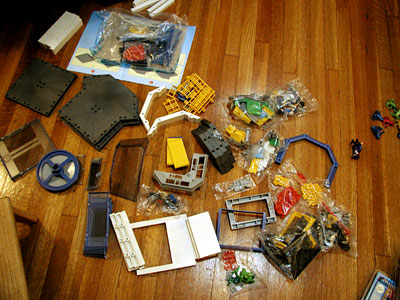
and transform it into something more or less, approximately or perhaps exactly like this:

Bear in mind, however, that this operation will take several hours, will involve back pain and eye strain, will teach you exactly how good your fine motor skills really are, and will cause you to wonder why they gave you that Harvard degree anyway because clearly you're not as bright as you thought you were.
It will also cause a small child to stuff all his palm-sized rubber frogs (and one plastic lizard) into their brand new plane, fly that plane out from his bedroom (a/k/a Froggy Land) so they can crowd off that plane onto the tarmac beside their brand new airport and then flood into that airport with shouts of great joy.
Worth it? Oh yeah.
Damian’s entering kindergarten next year. He’ll be enrolling in the public school system, because we can’t afford the thousands of dollars a year for private school, plus he’d lose his extra school district-provided services (speech therapy, occupational therapy, floor time therapy, adaptive PE, the possibility of a shadow in the classroom) and we certainly can’t cover that expense privately on top of tuition. We’d also lose the school accountability an IEP (individual education plan) gives us.
So public school it is. This scares me.
I’m not against a public school education. I attended a total of four schools myself, not including college. Two were private, the other two public. None were ideal, but probably my best experience was in a public elementary school, and the public high school had a few phenomenal teachers (as well as a bunch of stinkers).
No, what scares me is the nature of our local public school system. I know testing mania has hit the entire country (thank you GW Bush and your No Child Left Untested plan), but it sure is bad here. The results of the end-of-year tests determine how much money a school receives. The school principals often therefore insist the teachers teach toward the test. All year. Rote learning. Stuff that knowledge down the kids’ throats. Is it on the test? No? Then it doesn’t count, don’t bother teaching it.
There’s also a little extra something called Open Court. (Interesting link, by the way.) As I understand it, this is a literacy program. Every single day, the teacher sits on a chair with the children on the floor in front of her. Every day for a set amount of time (forty five minutes? something like that; a large chunk of the day) the teacher reads from a sheet, does exactly what’s on that sheet, does not – can not – deviate for a single sentence from that sheet, must say the right words in the right order, no matter whether the kids are fidgeting, bored out of their minds, already know this stuff, don’t learn best this way. They must drill, must learn this way and no other.
It makes me sad to think of my restless, eager, hungry child being forced to learn that way, a way that’s so antithetical to his pepper-you-with-questions, try-it-out-himself mind. Our home school, the school he is supposed to attend, is even worse. We live in a very Russian neighborhood. The school population is something like 80% Russian. I have nothing against Russians as a cultural group, they can be neighborly. As long as you make it clear you won’t be cajoled or bullied (yes, I have stories), they respect you and are rather sweet. We’ve got a complete set of Beatrix Potter thanks to a Russian cab driver. But… well… let’s put it this way: Damian’s dentist has a hygienist who used to live in our neighborhood. Her parents live there still and she uses their address so she can continue to send her kids to our home school. Why? Because it’s very old-school Russian. Lots of homework. Very strict, stern teachers. Learn this textbook this way, don’t question, just digest.
This goes against what I believe education should be about. A six year old or even a ten year old doesn’t need to have multiplication tables memorized as much as he or she needs to understand how to think about math, how to use math, and how very cool and neat and amazing numbers can be. That’s key, I think. Excitement about learning. Children naturally devour the world, asking so many questions, driving you crazy with it, exploring and analyzing, taking things apart and putting them together again. Why not harness that, why not make learning hands-on, make it flow naturally from their curiosity about the world and incorporate the necessary lessons into that? It looks to me like Damian will be reading fluently by the time he enters kindergarten. He doesn’t need literacy drills, he needs to be stimulated and guided. He needs the foundation of knowledge, yes, but also a foundation of a way of learning and thinking that’ll last longer than schooling, certainly longer than facts.
Where does this leave us? Well, the private schools are terribly tempting. I know of at least four in our general area (between Hollywood and Culver City, so within a seven mile radius) that have a lovely experiential learning, project-based philosophy. But we’d most likely be the poorest family in the school, which would absolutely have a psychological effect on me but also on my child as he grows older and more aware of such things. I don’t want him to be the poorest child in a rich school just as I don’t him to be the richest child in an inner city school. I want him to have friends of various income levels and skin colors and cultures. I want him to grow up with as little prejudice as possible and also to be comfortable with his identity. He’s got enough otherness already with his diagnosis, he doesn’t need to stand apart more because of a socioeconomic gulf.
Besides, there’s the money thing. We ain’t got it. If we could get a scholarship (will they bend over backwards to give financial aid to a special needs kid?), it would only cut the yearly cost from tens of thousands to mere thousands. Which means no vacations, no new clothes, no meals out. And that’s only elementary school. This is obviously a multi-year commitment and we’d run dry long before college. I’d sacrifice for Damian if it really was worth it and I know Dan feels the same, but I’m not sure it is.
What’s that I hear you say? Homeschool? It looks right but I don’t think it is, not for us. It fits philosophically and I applaud and admire the people who can make a commitment to it, but I’m not one of them. I’m already pretty burned out after everything this kid has needed from me; I think I’d quickly grow to resent Damian if teaching him took more of my time and energy than it already does. And I think if we can find a good school situation for him the socialization will do wonders for his confidence as well as his understanding of social interaction. And that’s a lesson that will last for the rest of his life.
Fortunately, there’s the charter school system. Charter schools are more independent than regular public schools. Each principal runs their school like a separate fiefdom according to the charter drawn up at the school’s inception. They don’t have to abide by every one of the school district’s strictures, though they do have to give the children end-of-year tests and those test scores need to show steady improvement until and unless they reach a certain high level. So there’s some district oversight, but not a lot. Finding a compatible charter school may be the answer. I’ve started looking. And stopped sleeping.
(To be continued.)
I was struck by a recent entry in Tiny Coconut. She talks about parenting models: Attachment Parenting and Taking Children Seriously and others, how she sees value in bits of each but each parenting modality demands too much that doesn't fit her as a mom.
I know exactly what she means. Though I chose to label myself an attachment parent, it was more in overall philosophy and approach than in the exact parameters. For instance, I couldn't tolerate co-sleeping for more than a month or so. Damian was a wiggler and I was up all night. So many childrearing philosophies seem to say it's all or nothing and that you must subsume your own needs for your child's. The problem with this, as TC points out, is that it sends your children a problematic message. She thinks about what she hopes for her daughter as she grows:
And I realize--and this is where the light comes on for me--that I don't want to raise her to be someone who feels compelled to subjugate all or even most of what she is as an individual for her own children.
I like her solution:
I guess what it all comes down to is that I want my children to see me care about and for me, because I want them to do the same for themselves when they are adults. I also want them to see me care about and for them and Baroy and friends and family and sometimes strangers in need, because I want them to do the same for others when they are adults. And so, lately, I've been making parenting decisions through that prism. Makes it much easier to sort things into column a and column b, to pick and choose from the parenting philosophies that call to me, and yet discard that which seems to be contrary to my goals.
I think this is an admirable approach. I've been doing the same, or trying to. It's difficult at times, balancing his needs and my own. This is why I haven't wanted a second child, not because I lack the desire but because I know I wouldn't be a good parent anymore, that two children (and at least one with more needs than your average kid) would turn that teetering, tentative balance into a permanent imbalance. As it is, sometimes I think I don't have enough of myself to give Damian. But when I can give enough to myself -- writing time, exercise time, friendship time -- I become a happier and therefore better parent. I'm more present and involved with him, not just going through the motions. And it's true, I am also showing him by my example that these things are important. Work you love, taking care of yourself, people in your life. The choices I make in my daily life affect how he grows almost as much as what I teach him through direct interaction.
Food for thought.
Tonight during the long car ride home (I hate Thursdays: I have to drive across town during rush hour), Damian told me his friend Corey's minivan doesn't have an air conditioner vent in the back seat. I told him it does. He said, "Oops, I mean the red car [our '88 Accord] doesn't have them."
I was a little taken aback, but ended up with this: "You did mean Corey's car, I think. But you made a mistake and you wanted to pretend you didn't."
He agreed, sounding small and sad. "It's not okay to make mistakes."
Oh.
I said the only thing I could: Yes it's okay to make mistakes. In fact, everyone makes mistakes. Every single day. Your teacher, she makes mistakes. I do.
And I told him of one he'd just witnessed on the ride home -- I unintentionally cut someone off. The guy was very mad but that was because he didn't know it was a mistake. (Also because he was an ass, but that's a different homily altogether.)
Damian thought about this for a minute while we headed into the lights of West Hollywood. He commented on the neon-bright stars lining the street. I thought we were done with the topic. But no. A moment later, "Why do people make mistakes?"
"We make mistakes because we're just learning something, or because we forget. I made that mistake because I'm just learning how to drive this car and I didn't know what to do at that moment. You made the mistake about C's a/c vent because you forgot. Everyone makes mistakes, sometimes because they're tired, sometimes because they're thinking about something else, sometimes because they just don't know. It's okay. It's normal. When Daddy gets home, let's ask him what mistakes he made today."
That seemed to help.
The subject came up again during the bedtime ritual. Dan told Damian a mistake he'd just made when he came in the door: he'd asked Damian if he was done with his ravioli and could Daddy eat it? Only thing was, Damian was eating lasagna. Which the kid was happy to point out.
So Dan mentioned that mistake. Damian smiled a little in recognition. Then Dan said "It's good to make mistakes."
Damian, of course, wanted to know why. Dan said "Because we learn from our mistakes. Mistakes are a big part of learning. On The Magic School Bus, Ms. Frizzle always says 'Get messy, take chances, make mistakes!' That's because you can't learn anything if you don't take chances and if you're doing something new, you'll make mistakes and then you'll learn what to do different."
I think this has been with Damian a long time, this fear of making mistakes. He didn't try to walk on his own until we set up a row of big water bottles across the living room floor so he could take a few steps from one to the next, never in danger of falling. Never in danger of making a mistake. I think he doesn't draw much now at least partly because he's afraid of doing it wrong. His issues probably make this more acute, but I think it may be part of his personal makeup. It makes me sad. When we fear life, we don't live. If there's anything we can do for him as parents, I hope it's this: I hope we can teach him to fall flat on his ass, having taken that step on his own, having tried and failed and gotten up to try again.
Today in the park, Damian was flinging sand about with a shovel. I asked him what he was doing. Looked pretty mindless to me. This is what he said: "I'm digging for gold so we'll be rich and then we can pay for cheap and expensive things so we can have a happy ending. Otherwise we'll have a sad ending."
Um. Not the message I want to be sending him. I think he got the idea from a story. Probably "Puss and Boots," which he's now seen as part of HBO's Happily Ever Afterseries retelling classing fairy tales and has also experienced as a bedtime story. An awful lot of fairy tales do hinge on material success, don't they? Poor folk become rich and have happy endings. Jack and the Beanstalk, Puss and Boots, Cinderella. Even Robin Hood (part of the HBO series) focuses on money, the haves and have-nots.
Hmm.
When your child says something painful to hear, when you know he's hurting and you want to help, the trick is finding the right words to say that will heal but in a thoughtful, respectful way. This entry in This Woman's Work talks about just such a moment. I think Dawn found exactly the right words. I hope I can too when Damian needs that from me.
This post on hippycritical unexpectedly brought me back to childhood:
I have been making an effort to stop telling Rebecca she's beautiful. Not that I probably say it that much anyway, but I'm finding more specific things to say to her. That's she smart or sweet or whatever. She's so beautiful to me, but it has nothing to do with how she looks and I don't want her to think I give a hoot about her appearance (other than, you know, hygiene). It makes me uncomfortable, really, when people say she's cute. It's about looks and I hate that our society is so hung up on a certain set of features that are considered attractive. There are plenty of years for Rebecca to learn about how people judge each other. Hopefully she will be confident enough to figure it all out for herself.
I completely understand the sentiment Aimee is expressing, and I think she’s absolutely right to foster her daughter’s confidence in herself (her self) apart from looks. Women are so often conditioned to judge themselves (and judge harshly) based on how cute or not-cute they are, as measured by some arbitrary societal standard. It’s crucial, I think, to lay a broader foundation than that for our children, especially of course daughters. Smart, sweet, thoughtful, talented, strong, brave. All these things, and I make sure to use them as appropriate with Damian.
But there’s another side of this which I think is also important to consider. My parents were hippy-lefty semi-bohemians. This was lucky for me in many respects. But they too felt it was wrong to comment too much on a girl's looks, to make her too dependent on that superficial non-character trait. And so they never told me I was pretty and discouraged other adults from saying that sort of flattering folderol to the solemn-faced little girl that was me. They instead said I was so smart and that I could do anything I set my mind to try. All good, right? But I thought nobody said I was cute because I wasn’t cute. And that hurt. It wasn’t until years later, looking at old photos, that I realized: I was more than cute. I was a beautiful child.
I literally had no idea.
When I told my mother the wide chasm that had existed between my self-image and the reality, she was shocked. But a child only knows these things through others’ eyes. I think it’s important for every child to feel loved and cherished in so many ways, and that includes knowing that your family appreciates your physical self. It, too, gives confidence. Yes, it’s possible to go overboard with it, but it’s just as possible to underplay it so badly that you end up with a teenage girl who thinks she’s not attractive enough to draw boys to her flame, who dresses like a schlub, hiding her face behind a curtain of unwashed hair, and who thinks she’s only good for her brain. Brains are good but so are bodies. It's taken me a long time to be able to look in the mirror and like what I see.